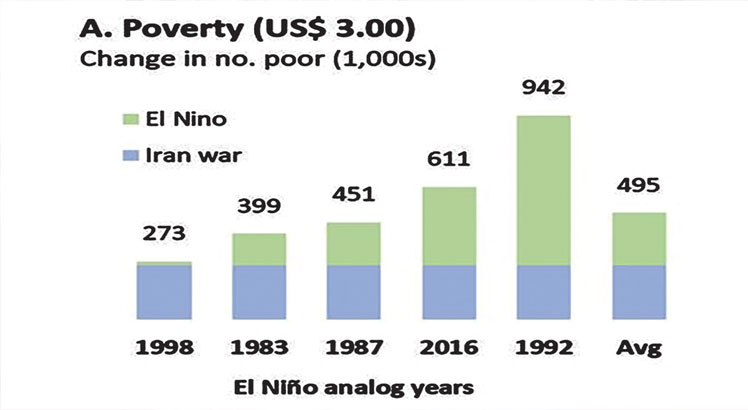
The Internatonal Food Policy Research Institute (Ifpri) say nearly half a million more Malawians could fall into poverty in 2027 as high fertiliser costs and El Niño crop losses are expected to push up food prices, erode purchasing power and slow economic activity.
In its blog El Niño and rising fertiliser costs: How vulnerable is Malawi in 2027?, the institute says the projected 495 000 additional people would add to the 17.3 million Malawians already expected to live below the $3-a-day poverty line.
The analysis also projects maize imports to nearly triple under the average El Niño scenario while a 25 percent increase in regional maize prices could push the number of additional undernourished people to around five million.
Reads the blog in part: “Together with lower economic activity, these price increases reduce households’ purchasing power: average real household expenditure falls by an average 4.2 percent.
“Domestic agricultural commodity prices rise by 5.4 percent to 52.3 percent across the El Niño scenarios and 17.6 percent on average, driven by reduced agricultural production resulting from increased input prices and poor rainfall.”
The Ifpri modelling estimates that the Iran war-related shocks alone would reduce Malawi’s gross domestic product (GDP) by about 0.9 percent in 2027, while the combined impact with El Niño could reduce GDP by between one and seven percent, averaging 2.9 percent.
Agricultural GDP losses, on the other hand, would average 8.1 percent, ranging from 2.7 percent to 19.6 percent, while local fertiliser costs for the coming season are estimated at 61 percent above the pre-war baseline.
Under the revised $3 (about K5 200) international poverty line, Malawi’s poverty rate is 75.4 percent, compared with 70.1 percent under the previous $2.15 (about K3 700) threshold.
The poverty projections come as Malawi targets lower-middle-income status by 2030, with economic growth averaging 2.2 percent against the 14 percent rate estimated as necessary to reach that target.
A 2025/26 Unicef climate financing budget brief estimates Malawi loses about 1.7 percent of GDP annually due to climate shocks, with losses projected at three to nine percent by 2030 and up to 16 percent by 2050
The country has faced repeated climate shocks, including Cyclone Idai in 2019, Cyclone Ana and Tropical Storm Gombe in 2022, Cyclone Freddy in 2023 and El Niño-induced droughts in 2024.
Centre for Social Concern economic governance officer Agnes Nyirongo said to reverse these trends, Malawi must urgently rethink its economic strategy, moving beyond subsidy programmes.
“Equally important is the need to stabilise the macroeconomic environment,” she said.
In March this year, Minister of Natural Resources Patricia Wiskes told delegates at the 5th African Regional Conference on Loss and Damage in Lilongwe, that climate change was already affecting Malawi’s economic growth through losses in output, infrastructure and public finances