In a world where youths often search for opportunities, especially in the job market, others choose to create the opportunities.
Others, in their quest of creating those opportunities, positively impact the world at large—doing things bigger than their ages, benefitting the present and future generations.
One such youth is Lisa Kampata, co-founder and chief executive officer (CEO) of Climate Tech Lab, which is a youth-led climate technology enterprise advancing the use of drone technology, data and artificial intelligence to strengthen climate resilience and support data-driven decision-making.
The Lilongwe University of Agriculture and Natural Resources (Luanar) graduate says the enterprise equips young people with digital skills training, climate awareness and entrepreneurship programmes, and engaging them across climate and education policy initiatives.
At Luanar, Lisa studied for a Bachelor of Science in Agricultural Economics, graduating with a higher credit (merit). She graduated early this year.
The birth of Climate Tech Lab
Lisa, 20, says the story of Climate Tech Lab is very personal for her.
“In 2023, Cyclone Freddy severely affected my home village in Chikwawa. My family was among those who lost almost everything, and experiencing that devastation firsthand made me start asking myself whether more could be done to prepare communities for natural disasters and reduce their impact,” she says.
“At university, I was introduced to drones while taking a course in Environmental and Social Impact Assessment. I became fascinated by the potential of drone technology, particularly its ability to collect data and provide information that can support decision-making. Although I loved studying economics, I realised that I had always been very interested in technology and analytical problem-solving.”
Lisa says this compelled her to begin thinking about how she could combine these interests with the climate challenges she had personally experienced.
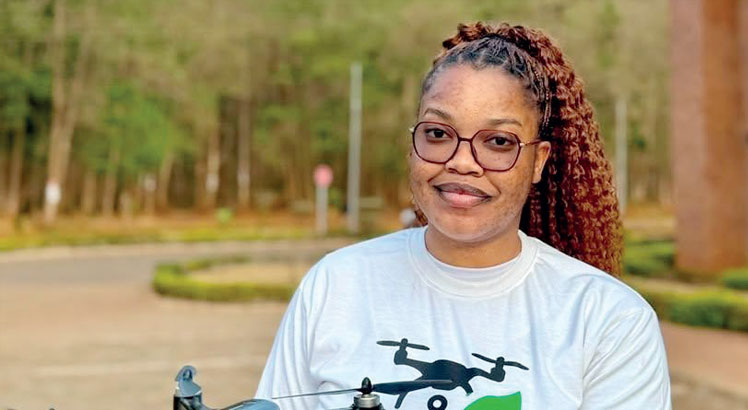
She says she had also noticed that there were relatively few organisations using technology specifically for disaster preparedness, monitoring and climate resilience.
“That presented an opportunity,” she says. “Together with my co-founder, we established Climate Tech Lab with the vision of building a climate technology company that uses drones, data and emerging technologies such as Artificial Intelligence (AI) to support areas, including disaster preparedness, climate resilience and precision agriculture.”
Lisa says to her, the enterprise sits at the intersection of three things she cares deeply about, and these are technology, economic development and climate action.
Climate Tech Lab’s impact on girls, youths
Lisa says when she started building Climate Tech Lab and putting together a team, she noticed that many of the people with the technical expertise needed were predominantly male. She says that made her reflect on the wider gender gap in science, technology, engineering and mathematics (STEM).
This motivated her to introduce digital skills training programmes that are open to young people generally, but with a deliberate focus on encouraging girls and young women interested in STEM.
Lisa says: “So far, we have trained 180 people in digital skills, including data visualisation, data analytics, Geographic Information Systems (GIS), digital tools and other technology-related areas, reaching young people across places including Lilongwe and Kasungu.
“We have also reached more than 400 people, including children and young people, through our climate awareness initiatives. In addition to training and awareness, Climate Tech Lab also provides business incubation and mentorship services for young entrepreneurs.”
According to Lisa, this came from interacting with different young people who had brilliant ideas but were not yet investor-ready, which prevented them from accessing the opportunities available to entrepreneurs.
She says through the incubation programme, Climate Tech Lab supports entrepreneurs to refine their ideas, develop and test their business models, strengthen their operations and prepare for investment.
“We also expose them to different financing opportunities. So far, we have three incubates who are currently at the prototyping stage. For me, the goal is not simply to teach a technical skill or support a business idea. It is also about changing the perception that technology, entrepreneurship and STEM are spaces reserved for men or for people with certain backgrounds,” she says.
“I want young girls and young people generally to see that they can build technology, analyse data, lead companies, attract investment and create solutions to problems in their communities. When a young person gains a new skill, develops an idea into a prototype or begins to see themselves as someone capable of building a viable business that is already a form of empowerment.”
Role of youths in addressing climate change
Lisa says young people need to recognise that climate action is not limited to attending conferences or participating in climate marches, stressing there are many ways to contribute.
She says young people can start by educating themselves about climate change and understanding how it affects their own communities.
“They can then use their different skills—whether in agriculture, technology, business, research, communication, arts or policy—to develop solutions. They should also participate in decision-making spaces,” she says.
“Young people need to be present where policies and programmes affecting their future are being discussed, but they also need to come prepared with ideas, evidence and practical solutions. Most importantly, I would encourage young people to start where they are. You do not need to wait for a large organisation or a major grant before taking action. Sometimes meaningful climate action begins with solving a small problem in your community and building from there.”
Further, Lisa says there is utmost need to start viewing climate action as an economic opportunity.
She says young people can build businesses, create jobs and develop innovations around climate-smart agriculture, renewable energy, waste management, technology and many other areas.
Challenges hindering youth participation
While it is imperative for youths to be active in climate change mitigation, Lisa points out access as a major challenge.
She says young people often have ideas and enthusiasm, but may not have access to funding, technology, mentorship, information or platforms where they can meaningfully contribute.
Besides, she says there is a gap between being invited and actually having influence, adding that sometimes young people are included in conversations because of their age, but their ideas are not necessarily incorporated into decisions.
As such, she stresses that it is high time that the country moves from symbolic youth participation to meaningful engagement.
She says: “Another challenge is that many young people are dealing with immediate economic pressures. It can be difficult to ask a young person to dedicate themselves to climate action when they are also worried about employment, education or supporting their families.
“This is why I believe climate action should also create economic opportunities. We need to show young people that addressing climate change can go hand in hand with entrepreneurship, innovation and sustainable development.”
Memorable moment with Climate Tech Lab
According to Lisa, one of the most memorable parts of her work has been watching young people become more confident in their abilities and start seeing themselves as innovators.
“There is something fulfilling about seeing an idea that existed only in your head or on paper eventually become something that is reaching young people and creating opportunities for them,” she says.
“One of the things I have learned through Climate Tech Lab is that impact does not always have to be something huge or immediate; sometimes it is a young person discovering a new skill, gaining the confidence to pursue an idea or realising that they have something valuable to contribute.”
She says such moments are particularly rewarding because Climate Tech Lab was created around the belief that young people do not lack potential—that sometimes they simply lack access to the right opportunities, resources and support.
Apart from c-founding Climate Tech Lab, Lisa is also a youth advisor on the European Union (EU)-Malawi Youth Sounding Board and a management trainee at Malawi Enterprise Development Fund.
Aside from her entrepreneurial exploits, Lisa has also had opportunities such the Anzisha Prize Fellowship and the Tony Elumelu Foundation Green Business Programme.