Malawian households stand to benefit from more than K3.4 trillion in government spending in the 2026/27 financial year, with the money targeting areas that directly affect daily life, it has emerged.
The allocation represents about 31 percent of the K10.9 trillion total expenditure, according to the 2026/27 Citizens’ Budget produced by the Ministry of Finance, Economic Planning and Decentralisation with support from United Nation’s Children Fund (Unicef).
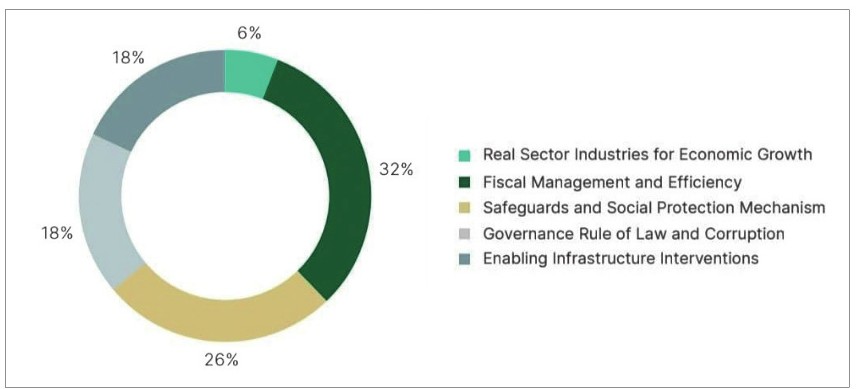
The ministry said the budget seeks to recover the economy through five pillars of fiscal management and efficiency, safeguards and social protection mechanisms, governance, rule of law and corruption, enabling infrastructure interventions and real sector industries for economic growth.
Reads the budget in part: “The 32 percent has been allocated to fiscal management and efficiency, 25.9 percent to safeguards and social protection mechanisms, 18.2 percent to governance, rule of law and corruption, 18.1 percent to enabling infrastructure interventions and 5.8 percent to real sector industries for economic growth.”
The biggest share is going towards rural development, agriculture and water-related interventions, according to the budget.
About K1.2 trillion is allocated to rural development, including K1.146 trillion for the Malawi Social Support for Resilient Livelihoods Programme, while agriculture, irrigation and water interventions account for about K953.4 billion.
The agriculture-related allocations include K111 billion for the fertiliser programme, K120 billion for irrigation, K302 billion for water and sanitation and K28.4 billion for mega farms.
For families relying on public services, the budget provides K337.2 billion for education-related interventions, including university programmes, student loans, learning materials and internships, while K58 billion is earmarked for free primary and secondary education.
The development comes at a time Ministry of Finance, Economic Planning and Decentralisation just conceded that the country’s social protection system continues to face major challenges, including limited coverage, weak evidence and heavy reliance on donor financing.
United Nations (UN) data show that social safety nets reach just 27 percent of more than 20 million Malawians despite that 51 percent of the people live in poverty while 75 percent survive on less than $3 (about K5 253) a day.
At the same time, Malawi spends just 0.9 percent of its gross domestic product on social safety nets, below the two percent regional average while heavy reliance on donor aid, at 95 percent, puts their sustainability at risk, according to UN.
Centre for Social Concern economic governance officer Agness Nyirongo said social protection programmes should go beyond addressing immediate needs and help households build sustainable livelihoods.
“While these programmes help reduce extreme hunger, they rarely give families the opportunity to invest, save or build sustainable sources of income,” she said.
Scotland-based Malawian economist Velli Nyirongo observed that while consumption is important for economic activity, consumption-led growth becomes difficult to sustain when it is not supported by stronger production, investment, productivity and exports.
“The policy priority should be to move from consumption-led growth towards production-led growth,” he said.
Malawi’s social protection system currently covers roughly 21.3 percent of the population, focusing primarily on social assistance for vulnerable groups and public works for the able-bodied.