The story of Mbona has intrigued me since primary school days. Our Chichewa Mtunda 8 textbook introduced me to a fascinating perspective on rainmaking.
Mlauli, the established rainmaker, tried everything to summon rain as villagers performed the rain dance. He pointed his cutlass, known as chikandalanga, towards the four cardinal directions, but not a drop fell.
Then came Mbona, who had amazed his childhood playmates by bringing clay toy cows to life. When he performed the rain dance, the clouds gathered, thunder rolled, lightning tore through the sky and rain drenched the villagers.
Angered by this rival, Mlauli pursued Mbona and attempted to pierce him with a spear. When that failed, Mbona instructed him to use luzi, a smooth tree bark. Blood flowed from Mbona’s neck, forming a river that reached the Ndione Wetlands near what is now Khulubvi Sacred Forest.
Steve Chimombo dramatised this legend in The Rainmaker. Our school, Kapirintiya, performed the play while preparing for Junior Certificate examinations, using the version featured in An Anthology of Malawian Literature for Junior Secondary, compiled by Christopher Kamlongera and Wales Mwanza.
Mbona’s story continues to attract scholars. In The River of Blood: The Genesis of a Martyr Cult, Matthew Schoffeleers explored the origins of the cult, while Christopher Wrigley offered a different interpretation in The River God and the Historians.
On October 3 this year, an annual sacrifice was held at Khulubvi, where participants poured libations and prayed for rain.
The following week, rain fell. Roads in Lilongwe’s Area 25 turned muddy, vehicles became stuck on the road to Neno, and water flowed through Blantyre’s drainage systems. In Mulanje, some villagers rushed to plant crops.
Had Mbona answered their prayers, or was the rain simply evidence of the Meteorological Department’s announcement that the rainy season had begun on October 1?
Driven by this enduring intrigue, I joined a team from the Centre for Environmental Education and Communication (Ceec), supported by the Malawi Gaming and Lotteries Authority, on a visit to learn how culture helps conserve the sacred forest in Nsanje.
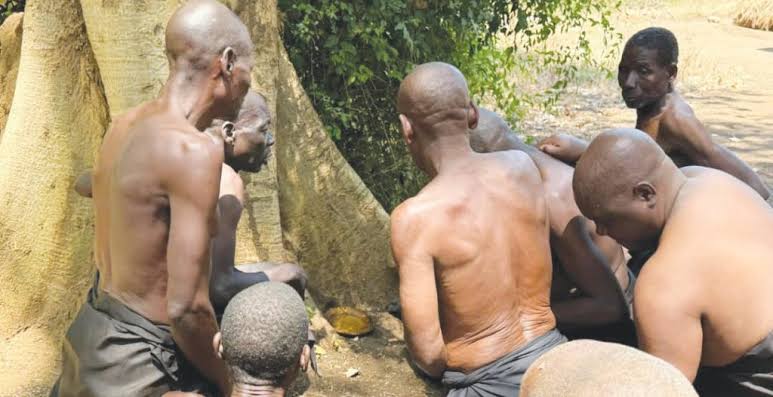
We travelled on Friday night, observing a traditional instruction to abstain from sex the day before visiting the shrine. Early the next morning, we arrived at its entrance, removed our shirts and shoes, and donned black cloths.
Under the shade of a magnificent mtondo tree, a gentle breeze stirred as birds called from the dense forest. Three huts stood around the tree, creating an atmosphere of deep reverence.
Group Village Head Mbuka explained that the huts represent the dwelling places of Mbona’s spirit, his spiritual wife, Sapitwa, and her maid, Chamanga, who obtains food and other necessities from the village.
He described the selection of Salima, a ceremonial title, and the renovation of the huts as important traditional observances that precede sacrifices.
Mbuka identified indigenous trees, including chilumansato, mtangatanga, thomole, mvuvu and mapoza. Monkeys feed on their fruits, while wildlife finds refuge in the forest.
“The spirits guard this forest. No one can cut down a tree except on special occasions, such as a funeral or the installation of a chief,” he said, adding that respect for nature was central to their traditions.
Pointing towards the bare Malawi Mountain, he lamented deforestation and charcoal burning in Matandwe Forest, saying wildlife had sought refuge in Khulubvi, where hunting was forbidden.
Forest custodian Ennet Kalumphalinga Chakanika said ancestral beliefs discouraged encroachment and helped protect the forest without relying on guns or other conventional enforcement methods.
She explained that villagers, traditional leaders and school children pass conservation knowledge to younger generations through cultural practices, including music. She believes the respect accorded to graveyards should extend to all forests.
Ceec operations director Thandiwe Mtonda described Khulubvi as an example of culture supporting conservation. She said the visit offered valuable lessons about the role of cultural custodians and indigenous knowledge in protecting natural heritage.
For Chikondi Kanyoza, a final-year Bachelor of Commerce in Tourism Management student at the Malawi University of Business and Applied Sciences and president of the Tourism Management Students’ Association, the shrine also promotes cultural and heritage tourism. Its spiritual significance and preservation of Mang’anja traditions attract people interested in Malawi’s history and indigenous knowledge.
As we put on our shoes and shirts, collected our phones and drove back through Nsanje Boma, plastic litter, sandy riverbeds and signs of bushfires offered a stark contrast to the protected forest.
My fascination with Mbona and rainmaking remained unresolved. Yet one lesson was unmistakable: Traditions sometimes dismissed as primitive can play a vital role in protecting the environment. At Khulubvi, cultural reverence continues to safeguard nature, preserving a legacy that stretches back to the story of how Mbona outshone Mlauli in Mtunda 8.