Centre for Social Concern (CfSC) has proposed four measures to tackle rising extreme poverty, including reviewing the Social Cash Transfer Programme and reducing dependence on rain-fed agriculture.
The measures include a review of social cash transfer programme, invest in irrigation farming, protect food security first and restore macroeconomic stability.
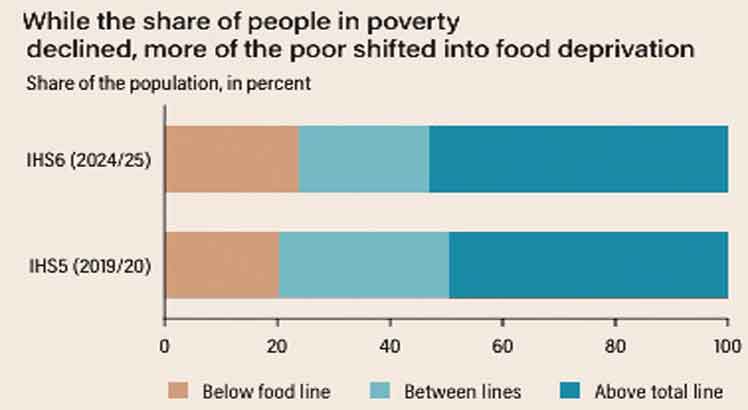
The recommendations follow the latest National Statistical Office (NSO) Poverty and Inequality Report, which shows that ultra-poverty rose to 24 percent in 2025 from 20.5 percent in 2020, despite an overall decline in the national poverty rate to 47.3 percent from 50.7 percent over the same period.
The report, based on findings from the 2024/25 Sixth Integrated Household Survey (IHS6), also indicates growing food deprivation, with food poverty accounting for 68.5 percent of the total poverty line, up from 61.1 percent recorded in the 2019/20 IHS5 survey.
Reads part of the report: “Rural poverty is 52.6 percent, compared with 20.9 percent in urban areas.
“The Southern Region has the highest poverty rate at 55.8 percent, the Northern and Central Regions are lower at 41 percent and 40.4 percent, respectively.”
In its analysis titled ‘Malawi’s poverty paradox: National rate falls, but ultra-poverty deepens’, CfSC described the situation as dangerous as it depicts growing inequalities as evidenced in the rising number of people at severe risk of food insecurity.
CfSC economic governance programme officer Agnes Nyirongo said social cash transfers values should be pegged to inflation to preserve purchasing power and coverage should be scaled to match the actual ultra-poverty rate.
“With food now comprising nearly 70 percent of the poverty line, interventions must prioritize caloric access,” she said.
Nyirongo said since ultra-poverty is concentrated in rural areas, investing in irrigation, drought-resistant seed varieties and extension services is critical to counter the rain-fed farming linked poor harvests in rural areas.
In its recent Malawi Economic Monitor, the World Bank noted that Malawi’s improving macro-economic indicators are yet to translate into better conditions as data show that more people cannot afford minimum food requirements despite moderating inflation.
The report indicated that inequality has increased, with the Gini index, a measurement of how unevenly wealth is distributed across a population, rising from 37.9 to 39.9, suggesting that improvements in welfare have not been evenly distributed.
Reads the report in part: “Welfare gains were modest, uneven and accompanied by more widespread and deeper food hardship.”
Mzuzu University economics lecturer Christopher Mbukwa said in an interview that the current situation reflects an uneven recovery in which some households near the overall poverty threshold improved while conditions deteriorated among those at the bottom.
Secretary to the Treasury Cliff Chiunda acknowledged in an interview that the findings provide valuable insights into the socio-economic challenges Malawi faces that need targeted and evidence-based interventions.
He said the report shows that while progress has been made in reducing overall poverty, significant challenges remain, particularly with respect to ultra-poverty and inequality.
Said Chiunda: “These findings highlight the need to accelerate reforms that stimulate economic growth, expand productive employment, strengthen food security, build resilience and improve the livelihoods of vulnerable households.
“The government’s vision is not merely to reduce poverty statistics, but to transform the economic conditions.”
He said that through the National Economic Recovery Plan, government is pursuing reforms that restore macroeconomic stability, promote investment and industrialisation, expand economic opportunities and improve the people’s welfare.
The findings show that while progress has been made, recurring shocks could undermine the country’s development aspirations under Malawi 2063, the country’s long-term development strategy that seeks to transform the economy to lower upper middle-income status by 2030 and upper middle-income by 2063.