Professors are known for talking. In academic circles, some jokingly call it “talking diarrhoea”, a professional disability that appears to come with the title.
And Professor Judith Kamoto seems to fit that description.
Ask her a simple question, such as: “Prof, please tell us who you are,” and you may find yourself following a long, but fascinating account of her life, from her childhood in Kayesa Village in rural Mchinji District to her rise through the academic ranks.
But there is a good reason Kamoto has so much to say. Her story is one of hard work, academic achievement and breaking barriers in a field where women remain underrepresented.
In April 2024, she became the first female full professor at the Lilongwe University of Agriculture and Natural Resources (Luanar).
But how did a girl from Kayesa Village rise to become such?
This is where her story becomes even more interesting.
It started in 1988 when she enrolled at Bunda College, then part of the University of Malawi, to study Agriculture and Rural Development.
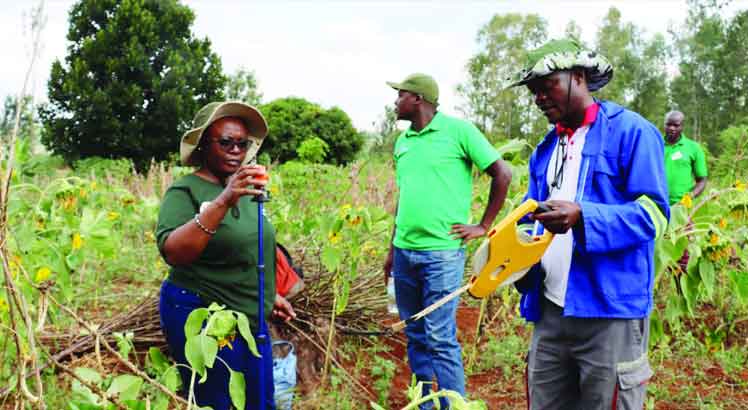
She obtained a diploma in 1992 before proceeding to earn a Bachelor of Science degree in the same discipline in 1994.
The same year, she joined the Malawi Government Forestry Department and the Malawi College of Forestry and Wildlife as a forestry officer and lecturer.
This marked the beginning of a career that would bring her into close contact with forests, natural resources and communities whose livelihoods depend on them.
Her interest in forestry would also shape her academic direction. Rather than stopping at her first qualifications, she continued studying while building her professional experience.
In 1999, she obtained a Master of Science degree in Tropical Forestry, specialising in Social Forestry, from Wageningen Agricultural University in the Netherlands.
In March that year, she joined Bunda College as a lecturer. She would spend more than two decades at the institution, combining teaching, research and leadership.
But a career in academia requires more than teaching students and holding university positions. It also demands research, publications and a contribution to knowledge in one’s field.
Kamoto continued along that path when she enrolled for a PhD in Development Studies at the University of Reading in the United Kingdom, completing it in 2009.
Her doctoral research examined decentralised forest governance and community-based forest management in Malawi.
The subject reflected a growing concern in her work: how natural resources are governed, who benefits from them and whether the systems established to manage them improve people’s lives.
For Kamoto, nature has been part of her professional life.
Her early work introduced her to practical demands of forestry and natural resource management with subsequent academic studies and research deepening that engagement.
Kamoto’s research has covered forest governance, gender and land tenure, livelihoods, nutrition, community-based forest management, Miombo woodlands, household energy, charcoal and cleaner cooking.
She has also been involved in climate and carbon research using permanent sample plots.
“Forests provide resources and livelihoods, while the way they are managed can affect household energy, food security, income and the environment,” she argues.
Kamoto says studying forests also means understanding the people who depend on them.
That relationship between natural resources and human wellbeing is central to her inaugural lecture, titled “The Paradoxes of Governing the Commons: Explaining the Gap Between Natural Resources Governance and Benefits for Human Wellbeing in Malawi.”
The lecturer examines the gap between policies and systems intended to protect natural resources and the benefits people actually receive from them.
Her work has also extended beyond the university. She chairs the Miombo Network and chaired the launch of the Maputo Declaration on the sustainable management of Miombo woodlands.
At Bunda, her engagement with the environment has also been reflected in institutional initiatives.
Her professional journey has thus moved between the forest, the classroom, research and institutional leadership.
A professorship is not simply a title awarded for years spent at a university. It reflects sustained academic contribution, research, publications and recognition in one’s discipline.
And thus, for Kamoto, the journey has involved these academic demands alongside responsibilities in university management.
So far, she has brought more than 10 research projects to Luanar, contributing to the university’s research work and creating opportunities for knowledge production.
Her curriculum vitae records more than 20 journal articles since her last promotion in 2020, with seven more in press.
She has also contributed three refereed book chapters, seven conference papers and a manual.
Her scholarly work includes publications in journals such as “Nature Food and Conservation Letters.”
Such work is part of the demanding process through which academics build their careers and qualify for promotion.
As her academic career progressed, so did her leadership responsibilities.
Between 2003 and 2005, she became the first woman deputy head of the Forestry and Horticulture Department.
She later became the first female head of the Forestry Department, serving from 2014 to 2017.
Kamoto subsequently served as deputy dean of the Faculty of Natural Resources from 2017 to 2019, acting vice principal from 2019 to 2020 and deputy college director in 2021.
In January 2022, she became acting college director, a position she held until July 2025. She assumed the substantive position of college director in August 2025.
Her leadership responsibilities have included academic and institutional management, research funding, curriculum development, student administration and improving the systems that support teaching and learning.
The progression from lecturer to department head, dean, senior university administrator and eventually full professor reflects a career built over several decades.
But why had it taken so long for a woman to attain the rank of full professor at Luanar?
Kamoto attributes the gap partly to the demands placed on women in academia, who often have to balance professional responsibilities with reproductive and community roles.
“The reason for no female professor has been lack of recognition of female multiple roles within academia in Malawi. Female counterparts have multiple roles of reproductive and productive and community, and there are time poor. Therefore, female academics have to put a lot of effort and extra hours to deliver the same results as their male counterparts,” she says.
She also points to the science-based nature of forestry and natural resources disciplines, where women remain underrepresented.
“Forestry and aatural resources are science-based fields. There are fewer women in science,” she says.
Her observations point to the additional demands women academics may face as they pursue research, publications, teaching and promotion while also carrying responsibilities outside the university.
Kamoto’s achievement, therefore, is not only about reaching the highest academic rank. It also brings attention to the barriers women may encounter while pursuing similar careers.
She explains that attaining the rank of professor and being formally inaugurated through a lecture are two distinct stages of the academic tradition.
She adds: “A professor who is not inaugurated is like one just promoted based on human resources contract, but the lecture cements the academic tradition.”
For women and girls aspiring to follow a similar path, Kamoto attributes her achievement to hard work and determination.
She urges women, particularly young girls, to be passionate about what they want to achieve, develop a clear vision and set goals, then remain determined to reach them within set timelines.
Her message is particularly relevant to girls growing up in rural communities, where long distances to school, food insecurity and poverty can make education a difficult journey.
For some, the challenges begin with simply getting to school. Others have to contend with limited resources and the pressure of circumstances that can make continuing with education difficult.