Malawi risks missing its target of producing 100 000 metric tonnes (MT) of farmed fish annually by 2030, as limited commercialisation has kept aquaculture output stagnant at about 14 000MT over the past three years.
The challenge comes at a time when fish production from the country’s natural water bodies remains constrained by factors including climate change, leaving an estimated supply gap of 20 000MT, according to WorldFish.
In a recent policy brief, Mwapata Institute observes that although Malawi is banking on aquaculture to close the supply gap and potentially support regional exports, commercialisation challenges continue to constrain the subsector’s growth.
The study, titled Unlocking the Economic Potential of Malawi’s Aquaculture Sector through Commercialisation, identifies limited availability of quality fingerlings, inadequate investment in technology and rising fish feed costs as major barriers to commercialisation.
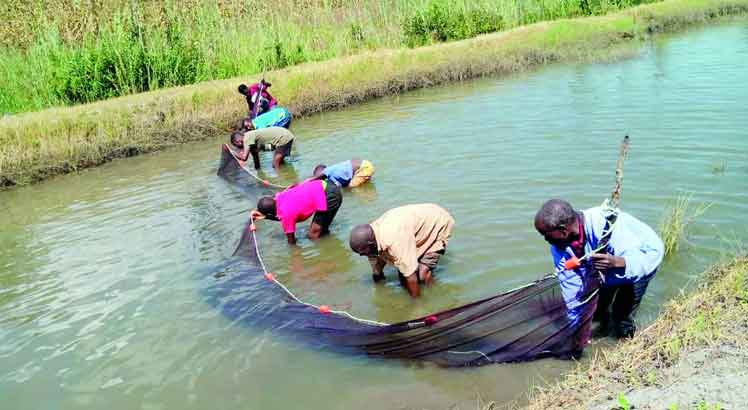
“National fingerling production from both public and private hatcheries in Malawi was estimated at 6.2 million, compared with an estimated national demand of more than 13 million fingerlings, based on current pond hectarage and cage culture capacity.
“This represents a supply deficit of nearly 50 percent, forcing many fish farmers to rely on recycled fingerlings from their own ponds or neighbouring farmers rather than purchasing certified stock,” reads the policy brief.
The institute warns that continued reliance on recycled fingerlings contributes to inbreeding, declining genetic quality, slower growth rates and poor survival, ultimately resulting in lower fish yields and profitability.
The study, conducted by researchers Joyce Minofu, Bonface Nankwenya, Maggie Munthali, Lemekezani Chilora, Zephania Nyirenda and Christone Nyondo, acknowledges that achieving the 100 000MT target by 2030, as envisaged under Malawi 2063, will be challenging.
It recommends expanding commercial fingerling and local fish feed production, strengthening aquaculture extension services, improving access to affordable financing and scaling up viable community-based commercial models.
The policy brief further calls for increased investment in commercial and medium-scale aquaculture, noting that limited access to capital remains a major constraint, particularly for pond construction, fingerling acquisition and fish feeding.
It also recommends promoting commercial fingerling production through investment in solar-powered hatchery infrastructure to unlock underutilised capacity at public institutions, including the Lilongwe University of Agriculture and Natural Resources (Luanar) and Domasi.
Meanwhile, Innovative Fish Farmers Network Trust chairperson Lucky Penemulungu has attributed the subsector’s stagnation largely to inadequate financing, saying shortages of fingerlings and fish feed continue to constrain production.
Penemulungu, who also operates a fish hatchery, said Malawi had the technical capacity to produce both fingerlings through artificial breeding and fish feed, but inadequate capital remained a major obstacle.
He said: “All we need now is organisations such as Agriculture Commercialisation [Agcom] to provide us with financing. Once we get the finance, we are going to produce more fingerlings and feed.”
Speaking after touring Central Poultry (CP) Feeds Limited in Lilongwe recently, Minister of Natural Resources Patricia Wiskes assured the public of the government’s commitment to unlocking investments that could boost production across the aquaculture value chain.
“The country is currently facing high demand for fish amid declining stocks in Lake Malawi, making aquaculture a critical solution for increasing fish production. Fish feed production remains inadequate to meet the growing demand from fish farmers across the country,” she said.
CP Feeds Limited managing director Nizam Kasmani said the company, which produces 200 000MT of chicken feed, has the capacity to manufacture 45 000MT of fish feed annually. He added that the company was also considering investing in fingerling production.
At regional level, aquaculture production increased from less than 400 000MT in 2000 to 2.4 million MT in 2024. In Malawi, production rose from 800MT in 2005 to 14 000MT in 2024.
WorldFish figures show that Malawi’s total fisheries production, including catches from natural water bodies, stood at approximately 211 000MT in 2025. However, demand exceeded reliable supply by about 20 000MT.
The country’s per capita fish consumption was estimated at 9.5 kilogrammes per person annually in 2025, below the World Health Organisation’s recommended intake of 13 to 15 kilogrammes.