Malawi Government says the country needs K4.2 trillion to fix its roads.
But The Nation’s analysis shows this is a fiscal trap forcing a choice: roads, or schools, hospitals and debt repayment.
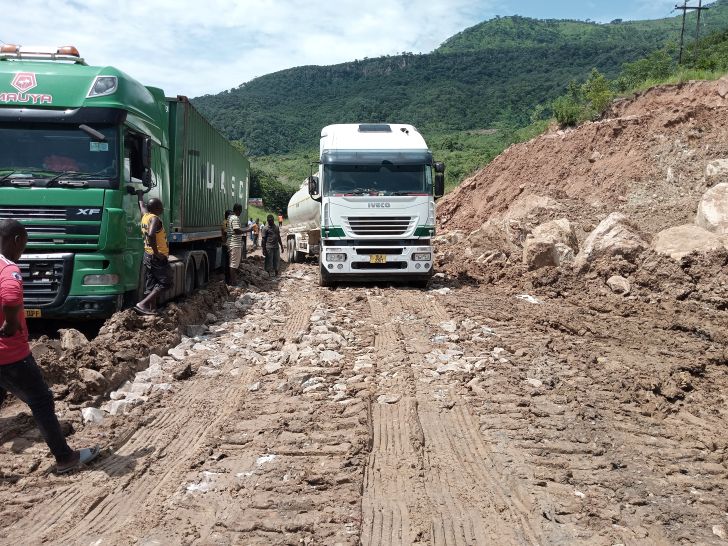
Roads Authority (RA) chief executive officer Joel Longwe gave the figure on Tuesday when he appeared before Parliament’s Budget and Finance Committee alongside officials from the Ministry of Transport and Public Works and the Roads Fund Administration (RFA).
The figure is not a single-year budget line. It is a decade-long fiscal mountain, equal to 38.3 percent of the entire 2026/27 national budget.
Parliament authorised K10.98 trillion in spending in 2026/27, against K6.45 trillion in domestic tax collections.
Clearing the road backlog at once would consume nearly two-thirds of every kwacha collected by Malawi Revenue Authority, and would exceed the entire K3.40 trillion development budget for schools, hospitals, energy assets and other capital outlays.
Longwe said the K4.2 trillion is split into K3 trillion for rehabilitation and K1.2 trillion for periodic maintenance.
From good to broken
The deterioration has been steady. Longwe told the committee that the RA’s 2022 assessment of the 4 685km network found 67 percent in fair condition and 18 percent in poor condition, leaving only 15 percent in good condition.
That is a sharp fall from 2011, when 60 percent of the then 4 073km network was in good condition, 33 percent in fair condition and only seven percent in poor condition. A subsequent assessment in 2014 found 38 percent in good condition, 40 percent in fair condition and 22 percent in poor condition.
Longwe attributed the decline largely to inadequate periodic maintenance.
“We are doing a latest assessment of roads and, depending on the availability of resources, we will have a clear picture of the current status of our roads,” he said.
The human cost was underlined by Budget and Finance Committee vice-chairperson Emily Chinthu Phiri, who chaired the meeting. She cited prolonged works on the M5, saying delays had severely affected mobility in lakeshore districts.
Road Safety Alert Foundation executive director Joel Jere said in an interview that the poor state of roads was undermining efforts to reduce accidents.
Funding crisis
The financing gap cannot be closed by borrowing alone. Total public debt stands near K24.3 trillion, or 93.2 percent of gross domestic product (GDP) while the 2026/27 deficit of K2.85 trillion, 9.0 percent of GDP, already depends on K2.66 trillion in domestic borrowing.
With an 18 percent policy rate and inflation of about 20 percent, further local borrowing would crowd out private credit. Imported bitumen, diesel and machinery must also be paid for in dollars, while official reserves hover near $600 million against annual import demands of around $3 billion against exports hovering around $1 billion per year.
External finance is essential, but difficult. After the previous Extended Credit Facility was terminated in May 2025, major donors held back inflows.
An International Monetary Fund (IMF) mission concluded constructive talks in October 2026 towards a new programme, but large-scale concessional lending remains conditional until that deal is finalised.
Treasury is also bound to zero non-concessional borrowing and no sovereign guarantees, ruling out commercial Eurobonds or contractor-financed loans.
The RFA holds a K447.1 billion vote, with roughly K300 billion for maintenance. In March, it announced a K300 billion budget for maintenance and rehabilitation nationwide, including K100 billion for routine maintenance and rehabilitation, K50 billion for damaged sections of the M1 between Lilongwe and Blantyre, K40 billion for the four city councils, K11 billion for municipal councils and K15 billion for emergency works.
For 2026/27, Longwe said RA planned works covering 215km: 50km for construction and upgrading, 145km for periodic maintenance and rehabilitation, and 20km for capacity improvement. Only 66km had been completed by Tuesday, although he expressed optimism that targets would be met before the end of the financial year.
He said delayed payments to contractors and consultants remained a challenge, and that RA had engaged Treasury to prioritise payments.
Some relief has come from fuel levies. RFA director of finance Alexander Mankwantha said the resumption of remittances had improved capacity to finance projects after previous non-remittances disrupted maintenance. He said RFA had so far received K283 billion in fuel levies, comprising K94 billion in arrears and K184 billion in current remittances.
Ministry of Transport and Public Works Principal Secretary Bright Kumwembe acknowledged that resource constraints were affecting the ministry, partly due to rising costs.
The ministry had asked Treasury for an additional K1.914 billion in other recurrent transactions funding for 2026/27 to meet increased operational costs, including vehicle insurance, fuel, allowances and maintenance.
Is private capital the fallback?
With sovereign borrowing capped, policymakers have turned to Public-Private Partnerships and tolling. That shift was on display at the recent Public Private Sector Partnership Commission (PPPC) Infrastructure Financing and Partnership Forum in Lilongwe, under the theme ‘Mobilising Private Capital for Sustainable Infrastructure Development’. Minister of Finance, Economic Planning and Development Joseph Mwanamvekha said limited fiscal space and high financing costs constrain government’s ability to fund all infrastructure needs publicly.
The history of tolling explains why private capital has remained elusive. The original plan in 2016 was to toll under a PPP. Then Minister of Transport Ralph Jooma told Parliament that a PPPC feasibility study had found that route unworkable.
Government thus opted to toll using its own resources through the RFA, an approach confirmed as viable by a 2018 study.
In November 2026, the RFA reported that Chingeni and Kalinyeke tollgates generated K4.58 billion between April and October, an 85 percent jump after tariff hikes. Tolls can supplement maintenance, but at current levels they remain a fraction of the reconstruction bill. Most highways still fall below the traffic volumes needed for private operators to recover construction costs purely from tolls, according to previous studies by government.
Banks offer faster, but costlier path
The clearest alternative test is underway on the Golomoti-Monkey Bay Road. FDH Bank plc is financing Lot 1, stretching 30km from Chantulo to Monkey Bay, for K100 billion, while National Bank of Malawi plc is financing Lot 2, 28.4km from Golomoti to Chantulo, also for K100 billion. The attraction is speed and local currency, without waiting for a donor programme.
That model is now being tested at far greater scale on Chiweta-Karonga section of the M1, the northern lifeline to Dar es Salaam.
The 105km rehabilitation is split into Lot 1, 53km from Chiweta to Wovwe Bridge, given to Unik Construction Engineering at K326.13 billion, and Lot 2, 52km from Wovwe Bridge to Karonga, recommended for China Civil Engineering Construction Corporation at K260.99 billion. Together, the contracts total K587.12 billion funded through a bank bond arrangement.
At K587.12 billion for 105km, the average is K5.59 billion per kilometre, far above the national benchmark of about K1.4 billion per kilometre.
World Bank estimates show flood disruptions alone cost Malawi $163 million, 1.3 percent of GDP, annually, giving climate-resilient upgrades a benefit-cost ratio of up to 2.7 to 1.