Malawi Confederation of Chambers of Commerce and Industry (MCCCI) says addressing foreign exchange shortages must remain at the centre of the country’s economic recovery efforts, warning that limited access to forex continues to constrain productive investment and industrial growth.
In its Third Quarter Economic and Business Review, MCCCI said persistent foreign exchange shortages, coupled with unreliable electricity and fuel supplies, high logistics costs and expensive financing, continue to weigh heavily on business activity.
The private sector lobby group said strengthening foreign exchange generation should be complemented by a transparent, predictable and efficient allocation framework that prioritises essential productive imports, including raw materials, machinery, fuel, fertilisers and other inputs required to sustain production.
MCCCI said Malawi’s business environment is expected to remain challenging in the near-term as persistent foreign exchange shortages, high borrowing costs and elevated operating expenses continue to threaten recovery despite some positive economic developments during the third quarter of 2026.
Reads the report in part: “Ultimately, translating macroeconomic stabilisation into meaningful economic recovery will require a shift from short-term crisis management towards a more deliberate strategy of productive transformation.
“The overarching policy direction should be to build a more productive, diversified and export-oriented economy capable of generating its own foreign exchange, creating sustainable employment and withstanding external economic shocks.”
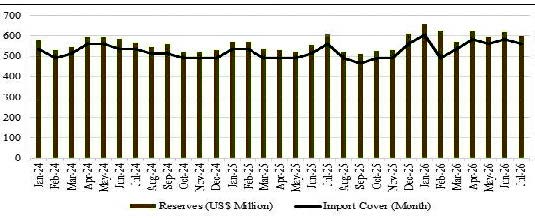
Data contained in the review show that Malawi’s foreign exchange reserves showed some improvement during the first seven months of 2026 although the overall reserve position remained fragile and below the levels required to provide adequate import cover.
In terms of import cover, total foreign exchange reserves provided approximately 2.4 months of import cover in July 2026, unchanged from July 2025, but below the 2.6 months recorded in January 2026.
Although this represents some improvement from the two months recorded in September 2025, reserve adequacy remains a significant concern, particularly given Malawi’s high dependence on imported fuel, fertilisers, pharmaceuticals, machinery and industrial raw materials.
Reserve Bank of Malawi (RBM) Governor George Partridge is on record as having said that the rapid money supply growth, excessive borrowing and fiscal deficits have increased demand for foreign currency faster than the economy’s productive capacity.
Launched in June 2026, the five-year National Economic Recovery Plan (Nerp) 2025-2030 aims to restore macroeconomic stability, address debt and fiscal pressures and accelerate private sector-led growth in alignment with the Malawi 2063, the country’s long-term strategy that seeks to turn Malawi into a lower middle-income economy by 2030 and an upper middle-income economy by 2063.
The plan, under the macro-economic stability pillar, seeks to reduce inflation, targeting single digits by 2027, ease foreign exchange shortages, stabilise prices and manage money supply and borrowing costs.
Economics Association of Malawi president Bertha Bangara-Chikadza proposed a deliberate shift towards sectors capable of earning foreign exchange, including tourism, mining, horticulture and value-added manufacturing as public investments in the key sectors identified by Nerp remains heavily concentrated in agriculture.
She said: “Without addressing the structural export challenge, the country risks remaining in a perpetual cycle of devaluations that delivers little economic benefit.”
Minister of Finance, Economic Planning and Decentralisation Joseph Mwanamvekha earlier conceded that chronic foreign exchange shortages was one of the underlying structural challenges that Nerp seeks to tackle.
Meanwhile, MCCCI says the quarter under review remained difficult for businesses despite easing headline and food inflation, lower average international oil prices.