Before the 1990s, many Malawian communities feared coffins almost as much as death itself. Burial rites largely followed traditional practices, with the dead wrapped in mats or blankets and carried on improvised stretchers destroyed after burial. Funerals carried little financial burden beyond preparing food for mourners.
If a coffin was needed, it was often made on the day of burial after relatives contributed timber for a village carpenter to assemble. Preparing a coffin before anyone had died was widely considered taboo.
Inkosi Mabilabo says elders believed keeping a coffin in advance could invite death into a family.
“To this day, few people would dare store a coffin in their home unless there has already been a death,” he said.
Even coffin makers themselves rarely keep finished coffins where they sleep. Perhaps because of such fears, coffins remain among the few products that can spend nights in the open without attracting thieves.
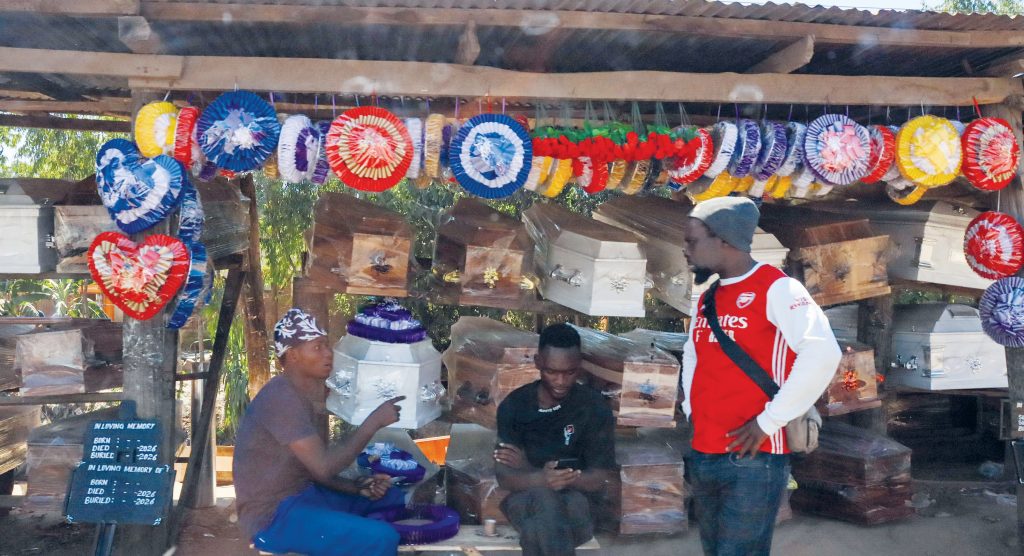
But attitudes have changed dramatically. Coffins are now openly displayed along roadsides, outside workshops and near hospital mortuaries. What was once feared has increasingly become ordinary business—and, for many families, an unavoidable part of mourning.
At the same time, some traditional burial rites are disappearing.
In the Mtambo royal family in Chitipa, certain customs still survive, including burying the deceased in a sitting position. But Village Head Mukombanyama [Timothy Mtambo] says preserving such traditions is becoming difficult and expensive.
He argues that coffins are not indigenous to Malawi and believes modern funerals now place more emphasis on death than on caring for the sick while they are alive.
“In the past, people buried relatives modestly, sometimes without expensive coffins, and communities still mourned with dignity,” he said. “Now funerals are becoming too expensive.”
Mtambo lamented that coffins have shifted from optional burial items to social obligations.
“Today, when there is no coffin, people begin talking. Families feel embarrassed even when they genuinely cannot afford one,” he said.
He added that dignity in death should not become a financial burden.
“Our culture used to focus more on caring for someone when they were sick. Today, some people neglect the sick but compete to be visible once someone dies. That is a bad culture,” he said.
The financial burden surrounding funerals has indeed grown heavier. A medium-range coffin now costs between K500 000 and K700 000. Combined with transport, food for mourners and burial contributions, funeral expenses can run into millions of kwacha.
For struggling families, raising such money is often impossible. Some borrow money, sell livestock or organise emergency community contributions simply to bury a loved one.
Traditional leaders fear Malawi may be abandoning simpler and less-costly burial traditions too quickly as funerals increasingly shift from communal cultural practices to expensive public displays of mourning and status.
But how did coffins become normalised?
According to Anthony Gunde, Associate Professor and Head of the Department of Media and Communication at the University of Malawi, the country’s relationship with coffins changed significantly during the peak of the HIV and Aids crisis before antiretroviral drugs became widely available in the 1990s.
“During that period, deaths were extremely high. Coffins became important because they were considered the safest and most practical way of transporting bodies over long distances,” he said.
Over time, the fear surrounding coffins weakened as funerals became increasingly modernised and commercialised.
“Today, coffins are openly displayed even in villages,” he said.
One such coffin maker is John Makiyoni, a 50-year-old carpenter from Mkalakala Village in Phalombe District. He inherited the trade from his father, who started making coffins in 1989.
“Those days, my father told me a month could pass without selling one. But it was different from 1993 onwards,” he said.
For the past 15 years, Makiyoni has operated a coffin workshop in Mchesi after abandoning ordinary furniture-making.
“Furniture takes too long to sell. People can sleep on the floor or improvise tables. But when someone dies, a coffin is needed immediately,” he said.
Makiyoni acknowledges that his business depends on death.
“Without deaths, these shops would close,” he said, quickly adding that coffin makers do not cause death.
Despite spending his days surrounded by coffins, Makiyoni remains a devoted Roman Catholic who worships at St Patrick’s Parish in Lilongwe.
“I simply pray for daily provision. God understands what I mean,” he said with a laugh.
Inkosi Mabilabo believes coffins were historically not commercialised because communities feared coffin makers would be accused of benefiting from death.
“How do you celebrate that business is doing well when your profits come from coffins? People would think you want others to die for your business to grow,” he said.
He also observed that coffins have become so embedded in modern funeral culture that politicians and aspiring members of Parliament commonly donate them to bereaved families.
However, Gunde faults the growing concentration of coffin workshops near hospital mortuaries.
“It is psychologically disturbing. Patients going to seek treatment should not constantly be confronted by displays of death,” he argued.