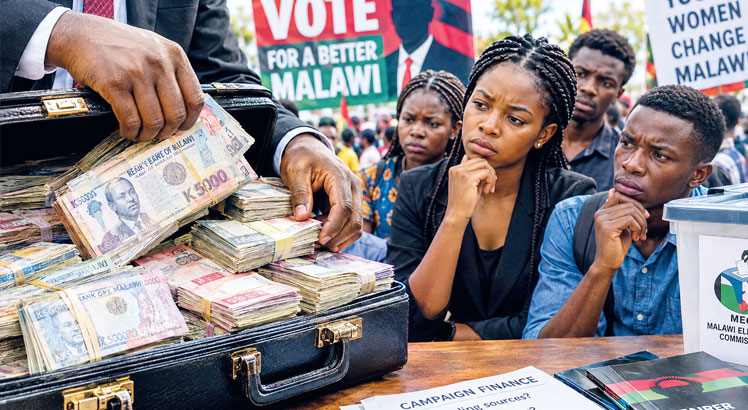
Malawi is spending millions to win political power—but the country’s election-finance rules cannot fully tell voters where much of that money comes from, how it is spent or who ultimately benefits.
Research by the Institute for Policy Interaction (IPI) and the University of Texas, reviewed by Weekend Nation, found that parliamentary candidates spent an average of K88.8 million each in the September 16 2025 elections, up from K14.8 million in 2019.
Yet, according to the Office of the Registrar of Political Parties (ORPP), Malawi has no specific legal framework imposing campaign spending limits or giving the regulator a comprehensive mandate to track election-specific financial flows.
That mismatch, millions being spent against rules that do not fully account for those millions, is at the heart of growing concerns over the financing of political power in Malawi.
ORPP chief Kizito Tenthani said in an interview on Wednesday that the existing legal framework deals with political party financing generally rather than campaign-specific spending.
“Currently, when you talk of party financing, you cannot talk of spending limits, it’s just general. That’s why I have always said that in campaign finance, there should be specific requirements for parties to observe,” Tenthani said.
The Westminster Foundation for Democracy (WFD), in its Cost of Politics in Malawi report published on August 4 2026, documented the consequences of the rising cost of political competition, saying expensive campaigns disproportionately disadvantage women and young people and increase the potential influence of wealthy financiers.
The result is a political marketplace where the ability to raise and spend money can become as important as the ability to persuade voters—while the rules governing that money remain fragmented.
At the centre of the problem is the Political Parties Act (PPA), which requires political parties to disclose individual donations exceeding K1 million and organisational contributions above K2 million within 90 days.
But governance experts interviewed by Weekend Nation say donation disclosure alone does not amount to a comprehensive campaign finance regime.
Private-practice lawyer and chairperson of the Civil Society Elections Integrity Forum (Csief) Benedicto Kondowe said campaign finance must address not only who gives money to political parties but also how much is raised and spent, what it is spent on and how candidates and parties account for it.
“Campaign financing is much broader and more specific: it concerns who finances electoral campaigns, how much may be raised and spent, what it is spent on, and how parties and candidates account for those resources,” Kondowe said.
He argued that Section 27 of the PPA is being stretched beyond its intended purpose because disclosure of major donations only reveals who gave money to a party, not how much was ultimately spent during an election campaign.
The escalating cost of politics has also reinforced existing inequalities.
According to WFD, expensive campaigns have created a political environment dominated by older and wealthier male candidates. Although the Malawi Electoral Commission (MEC) reduced nomination fees for women and youth to K1.25 million, the reduction addresses only a small fraction of the actual cost of running a campaign.
WFD found that female candidates face greater financial barriers due to structural inequalities, including limited access to formal credit because of lower asset ownership.
The organisation also noted that social expectations often pressure women candidates to fund community needs such as boreholes, development projects and medical assistance, pushing their average campaign expenditure to about K90.4 million.
For young candidates under 35, the average campaign cost stands at K54.5 million.
WFD said the combination of high expenses, uncertain electoral returns and competition against established politicians with extensive patronage networks discourages many young people from contesting.
Beyond questions of fairness, experts warn that opaque political financing poses wider economic risks.
Legal expert Audetter Masaninga, presenting her paper Political Finance, Disclosure and Accountability in Malawi at the fourth Biennial Political Science Association Conference in Salima last Saturday, said corruption consumes about five percent of Malawi’s gross domestic product (GDP), while tax evasion accounts for an estimated eight percent to 12 percent.
She argued that between 13 percent and 17 percent of economic activity could therefore be operating outside formal accountability systems.
An undisclosed political donation is not automatically money laundering or an illicit financial flow. However, experts warn that weak transparency mechanisms create opportunities for questionable funds to enter politics without scrutiny.
During election periods, such hidden financing can support campaign activities, patronage networks and vote-seeking initiatives outside formal party structures.
Gift Sambo, an expert in electoral and legislative politics at the University of Malawi, said in an interview on Wednesday many private financiers prefer secrecy because they are uncomfortable with public disclosure of political contributions.
He warned that this culture of secrecy can undermine accountability and weaken the prospects of people-centred leadership.
The European Union Election Observation Mission report on the September 2025 elections also highlighted campaign finance weaknesses, noting that Malawi has limited restrictions on sources of donations and does not require spending reports from independent candidates or privately funded parties.
Sambo said Malawi needs a fundamental shift in how political financing is regulated to protect democracy from becoming dominated by wealth.
Human rights defender Gift Trapence said the greatest risks come from “silent donors” and individuals who fund social initiatives linked to political actors in expectation of influence or future benefits.
In an interview on Wednesday, he called for Parliament to introduce a dedicated campaign finance law with expenditure ceilings, stronger disclosure requirements and measures to create a more level playing field for women, youth and less wealthy candidates.
Trapence said candidates should be required to use separate campaign bank accounts, subject to independent audits, while financial disclosures should be made public during the election period.
He further argued that the ORPP and MEC should be given stronger legal powers and resources to investigate violations, enforce compliance and sanction candidates who breach campaign finance rules.