Data reveals 99% of loan bills bypassed baseline scrutiny timelines

The afternoon sun beats down on the dome of Parliament Building in Lilongwe, but inside the National Assembly chamber, the atmosphere is hushed and hurried.
A Minister of Finance stands before the House, clutching a copy of a newly-drafted money Bill. Citing an urgent national emergency—an immediate food crisis, a critical fuel shortage, a climatic disaster or an unforeseen balance-of-payments shock—the minister makes a familiar request: a total suspension of the rules to waive the mandatory 28-day notice period for legislative review.
With the wave of a procedural wand, Standing Orders designed to protect public funds through adequate scrutiny are waived. By the time the closing gavel strikes later that afternoon, a new multi-billion kwacha loan has been authorised.
This breakdown of legislative oversight is not a recent aberration. It is a systemic historical standard, according to a groundbreaking analysis by the Parliament of Malawi Library and Research Services finalised in February this year.
The analysis reveals that out of 584 loan authorisation Bills approved by members of Parliament (MPs) between independence in 1964 and 2026, only six satisfied the mandatory 28-day notice requirement.
This means 99 percent of all loan authorisation Bills were passed without giving lawmakers the baseline timeline intended for rigorous review and scrutiny, exposing an institutional legacy of rubber-stamping executive debt.
When money Bills circumvent scrutiny by Parliament mainly through the Budget Committee and other relevant committees, the constitutional mandate of Parliament to provide oversight is undermined, warns Malawi Congress Party (MCP) spokesperson on finance in Parliament Peter Dimba.
In an interview, he stresses the heavy multi-generational burden of these hurried legislative votes, stating that it is crucial to remember that the Executive borrows these funds on behalf of the people, including future generations who will be bound by the decisions government makes today.
“Transparency and accountability are, therefore, paramount,” Dimba said.
The persistent gap between constitutional authority and safeguards cuts across every political era in Malawi’s history, according to the parliamentary report.
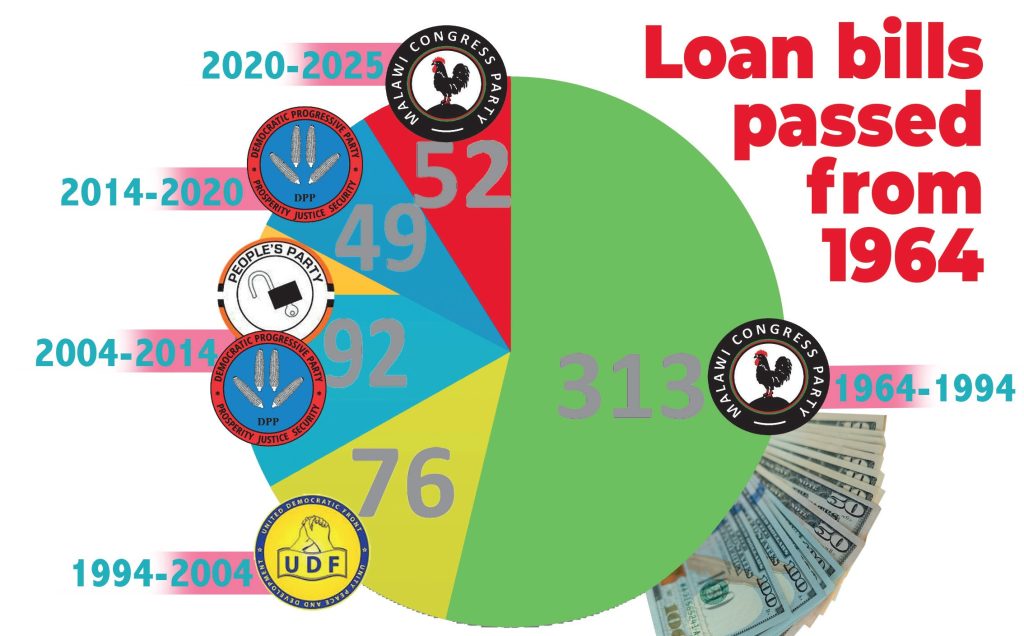
The one-party era (1964-1993) under the first MCP regime accounted for the lion’s share of borrowing volume with 313 bills, representing 53.6 percent.
Following the transition to democracy, the United Democratic Front (UDF) era recorded 76 bills which accounts for 13 percent.
On the other hand, the combined Democratic Progressive Party (DPP) and People’s Party (PP) period between 2004 and 2014 registered 92 bills, representing 15.8 percent followed by the standalone DPP era from 2014 to 2019 with 49 Bills or 8.4 percent. The contemporary MCP era from 2020 to 2025 recorded 52 Bills or 8.9 percent.
While the analysis shows that the recent MCP era registered the highest historical compliance rate at 9.6 percent, accounting for five of the six total bills that ever survived the 28-day rule, procedural short-cuts remained standard across six decades.
Detailed scrutiny by parliamentary committees has been equally deficient. Out of those 584 loan Bills, only 44 Bills (7.5 percent) ever received detailed committee review, leaving 92.5 percent to be passed blindly by the whole House.
Encouragingly, committee referrals have shown a positive, upward trajectory over time.
Committee reviews rose from zero percent in the earliest regimes to 3.3 percent during the DPP/PP decade, 20.4 percent under the DPP between 2014 and 2019, and 55.8 percent during the recent MCP era.
The 2025–2026 legislative year recorded 100 percent committee review for both of its considered bills.
Yet, as Budget and Finance Committee chairperson Sosten Gwengwe notes, these waivers are pushed through procedural political bargaining in business committees, leaving oversight bodies with little operational control on whether a bill is fast-tracked.
This breakdown of legislative discipline has effectively erased the historic economic lifelines handed to Malawi.
In 2006, after years of gruelling structural reforms, Malawi reached the completion point of the Heavily Indebted Poor Countries (HIPC) Initiative and the Multilateral Debt Relief Initiative (MDRI).
This package cancelled $2.3 billion in nominal external public debt, slicing total public liabilities by 90 percent.
At that moment, Malawi’s total debt crashed from over 71 percent of gross domestic product (GDP) to under 18 percent, freeing up roughly $110 million in annual debt-servicing savings to build schools, hospitals and support other social programmes.
Lacking strict compliance with parliamentary notice periods and independent risk assessments, successive administrations quickly relapsed into predatory credit lines.
Driven by a dependency on short-term domestic commercial banking finance—which carries severe, compounding interest rates—the foreign and domestic debt mountain climbed rapidly up again.
By December 2025, official Ministry of Finance data revealed that Malawi’s public debt surged to K24.33 trillion, up from K19.18 trillion just nine months earlier in March 2025.
This immense burden forces Malawi’s debt-to-GDP ratio to an unsustainable 90.9 percent to 93.2 percent, placing the country under severe debt distress.
Within the State’s K10.978 trillion budget framework, fiscal deficits have averaged 10.9 percent of GDP since 2022, according to The Nation’s review of budget documents.
This dynamic has forced annual interest payments to absorb an astounding K2.793 trillion of the budget.
Today, 25.4 percent of the entire national budget—and nearly half of all domestic revenues collected—is cannibalised by interest payments before a single kwacha can be spent on capital assets or public investment.
This interest obligation dwarfs the combined K1.334 trillion allocated to the country’s main growth sectors: agriculture, tourism, mining, and manufacturing combined.
Worse, driven by domestic financing imbalances, interest costs continue to climb, consuming revenue before it is even generated.
The real-world consequences of this mathematical collapse are painfully apparent outside the Treasury.
Public finance management expert Marvin Banda warns that these borrowing choices create direct competition with essential human services, particularly where debt servicing competes with spending on medicines, fertiliser, education, and infrastructure.
“Every loan must answer three questions: how much will it cost, what economic value will it generate, and can the country afford to repay it?” he says.
Banda emphasises that Malawi must strengthen oversight and track loans from authorisation and disbursement through project implementation and repayment to ensure borrowed money delivers measurable public value.
Given that fast-tracked Bills regularly bypass scrutiny, the Parliament Library report notes that money Bills are routinely passed with glaring data gaps regarding interest rates, maturity dates, currency risks and project feasibility studies. Government borrows money without showing how it will be spent, leading to a complete lack of tracking on value for money and intended public benefits.
In an interview, Scotland-based Malawian economist Velli Nyirongo notes that the number of loan bills passed is only part of the problem.
He warns that weak appraisal could expose taxpayers to expensive borrowing terms, repayment difficulties, exchange-rate risks and projects that fail to generate sufficient economic benefits.
“The number of loan bills alone does not establish the severity of Malawi’s debt burden. Parliament must also examine the value of each loan, its interest rate, maturity, repayment conditions, intended purpose and actual economic returns,” Nyirongo points out.
Within political circles, the reason for this chronic oversight failure depends on who one asks.
Former Clerk of Parliament Roosevelt Gondwe points out that changing legislative rules have institutionalised the practice, noting that Standing Orders were amended to allow for a truncated seven-day circulation period under Section 126(1)(b) for urgent cases.
On his part, former Finance Minister Felix Mlusu argues that fast-track waivers must be judged based on the immediate importance of the crisis, noting that exceptions should depend entirely on the circumstances.
However, he adds a caveat regarding committee involvement: “You still have to give Parliament to go through that necessary committee, to go through that and still give them their input. You just can’t have it approved without a necessary committee having looked at it and given their input.”
Public finance law expert Kamudoni Nyasulu offers a far more damning perspective.
He insists that focusing on procedural reforms misses the point, arguing that existing laws—including the Constitution and the Public Finance Management Act—already contain strong safeguards.
Nyasulu states flatly that the procedural shortcuts represent a profound structural breakdown rather than a gap in regulations.
“That only six out of 584 Bills satisfied the 28-day notice requirement, and only 44 Bills received committee review is not a matter for reform. This is a failure of compliance with the Constitution and Statute,” he states.
Nyasulu describes it as a complete breakdown of accountability and transparency, concluding: “We must first demand compliance, transparency and accountability before we offer duty bearers an escape route in the name of reform.”
While the office of Speaker Sameer Suleiman offered no comment on the historical library data, the report lays out clear institutional steps forward.
It recommends implementing a Mandatory Loan Information Pack detailing all interest, risk and feasibility metrics before any floor vote, strictly enforcing committee referrals for all financial legislation, protecting the 28-day rule by legally limiting what qualifies as an executive emergency and creating rigorous mechanisms to track loan utilisation from disbursement to project delivery.