
At the height of uncertainty about payment to contractors for M1 rehabilitation, the main funders European Investment Bank (EIB)—a financing arm of the European Union (EU)—has said it paid all the €139.5 million (K290.7 billion) to government.
In an email response through EU spokesperson Grace Nachiola, the EIB said they are aware of the stand-off between contractors and government, but trust that Lilongwe will do the needful as the next funding is dependent on the success of the first phase.
It said the EIB Global finances specific projects and has contractual covenants in place to ensure that the bank’s funding, as well as the EU grants, are used for expenditures related to the project.
For Malawi, the EIB Global said it signed its largest single investment of €95.5 million and blended with a substantial EU grant of €44 million.
“The funds have been fully disbursed to the Government of Malawi to rehabilitate 300km of the M1 road, which not only links all of the country’s major cities, but is also part of a strategic corridor linking Malawi to its neighbouring countries and the port of Dar es Salaam in Tanzania.
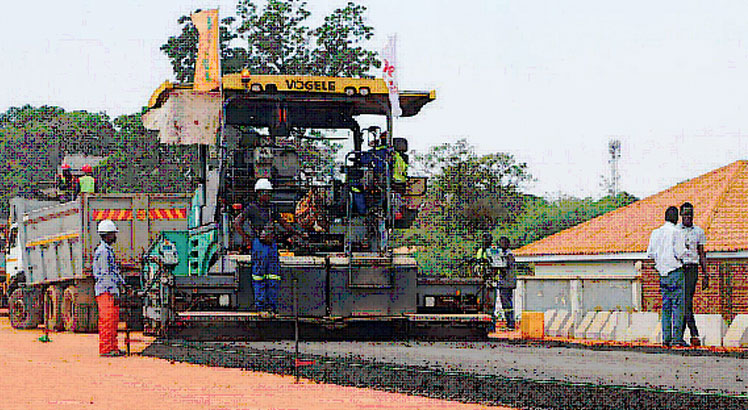
Crossroads and Mzimba Street in Lilongwe. | Nation
“We are aware of delays in payment to contractors and related exchanges on the use of local or foreign currency, issues we have discussed with and that are being addressed by the Government of Malawi as the project implementer,” it said.
The response further said EIB Global conducts rigorous monitoring and evaluation of each project it supports and has not received evidence of prohibited conduct or misuse of funds.
Added the response: “As for any EIB-financed operation worldwide, suspicion or evidence of prohibited conduct can be shared with our Investigations Division.
“We are currently in discussion with the Government of Malawi on the signature of an additional €38 million EIB funding and €20.4 million EU grant for the project, which is naturally also conditional on the successful implementation of the first phase.”
Both Minister of Finance, Economic Planning and Decentralisation Joseph Mwanamvekha and his Transport and Public Works colleague Jappie Mhango declined to comment on the issue.
But in an earlier interview, Mwanamvekha admitted that contractors were insisting being paid in foreign currency.
“We had a meeting and contractors are insisting on getting foreign currency, but if they wanted in kwacha, all of them can be paid today! We told them to talk to the Reserve Bank of Malawi [RBM] through the Roads Authority [RA] and Roads Fund Administration [RFA] to meet the contractors on their demand.
“It’s not a question of money, no, money is available and remember this one is off the budget, but what they are demanding is the issue,” he said.

question of money. | Nation
Loose minutes we have seen captured by an attendee from one of the contractors show that two meetings were held on January 30 2026 at RA and February 2 2026 at RBM offices.
The January 30 meeting, according to the minutes, was chaired by RA and attended by representatives from RFA, RBM, Ministry of Finance and the four contractors.
The minutes read in part: “At such meetings, it was requested that a portion of the outstanding certificate of payment and future payments of the contract is to be paid in Malawi kwacha.
“This request is in conflict with the provision of Sub-clause 14.7.2 [payment currency] of the GCC [General Conditions of Contract], which forms part of the basis of the contract accepted between the parties and executed between the parties thereof.”
The document says the currency of payment as agreed among the Government of Malawi, the EU/ EIB and the contractor was euro.
“For the avoidance of doubt, we reiterate that any request for payment of any portion of the IPCs in local currency has not been accepted, as it is inconsistent with the contractual provisions and all payments due to the contractor are to be made in the currency of euro,” it adds.
Last week, it was discovered that contractor for Lot 1, China Jiangxi International, was last paid in June 2025 and has since suspended works in protest against non-payment.
Contractor for Lot 2, Mota Engil, was last paid in October 2025 and gave government up to February 13 to pay, failing which it will suspend works while contractors for Lots 3 and 4 have also given notices.
Snaking roughly through 1 140 kilometres from the Tanzanian border in the North to the Mozambican border in the South, the M1 is the country’s primary North-South transport backbone, serving as the main artery for trade, agricultural logistics and regional connectivity.
The current rehabilitation and upgrading efforts are meant to turn the route into a durable and safe corridor that can help bring efficiency to the national economy.
Former president Lazarus Chakwera launched rehabilitation of the M1 in July 2022. However, the project did not start for about a year due to various challenges, including changes in design.