From gold diggers crushed by boulders in the bowels of the earth to yawning pits replacing forested hills, Malawi’s surging gold rush scarcely respects rules amid absent law enforcement.
Excavations opened by gold diggers increasingly pose a danger to passers-by, livestock, the environment and food security.
The trail of destruction includes farmlands stripped of fertile soil amid worsening hunger fuelled by climate change, barren soil and population pressure.
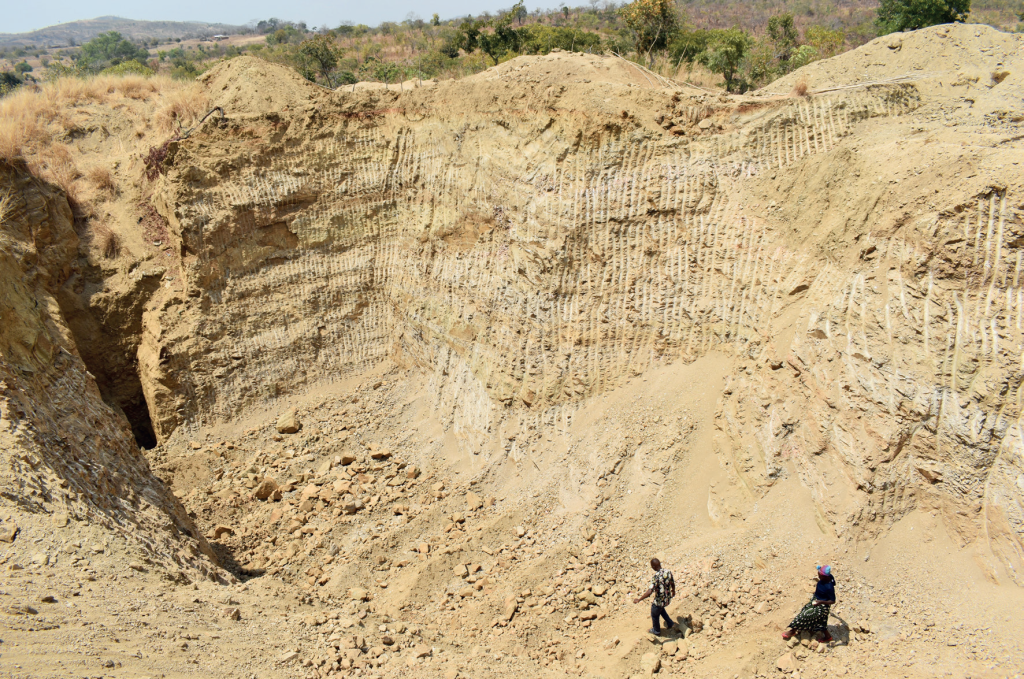
In deforested hills, silted streams and crumbling riverbanks, desperate locals descend into dizzying depths without protective wear in search of gold deposits.
They risk their lives and the environment for just a ponto, a milligramme of gold. The unregulated miners have to dig out over two tonnes of soil to unearth a ponto worth K9 000 in their midst and K42 000 at the Reserve Bank of Malawi (RBM).
“It’s backbreaking and we are ruining our farmlands, rivers and forests. But what else can we do to beat hunger and poverty as the rains are no longer predictable?” asks Peter Chagunda, from Chitimbe Hills along the boundary between Balaka and Neno districts.
Bit by bit, he dug two to three metres into a free-for-all bank of a furrowed dry stream using a pick, a hoe and a shovel.
In 2019, the man lost his crop field the size of a football field to a Chinese gold merchant, who paid no coin for it.
Currently, he wakes up as early as 4am and hurries to the rivulet to fetch gold, which splits rocky hills and natural forests reduced to gaping pits by gold diggers.
The seasonal stream flows into Lisungwi River, a tributary of the Shire River where much of the power for the national grid is produced.
Electricity Generation Company (Egenco) spokesperson Moses Gwaza says debris chokes the turbines that produce 380 megawatts along the country’s largest river.
They include four power houses that generate 121MW at Tedzani, two that produce 135MW at Nkula and another pair that churns out 129MW at Kapichira in Chikwawa.
The neglected social and environmental impacts brings into question the ethical nature of the country’s gold stockpile, estimated at 536 kilogrammes worth K129 billion by the Reserve Bank of Malawi.
Activists ask: “How long will the central bank continue to accumulate gold bars without minding worsening ills at the source?”
They want miners, buyers and regulators to treat people, communities and the environment with fairness and respect.
Even buyers of tobacco—Malawi’s green gold which contributes 13 percent to the country’s gross domestic product (GDP)—have taken measures to trace the leaf from the field to the world market so that it does not harm the environment, workers and children.
Reserve Bank of Malawi (RBM) spokesperson Boston Banda says the central bank is equally concerned about the environmental loss and damage occurring in some mining areas.
“While the bank’s mandate primarily focuses on the purchase and management of gold as part of the country’s reserves, we work closely with the relevant authorities such as the Ministry of Mining, the Malawi Environmental Protection Agency [Mepa] and the Mines and Minerals Regulatory Authority to take the lead in enforcing environmental and social safeguards within the sector,” he states.
RBM’s Export Development Fund supports tree planting and environmental education initiatives to contribute towards “responsible mineral value chain management” and landscape restoration, says Banda.
Maliketi Banda told The Nation that RBM conducts a comprehensive Know Your Customer (KYC) process for all suppliers involved in gold transactions.
“This due diligence ensures that we procure gold from traceable and legitimate sources,” says Banda.
He added that RBM’s gold procurement policies are aligned with the Organisation for Economic Co-operation and Development (OECD) Due Diligence Guidance for Responsible Supply Chains of Minerals.
OECD works with over 100 countries to build stronger, fairer and cleaner societies, its website reads. Its standards promote ethical practices, human rights protection and environmen
Environment under siege,
authorities bury their heads
GOLD MINING
JAMES CHAVULA
Staff Writer
From gold diggers crushed by boulders in the bowels of the earth to yawning pits replacing forested hills, Malawi’s surging gold rush scarcely respects rules amid absent law enforcement.
Excavations opened by gold diggers increasingly pose a danger to passers-by, livestock, the environment and food security.
The trail of destruction includes farmlands stripped of fertile soil amid worsening hunger fuelled by climate change, barren soil and population pressure.
In deforested hills, silted streams and crumbling riverbanks, desperate locals descend into dizzying depths without protective wear in search of gold deposits.
They risk their lives and the environment for just a ponto, a milligramme of gold. The unregulated miners have to dig out over two tonnes of soil to unearth a ponto worth K9 000 in their midst and K42 000 at the Reserve Bank of Malawi (RBM).
“It’s backbreaking and we are ruining our farmlands, rivers and forests. But what else can we do to beat hunger and poverty as the rains are no longer predictable?” asks Peter Chagunda, from Chitimbe Hills along the boundary between Balaka and Neno districts.
Bit by bit, he dug two to three metres into a free-for-all bank of a furrowed dry stream using a pick, a hoe and a shovel.
In 2019, the man lost his crop field the size of a football field to a Chinese gold merchant, who paid no coin for it.
Currently, he wakes up as early as 4am and hurries to the rivulet to fetch gold, which splits rocky hills and natural forests reduced to gaping pits by gold diggers.
The seasonal stream flows into Lisungwi River, a tributary of the Shire River where much of the power for the national grid is produced.
Electricity Generation Company (Egenco) spokesperson Moses Gwaza says debris chokes the turbines that produce 380 megawatts along the country’s largest river.
They include four power houses that generate 121MW at Tedzani, two that produce 135MW at Nkula and another pair that churns out 129MW at Kapichira in Chikwawa.
The neglected social and environmental impacts brings into question the ethical nature of the country’s gold stockpile, estimated at 536 kilogrammes worth K129 billion by the Reserve Bank of Malawi.
Activists ask: “How long will the central bank continue to accumulate gold bars without minding worsening ills at the source?”
They want miners, buyers and regulators to treat people, communities and the environment with fairness and respect.
Even buyers of tobacco—Malawi’s green gold which contributes 13 percent to the country’s gross domestic product (GDP)—have taken measures to trace the leaf from the field to the world market so that it does not harm the environment, workers and children.
Reserve Bank of Malawi (RBM) spokesperson Boston Banda says the central bank is equally concerned about the environmental loss and damage occurring in some mining areas.
“While the bank’s mandate primarily focuses on the purchase and management of gold as part of the country’s reserves, we work closely with the relevant authorities such as the Ministry of Mining, the Malawi Environmental Protection Agency [Mepa] and the Mines and Minerals Regulatory Authority to take the lead in enforcing environmental and social safeguards within the sector,” he states.
RBM’s Export Development Fund supports tree planting and environmental education initiatives to contribute towards “responsible mineral value chain management” and landscape restoration, says Banda.
Maliketi Banda told The Nation that RBM conducts a comprehensive Know Your Customer (KYC) process for all suppliers involved in gold transactions.
“This due diligence ensures that we procure gold from traceable and legitimate sources,” says Banda.
He added that RBM’s gold procurement policies are aligned with the Organisation for Economic Co-operation and Development (OECD) Due Diligence Guidance for Responsible Supply Chains of Minerals.
OECD works with over 100 countries to build stronger, fairer and cleaner societies, its website reads. Its standards promote ethical practices, human rights protection and environmental sustainability.
RBM, through the EDF, started buying gold in 2021, creating a gold rush among both licensed and unlicensed miners.
Section three of the Mining and Minerals Act amended in 2023 establishes the MMRA as a robust independent regulator to ensure the extraction of minerals benefits all citizens, protects the environment and attracts responsible investment.
MMRA director general Samuel Sakhuta acknowledges that gold mining “has become very destructive to those who depend on land and water resources for their livelihoods, including in agriculture”.
He said his regulatory body is pursuing three strategies to tackle the challenge fuelled by unlicensed miners.
However, the mining regulator works with the Malawi Environmental Protection Authority (Mepa) to ensure revenue from the extractive industry does not come at the expense of natural resources and human health.
Created by the Environmental Management Act of 2017, Mepa is supposed to see to it that government fulfils its constitutional obligation of protecting the environment not only to promote the well-being and development of Malawi’s population, but also the needs and rights of future generations.
The free-for-all gold rush that hides in plain sight across the length and breadth of the country smacks of lawlessness in illegal mining where political heavyweights, businesspersons and crooks call the shots.
The seemingly abandoned environmental sustainability is one of the pillars of the national vision to turn Malawi to an inclusive, self-reliant, industrialised, upper middle-income economy by 2063, the centenary of self-rule.
This turns up calls for sustainable business practices, especially environmental protection and respect for local communities, in gold mining sites whether licensed or not.
However, Mepa chief Wilfred Kadewa states: “Our mandates limit us to the protection and management of the environment and sustainable utilisation of natural resources in the country. The aspect of ethical business, which calls for sustainability, transparency and accountability, does not fall completely within our mandates..