The Gender Equality Act guarantees access to comprehensive sexual and reproductive health (SRH) services for all.
Yet, for persons with disabilities, this right is routinely denied, questioned and trampled upon.
“I am a sexually active man, yet some people look at me and assume I cannot love, desire, have a family and seek SRH services. This is painful,” says Rex Kalima, 40, from Namiyango Township in Blantyre City.
The man, who uses a wheelchair, feels ostracised when seeking basic commodities such as condoms.
For him, asking for the rubber that prevents sexually transmitted infections and unintended pregnancies, often felt like walking into a courtroom where his sexuality and dignity was on trial.
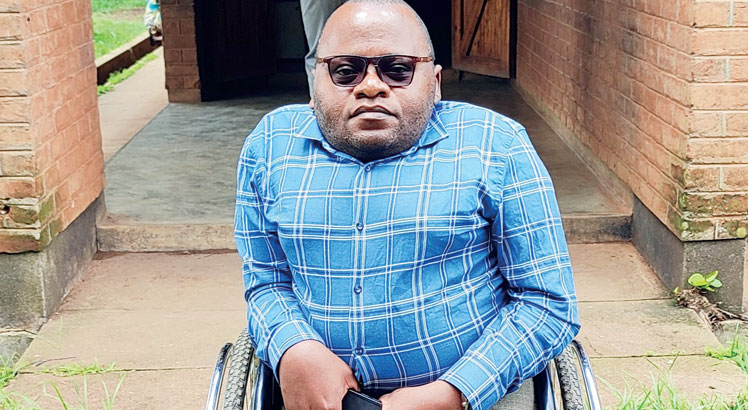
Kalima has endured years of ridicule, disbelief and emotional torture since his secondary school days in the early 2000s.
But one incident still haunts him.
Kalima recalls the afternoon he went to Limbe Health Centre, determined to access SRH services like any other client, but he was in for a shock.
He recounts: “A healthcare worker looked at me in shock and asked brazenly: ‘Even you also need condoms? What for?’ That question cut through my heart like a blade.
“What puzzled me most was that the trained healthcare worker who uttered these insensitive words was supposed to understand that a person with disability is like any other person. Instead, the caregiver made me feel like a lesser being. I went back home without receiving the services I needed.”
Kalima’s story is not an isolated case.
About 50 kilometres away, Nyozeni Rajab of M’boola Village, Traditional Authority Lundu in Blantyre, a mother of one, battles stigma and discrimination in her community.
“Being physically challenged in Malawi is hell. People laugh at me when I talk about contraceptives. They say I don’t deserve such services. Sometimes, I pity myself,” she says.
Rajab, 45, says people with disabilities often suffer in silence, with many choosing to stay at home instead of participating in public life.
“Most of us just stop going to health facilities. We fear the gossip and the insults. This is not good for our health,” she says.
Kalima and Rajab’s experiences reflect a deeply entrenched challenge.
Young Voice Organisation champions the rights of people with disabilities to access SRH services and information without discrimination.
The organisation’s programmes manager Emmanuel Namponya laments widespread lack of disability friendly SRH services in public facilities.
“Most public health facilities do not provide disability-friendly sexual and reproductive healthcare such as sign language interpreters. This creates a huge communication barrier between healthcare workers and patients with hearing impairments. As a result, misunderstandings, frustration and sometimes outright discrimination occur,” he says.
Namponya says his organisation receives at least a report of abuse, miscommunication and degrading treatment against people with disabilities every week.
“People with disabilities are systematically excluded. Some are insulted, others ignored and many discouraged. Eventually, they stop going to hospitals altogether. That puts their health and lives at serious risk,” he observes.
Globally, the challenge is equally stark.
In 2024, the United Nations Department of Economic and Social Affairs reported that persons with disabilities are being left behind in efforts to achieve the Sustainable Development Goals by 2030.
The UN flagship report on disability and development affirms that people with disabilities have the same SRH needs as everyone else, but harmful myths and assumptions, especially the belief that they are not sexually active, continues to deny them access to essential services.
These misconceptions strip away dignity, reduce human beings to stereotypes and fuel a culture where people like Kalima and Rajab must first prove their humanity before receiving care.
Yet behind every physical challenge, is a person with dreams, desires, fears and hopes just like everyone else.
“I want to love. I want to protect myself. I want a family. I want respect. I want to be treated like a human being,” says Kalima.
His plea echoes the silent cries of thousands across the country. According to the 2018 Census, approximately 1 734 250 Malawians aged five and above live with at least one form of disability, representing about 11.6 percent of the country’s population.