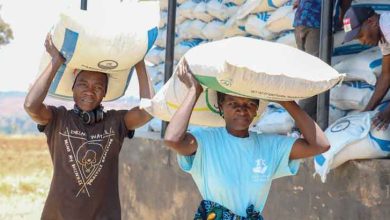
Malawi is facing a fertiliser deficit of 282 206 metric tonnes (MT) barely three months to the start of the farming season.
Fertiliser Association of Malawi (FAM) said yesterday that its members have a combined 192 794MT of fertiliser out of the 475 000MT required to meet annual production needs.
The stock is either in warehouses, in transit or on the higher seas, coming, but importation of more quantities is hampered by lack of foreign exchange coupled with increasing costs of the
commodity on the international market, according to industry players.
In a written response to a questionnaire, FAM executive administration officer Hannah Makhambera said the key challenge affecting importation is the unavailability of forex for settling international transactions.

She said: “FAM members are using whatever means to bring in fertiliser to support the farming community. The only challenge is forex availability to the extent that the members have enough Malawi kwacha, but cannot access forex to complete the importation process.”
Makhambera also said farmers should expect the price of the commodity, currently at between K150 000 and K170 000 per 50 kilogramme (kg) bag,
to continue rising in response to costs on the global market.
She said global fertiliser prices of Urea have continued to rise from Free On Board (FOB) of $366/MT (about K635 109) earlier this year to $515/MT (about K893 664) at present.
Malawi Government allocated K131.6 billion to the Affordable Inputs Programme (AIP) in the K8.1 trillion 2025/26 National Budget, down from K161 billion last year.
However, Ministry of Agriculture is yet to announce the number of beneficiaries for a combined package of fertiliser and seeds as well as livestock in some areas.
In an interview yesterday, Minister of Agriculture Sam Kawale could not indicate the status of fertiliser stock at hand, insisting that government procured 300 000MT last year that has been arriving in the country.
Further, he said he did not have information regarding how much of the imported fertiliser will be for AIP and when the entire consignment will be in.
Kawale said such inputs are being provided through programmes such as Agricultural Commercialisation (Agcom), National Economic Empowerment Fund (Neef ), Sustainable Agriculture Production Programme (SAPP) and Programme for Rural Irrigation Development (Pride).
He also said the ministry stopped preparing seasonally; hence, the reason distribution of farm inputs did not stop and will continue.
“We procured over 300 000MT of fertiliser over a year ago. It is coming
on a daily basis until all of it comes. This fertiliser is used by Neef, AIP, commercial farmers and mega farms. Our target is to reach all the four million households in all programmes,” he said.
Based on current BOF prices of $515/MT, with the K131.6 billion for AIP, the government may procure about 147 259 or 2 945 180 bags of fertiliser weighing 50kg each.
However, not all this amount goes into fertiliser as some covers administration of the programme, procurement of seeds, transport, security and the livestock component.
Meanwhile, Mwapata Institute director William Chadza has said the situation will lead farmers not to access the fertilisers on time and application would be done later than when the crops need them.
He said: “Unavailability could also result in farmers not applying the correct type of fertilisers for the crops and soils. Low supply on the market could even result in higher prices, making it unaffordable for most of the farmers.
“Implications? There will be potentially low yields, especially for maize. Support traders to access forex to bring in fertilisers though there are competing demands. We have recently seen this with cement. Sound macroeconomic policy for long term solutions.”
In an earlier interview, Farmers Union of Malawi president Maness Nkhata urged farmers to start making compost manure and Mbeya fertiliser to cover the shortfalls that may result from the high cost of fertiliser