Malawi Confederation of Chambers of Commerce and Industry (MCCCI) says the country’s businesses faced a tougher operating environment in the first half (H1) of this year as worsening foreign exchange shortages, rising taxes and fuel supply challenges squeezed production and profitability.
In its First Half 2026 Economic and Business Review, MCCCI indicated that 88.2 percent of businesses cited foreign exchange scarcity as their biggest challenge, up from 74.1 percent during the same period last year, making it the most critical constraint affect the private sector’s growth.
The chamber said the shortage of foreign currency continued to disrupt the importation of essential raw materials, machinery and other production inputs, forcing many firms to scale back operations and absorb higher costs.
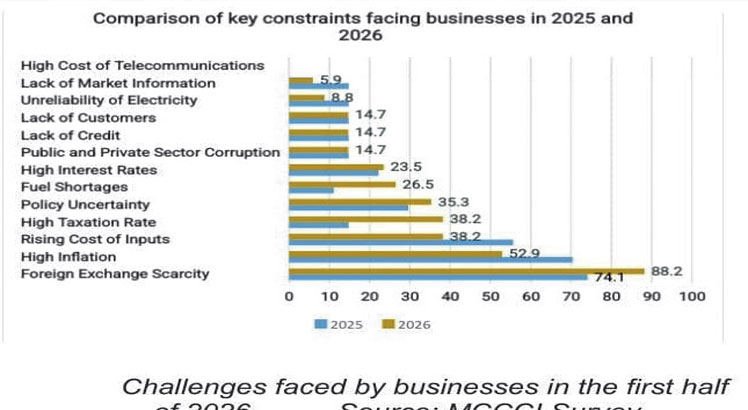
Reads the MCCCI review in part: “The comparison of business challenges between 2025 and 2026 shows that Malawi’s business environment remained difficult, with macroeconomic challenges continuing to dominate business operations.”
While inflationary pressures eased during the review period, business concerns shifted towards foreign exchange availability, with the proportion of firms citing high inflation falling from 70.4 percent to 52.9 percent and those reporting rising input costs dropping from 55.6 percent to 38.2 percent.
The report further indicates that concerns over taxation increased sharply, with 38.2 percent of firms identifying high taxes as a challenge compared to 14.8 percent a year earlier while businesses affected by fuel shortages rose from 11.1 percent to 26.5 percent.
The difficult operating environment also weighed heavily on production, with only 11.8 percent of businesses
operating above 75 percent of installed capacity, according to MCCCI.
The private sector lobby group further said that more than half of the firms surveyed or 52.9 percent, reported operating at between 50 and 75 percent of capacity while 35.3 percent were producing at less than half of their potential output.
“These findings suggest that the majority of firms remain significantly underutilised, reflecting the adverse effects of the challenges facing businesses,” reads the report.
The chamber has since warned that continued low capacity utilisation is raising production costs, reducing profitability and weakening the competitiveness of local firms, calling for urgent measures to improve foreign exchange availability, ensure reliable fuel supplies and create a more predictable business environment.
Minister of Industrialisation, Business, Trade and Tourism Simon Itaye, in an interview yesterday, said “government is targeting to curb foreign exchange leakages as part of immediate measures to ease shortages affecting the economy”.
He said addressing the leakages is a short-term intervention while in the long-term, government is focusing on import substitution to reduce demand for foreign currency and export diversification to increase inflows and reduce pressure on the forex market.
In May this year, the Reserve Bank of Malawi admitted facing challenges to manage allocations of foreign exchange to the country’s essential sectors due to inadequate forex reserves.
RBM principal economist Whytone Jombo said during the Monetary Policy Technical Committee Forum in Mzuzu that making allocations has not been easy for the central bank.
He said: “I can assure you that when forex is not enough, it is really difficult to manage because you have to address competing needs such as pharmaceuticals and fuel.
“Some of the policies we implemented last year are working while some are under review.”
Malawi requires $250 million (about K438 billion) in a month to import strategic commodities such as fuel, fertiliser and pharmaceuticals