Malawi’s inflation rate has averaged 28.95 percent in first half (H1) of this year which is above the annual projection of 27 percent, attracting mixed reactions from analysts.
The inflation rate, which has been easing for four months in a row, averaged 33.3 percent during the corresponding period last year. The rate is currently at 27.1 percent as of June this year, according to the National Statistical Office (NSO).
In an interview yesterday, Economics Association of Malawi president Bertha Bangara-Chikadza said although the rate is easing, it remains above the annual average inflation rate target.
She said: “The half-year average inflation of 28.95 percent is already above the government’s annual target of 27 percent, which makes achieving that goal challenging.
“Bringing inflation down in the remaining months will require a marked slowdown in price increases supported by improved food supply, exchange rate stability and continued fiscal and monetary discipline.”
Bangara-Chikadza further observed that while domestic fuel prices remained stable during the first half of the year, risks remain particularly from anticipated election-related spending, which could increase liquidity and stoke demand-driven inflation.
In a separate interview, economist and Business Partners Malawi country manager Bond Mtembedzeka said yesterday that despite averaging 28.95 percent in the first half, it remains feasible to attain the 27 percent annual inflation target if measures are put in place to control prices.
He said: “It’s achievable provided that monetary policy remains tight. Of course, monetary policy is just one side of the equation.
“Efforts to stabilise, or even reduce, food inflation through measures such as maize imports will also play a critical role.”
Consumers Association of Malawi executive director John Kapito in an interview yesterday observed that it takes time for inflation rate to drop significantly, but said it is critical to sustain the momentum.
“These gains will take a long time to be passed on to consumers and it is insensitive for us to begin celebrating the lowering of inflation taking into consideration the impact it has on consumers,” he said.
RBM Deputy Governor Kisu Simwaka is on record as having said due to the ease in inflation, at its upcoming meetings, the Monetary Policy Committee (MPC) will assess progress based on the totality of the incoming data, the evolving inflation outlook and balance of risks.
“Based on this assessment, they will decide whether to reduce or hold the policy rate constant while waiting for further data,” he said.
The policy rate, the rate at which commercial banks borrow from the central bank as the lender of last resort, is currently at 26 percent, with bank interest rate hovering at around 35 percent.
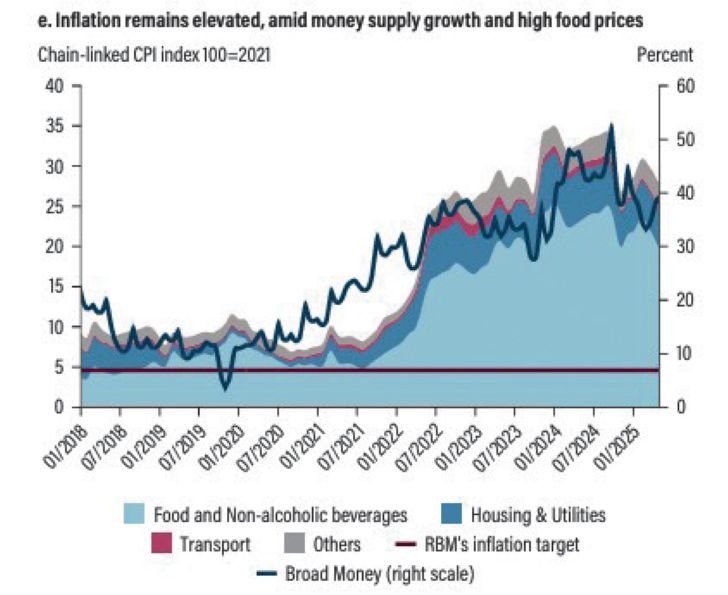
Simwaka said food prices are the major driver of the recent high inflation.
The NSO data shows that food inflation, which accounts for more than half of the country’s inflation basket, has slightly eased to 31.6 percent in June from 32.7 percent in May 2025 while non-food inflation stood at 20.1 percent from 20 percent over the review period.
In its recent quarterly business review, the Malawi Confederation of Chambers of Commerce and Industry projects inflation during the year to remain elevated due to an increase in government spending as the country is heading towards the September 16 General Election.
Reads the review in part: “The high and persistent inflation in Malawi, especially in food and energy, combined with a large budget deficit and economic uncertainty, poses significant challenges to businesses.
“These include rising costs, reduced consumer demand, and limited access to affordable finance. Strategic planning, cost control, and adaptability will be critical for businesses to navigate this economic climate.”
In its second MPC Statement for this year, the RBM maintained the policy rate at 26 percent and projected annual inflation to slow down to 27 percent in 2025 from 32.2 percent in 2024.