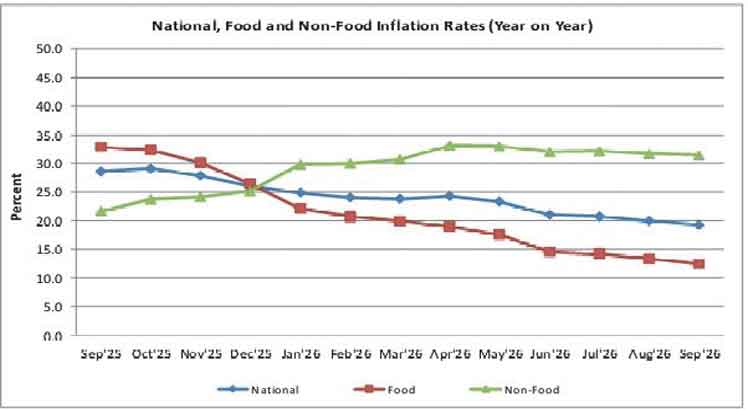
Malawi’s year-on-year headline inflation rate for September 2026 declined to 19.4 percent as the rate averaged 20 percent in the third quarter (Q3) of this year compared to 28.1 percent in the corresponding period last year, National Statistical Office (NSO) data show.
NSO data show that inflation rate declined from 20 percent in August largely driven by easing food price pressures.
The latest reading also marks the first time inflation rate has fallen below 20 percent since May 2022 when it stood at 19.1 percent, signalling continued moderation in prices.
“Food inflation declined to 12.5 percent in September 2026, down from 13.4 percent in August 2026 while non-food inflation moderated to 31.5 percent from 31.8 percent over the same period,” reads part of the NSO Stats Flash.
In separate interviews yesterday, analysts described the easing of inflation rate as a welcome development although they warned that the coming lean period coupled with the projected El Nino weather condition could bring back inflation pressures.
Economics Association of Malawi president Bertha Bangara Chikadza in an interview yesterday described the ease in inflation rate as positive despite upside risks remaining.
She said that the consistent decline in inflation rate has largely been due to easing food inflation, which has been offsetting non-food inflation pressure.
Said Bangara-Chikadza: “Going forward, the onset of the lean season threatens the price of maize, thereby exacerbating food inflation.
“Further, the renewed tensions in the Middle East threaten increase in fuel prices.”
Writing on his Facebook page, Reserve Bank of Malawi (RBM) Deputy Governor for operations Kisu Simwaka said the downward trajectory is in line with its forecast of an annual rate of 22 percent from 28.4 percent in 2025 despite non-food inflation posing a threat to the outlook.
He said inflation rate is projected to remain in teens in the fourth quarter, but the disinflation path remains volatile because of high non-food inflation rate.
“The real worry is that non-food inflation has barely moved. This stickiness tells us that past exchange rate adjustments are still transmitting to domestic prices through import prices,” said Simwaka
He said the volatility of the disinflation path signals that headline inflation rate is improving, but non-food inflation rate remains sticky.
Mzuzu University economics lecturer Christopher Mbukwa attributed the continued easing of inflation rate to maize prices stability, but warned that the situation could change as the lean period approaches.
“With non-food inflation that is already rising, we may see headline inflation rising in the coming months,” he said.
Consumers Association of Malawi executive director John Kapito said he does not expect the benefits of the inflation rate decline to trickle down to consumers immediately.
In its 2026 Third Monetary Policy Statement, the RBM acknowledged upside risks that could affect the current inflation trend.
Reads the statement in part: “Domestically, the possibility of El Niño weather conditions during the 2026/27 agricultural season is a key risk given its potential impact on food availability.”
Nico Asset Managers Limited Half-Year Economic Review for 2026 indicated that high inflation rate is one of the current key economic risks that could erode people’s purchasing power.
RBM projected annual inflation to be at 22 percent in 2026, down from 28.4 percent in 2025 and 32.2 percent in 2024.