Kamuzu College of Health Sciences (Kuhes) Funeral Parlour mortuary assistant Joyce Mbewe never dreamt of working as mortician.
“From childhood, I wanted to be a nurse, but life happened I did not make it into a nursing school. Then I aspired to a career in journalism, enrolled with the Malawi Institute of Journalism and studied for one semester. Life happened again, I withdrew,” she starts narrating her story.
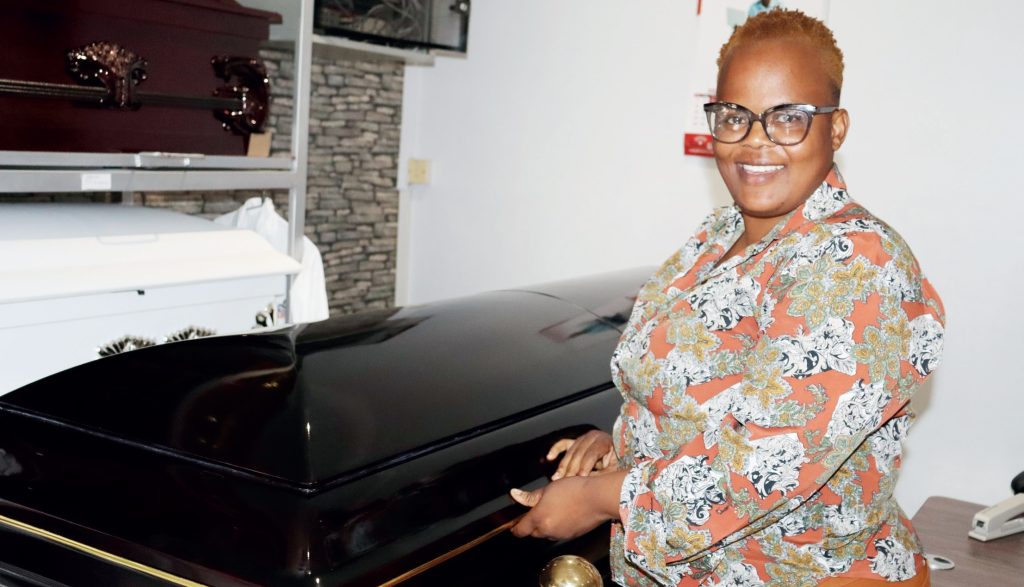
Joyce got a job at one of the hotels in Blantyre.
“I enjoyed the job because I love interacting with people,” she says.
Later, she came across an advertisement announcing a vacancy for a mortuary attendant at Kuhes Funeral Parlour. She applied.
Joyce also got encouraged by her friends. One of them said: “Joyce you should be the one going for this post. l know you to be a brave girl.”
“I was surprised the friends had confidence in me that I will make it. This also gave me confidence,” she says.
Before sending the application letter, Joyce consulted her parents.
“My mother was shocked and wondered why of all jobs I wanted to work in a mortuary. On the other hand, my father encouraged me to go for it and convinced my mother to accept my choice,” she says.
Joyce, a first born in a family of six, all girls, later attended the interviews.
As she waited for the results, her heart was full of anticipation and one afternoon, she received the long awaited call of the job offer.
“I laughed and danced. l have never been that happy in my life,” she says, her face brightening.
Upon recruitment, she underwent training in various aspects of the job, including body removal, body washing, embalming, body dressing, handling coffin lowering machines during burial and office procedures.
The mother of two recalls chills down her spine when she first entered the mortuary.
“The trainer removed a dead body from the cold room. I was so terrified that l stood two metres from the body as he showed me the process of embalming a body,” she says.
But this did not put her off. Come the second day, Joyce was back at the embalming table with her trainer. This time she was told to participate in the process.
“I told him to stand close to pick me in case I collapsed from shock,” she says with laughter.
The next day, Joyce was back at the embalming table under the same close supervision.
After embalming a number of bodies, she was ready to work without supervision.
Joyce recalls that while working on a night shift, she received a dead body of a 12-year-old-boy that was supposed to be collected early the following day.
She embalmed the body and reported to her supervisor.
“Upon arrival, my supervisor was impressed with my work and congratulated me for deciding to work ahead of schedule,” she says.
Joyce says her job is a calling to serve people in their time of distress. She gets encouragement in serving bereaved families by preparing a body to look like the deceased is just asleep.
“Sometimes we receive a body with a distorted face due to various circumstances. So when relatives see the body after embalming, they are appreciative of the job. This motivates me to keep going,” she says.
On myths surrounding the mortuary and dead people, Joyce laughs and says it’s all lies.
“For instance, people claim that when someone resurrects in the mortuary, morticians use a hammer to finish them off. There is no such thing. In my four years as a mortician, I have never seen anything like that,” she says.
On the risk of contracting diseases from dead bodies, Joyce says not all diseases can be transmitted from dead bodies.
She says the funeral parlour puts in place measures to protect staff from contracting diseases, including administering Hepatitis B vaccinations to staff.
Any ritual to help her avert nightmares? Another laughter.
“A night after spending my first day working in the mortuary, I asked my family members if I was speaking in my sleep, they said I had a peaceful sleep. I rarely dream so my job does not come into my sleep. People should not be deceived, being a mortician is like any other job and there is no witchcraft involved,” she says with assurance.
Another thing that helps her live with a clear mind is her bad memory for faces.
“Once I finish embalming a body and leave the mortuary room, I do not remember the face of the deceased. Because of that, I do not experience nightmares about dead people,” she says.
Joyce says the job has given her an opportunity to visit various parts of the country as travel refreshes her brain.
She says: “I was born in Thyolo District and raised in Machinjiri Township, Blantyre. We did not have many relatives living elsewhere so we did not have a chance to visiting them in distant places.
“The job has also taught me many cultures. Whenever I am serving at funerals, l know what to do and what not to do in various parts of the country.”
Joyce says working in villages has not always been rosy. Being a woman in a culture that has assigned graveyard roles to men, working with adzukulu (grave diggers) can sometimes be a challenge.
She says: “While many take my professional advice, there those who undermine it. I remember serving at a funeral where I told the adzukulu to enlarge the grave because the grave was not big enough to accommodate the casket.
“When the casket came for burial, it got stuck and they had to enlarge it while people waited.”
In another instance in Machinga District, Joyce was told by adzukulu to remove her shoes when she went to install the lowering machine at the graveyard. She oblidged.
“Surprisingly, the men were allowed to go into the graveyard with their shoes. In the course of working, the men discussed among themselves and allowed me to put on my shoes,” she says.
One other thing that makes her job interesting is the uncertainty about where she will spend the night when escorting bodies to their villages.
“In some instances, we go to places where there is no accommodation for us. We end up sleeping in the hearse because we are supposed to be close to the family we are serving always,” she says.
Is being a woman with a lot of visibility not make her prone to men’s advances? She laughs.
“Men are afraid of me. Some fear me for the mere fact that I handle dead bodies while others think I am too courageous to be a woman,” she laughs, louder.
Any future career aspirations?
“I am contented with my job. I love serving people who are bereaved. But I am interested in learning administration,” she says.
Now that she has established herself as a mortuary assistant, what does the family say?
“My father is worried that in the event of his death, I may not mourn him as a daughter is expected to do. He once asked me: Asisi koma tikadzamwalira mudzatilira inu?” she says.
As the interview was concluding, Joyce realised that the intensity of questions was declining and she challenged: Ask me any question.
Do your children know this is the job that brings food to the table?
“The first born knows that mum works in the mortuary. She once visited me at work and cried when she saw coffins on display in my office which also serves as a showroom,” she says.
Joyce says society should embrace mortuary workers like any other worker that provides service to humanity.
And so her journey in creating lasting images of departed souls continues.