Malawi Confederation of Chambers of Commerce and Industry (MCCCI) has proposed a phased exchange rate unification programme to attain a market-determined rate to restore forex availability, boost exports and attract investment.
In a position paper on exchange rate reform, the private sector lobby group said the gap between official and parallel market rates has widened in the past five years, with the official rate moving from K806 per dollar in 2021 to K1 750 against the dollar in 2025.
During the same period, the parallel market rate jumped from K900 to the dollar to between K3 500 and K4 500 against the greenback.
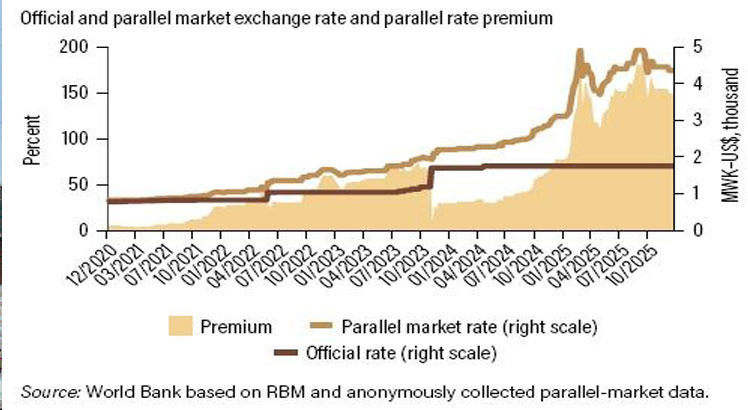
Resultantly, the premium has widened from less than 25 percent to about 157 percent, a situation MCCCI says “effectively operates as a tax on exporters and a subsidy for privileged access to foreign exchange”.
Reads the position paper in part: “Understanding Malawi’s foreign-exchange challenges, exchange-rate unification should be implemented through a phased and well-coordinated reform programme.
“While the transition can involve short-term adjustment costs, these experiences suggest that exchange rate reform is often a necessary foundation for achieving external stability, sustainable growth and private-sector-led economic development.”
MCCCI said the proposed reform can begin with a policy commitment to exchange rate unification and transition to a market-clearing rate, followed by the establishment of a transparent interbank forex market where rates are determined by supply and demand.
The chamber argues that the subsequent phases would remove export surrender requirements and administrative forex allocation systems, which MCCCI argues discourage foreign currency from entering formal channels.
MCCCI is also calling for complementary measures, including fiscal consolidation, tighter monetary policy, stronger revenue administration and controls on money-supply growth to safeguard macroeconomic stability.
Countries such as Egypt, Zambia, Ethiopia, Ghana and Uganda have shown that aligning official exchange rates with market fundamentals helps to reduce parallel market activity, improve foreign-currency availability, encourage exporters and remitters to use formal channels and strengthen investor confidence, according to the chamber.
Reacting to the MCCCI position paper yesterday, economist Milward Tobias said the core problem is weak production of tradable goods and low-value exports rather than the exchange rate itself.
He noted that as a net importer dependent on inputs such as fertiliser, fuel and machinery, Malawi needs an exchange rate that keeps imports affordable to support economic growth.
Tobias, who was an independent presidential candidate in the September 16 General Election, said: “In a situation where problem is less about scarcity and more about where forex is, the black market premium would be low. That is not the case in our situation.”
Mzuzu University economics lecturer Christopher Mbukwa observed that previous attempts to unify the exchange rate have failed miserably and I do see how it would work this time in the absence of promoting export earnings through foreign trade.
He said: “In my opinion, it is a non-starter since the parallel market rate will continue to shift each time there is an attempt for the official rate to move towards it due to forex shortage.
Reserve Bank of Malawi Governor George Partridge, speaking during the consultation session on National Economic Recovery Plan in Lilongwe last week, said foreign currency continues to circulate within the economy, but distortions in pricing and demand have created severe market pressures.