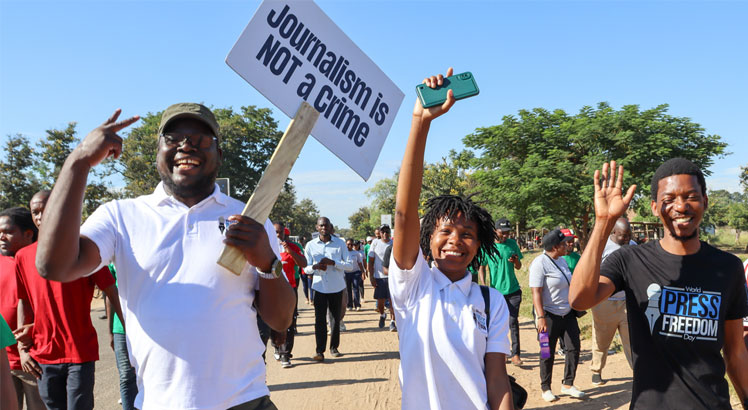
Malawian journalists yesterday joined the global community in commemorating World Press Freedom Day with a general sentiment that the media is “free, but still entangled”, calling on government and other stakeholders to stop meddling.
Coordinated by Media Institute of Southern Africa (Misa) Malawi Chapter, events started with the symbolic Press Freedom March from Chisomo Community Radio to River Mark Lodge in Salima where a debate was held. In the evening, as we went to press, Misa Malawi hosted a gala awards ceremony at Sunbird International Conference Centre in Senga Bay, Salima.
During the debate themed ‘Building an informed nation: Role of the media in promoting economic development’, Misa Malawi chairperson Golden Matonga called on government and other stakeholders to safeguard journalism amid prevailing economic challenges.
He observed that rising production costs, fuel shortages and limited access to foreign exchange are negatively affecting media operations and sustainability.
Said Matonga: “Let us come up with supportive measures, including tax incentives, transparent advertising systems and improved access to public information, to ensure survival of independent media.
“We are not completely free. There are fundamental challenges that the media industry is facing.”
He cited financial pressures in media houses, which at times prevent publication of certain stories.
Matonga also mentioned harassment and intimidation, particularly during elections, detentions, confiscation of equipment and obstruction by security agencies as other threats to media freedom.
One of the journalists working with Chisomo Radio in Salima, Lois Majamanda, said the media landscape remains a delicate ground for growth, stating that journalists face various challenges in their profession.
He also decried interference with journalists when doing their job, calling for change in preserving the profession.
In his contribution, Malawi University of Business and Applied Sciences (Mubas) media trainer Francis Kapiri examined the media’s role in national development, focusing on its influence on public understanding of economic policy and reform, and the state of media freedom.
He said informing, educating and entertaining remain the media’s core mandate, but called on more depth.
Kapiri said journalists must interpret policy and explain it in ways citizens can relate to in their daily lives, noting that technical language continues to exclude much of the public.
“What we are failing is to use creativity. We rely on technical terms instead of simplifying issues and using examples that connect with people’s lived realities,” he said.
Responding to concerns on the implementation of Access to Information (ATI) law, Office of the President and Cabinet (OPC) spokesperson Focus Maganga said government remains committed to improving access to information and supporting press freedom.
He said a Government Engagement Services directorate under the Ministry of Information and Communications Technology now handles ATI-related issues and supports information flow between public institutions and the media.
“We are ready to support. If there are issues to do with ATI, people can reach out,” said Maganga.
Meanwhile, President Peter Mutharika has expressed his administration’s commitment to protecting journalists and promoting a free and independent media.
In a statement to mark the day, the President said press freedom remains a fundamental human right and a cornerstone of democracy as there is need for a vibrant media landscape that allows citizens to access information freely.
“My administration recognises that a government that is not scrutinised is a government that cannot be held accountable. That is why my administration has prioritised creating a safe and open environment for journalists to do their work without interference,” said Mutharika.
Human Rights Defenders Coalition chairperson Michael Kaiyatsa also called for improved conditions of journalists.
He said: “Across Malawi, many reporters work under difficult and precarious conditions characterised by poor pay, irregular salaries, lack of transport, inadequate tools and dependence on meeting allowances simply to survive.
“Some journalists are expected to cover major national events without fuel, internet bundles, or basic field support. This is not only unfair to journalists; it is dangerous to democracy.”
In another statement, National Advocacy Platform chairperson Benedicto Kondowe called on media practitioners to uphold the highest standards of professionalism, including accuracy, fairness and accountability.
The World Press Freedom Day 2026 Global Conference will be held today in Lusaka, Zambia under the theme ‘Shaping a future at peace’, but in Malawi it was commemorated under the theme ‘Press freedom, media viability and economic development’.
World Press Freedom Day originates from the Windhoek Declaration on free press principles adopted by African journalists on May 3 1991 in Namibia. The United Nations Education, Scientific and Cultural Organisation endorsed the declaration before the UN General Assembly proclaimed May 3 as World Press Freedom Day.