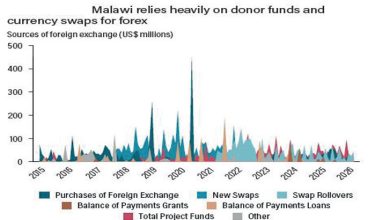
Economists have expressed mixed views on the new foreign exchange controls published by Ministry of Finance and Economic Affairs on Friday to strengthen the country’s dwindling foreign exchange reserves.
The economists were reacting to the controls contained in a Malawi Government Gazette dated December 13 2024 addressed to public institutions, including research institutions and public universities implementing donor-funded projects.
Among others, the institutions will be required to open foreign currency- denominated accounts at the Reserve Bank of Malawi (RBM).

The institutions will also be required to convert 80 percent of their foreign currency receipts into kwacha while non-governmental organisations are expected to convert 70 percent of their forex receipts into the local currency.
Reads in part the notice signed by Minister of Finance and Economic Affairs Simplex Chithyola-Banda: “The bank shall, upon receipt of a credit as funding in a foreign currency-denominated account, apply a mandatory conversion or retention ratio of 80 percent of the total funding at the official buying exchange rate published by the bank while retaining the remaining 20 percent in the foreign currency-denominated account.”
He said anyone who contravenes these regulations will face a fine of “not exceeding K200 million or an amount equivalent to the financial gain generated by the commission of the offence, whichever is greater and imprisonment for up to five years”.
But in separate interviews yesterday, economists gave mixed reactions, with some supporting the measure as a means to retain foreign exchange in the formal market while others expressed concern about its negative effects.
Financial Market Dealers Association president Lesley Fatch in an interview yesterday said the mandatory retentions would negatively affect commercial banks’ balance sheets.
He said: “The prescribed conversions will benefit the RBM, which will be the ultimate buyer of the prescribed conversions.
“This will affect the availability of foreign currency for importers, especially since the law is unclear on whether the RBM will have a mechanism to return the forex to the market.”
But Economics Association of Malawi president Bertha Bangara Chikadza supported the proposal, describing it as necessary to contain the thriving parallel foreign exchange market.
She said: “It is important to note that studies on the availability of foreign exchange indicate that forex is available, but it is either outside the financial sector, or in foreign currenc y-denominated accounts.”
But Bangara-Chikadza, who teaches economics at the University of Malawi, also expressed concern that the move could introduce new distortions in the foreign exchange market.
She suggested that while the law may help the government to access forex already within the system, it will be difficult to attract additional forex from external sources.
In a separate interview, Scotland-based Malawian economist Velli Nyirongo cautioned that the new forex controls could limit foreign direct investment in the country.
He said: “The mandatory conversion and increased reporting requirements could create uncertainty among investors, particularly concerning profit repatriation and access to foreign currency, which could deter future investments.
“The additional administrative burden and reduced operational flexibility could also raise costs for businesses, further discouraging future investments.”
As of October this year, total forex reserves stood at $560.3 million (about K981 billion) or an equivalent of 2.2 months of import cover, according to RBM data.
The recommended minimum cover is three months.