Reserve Bank of Malawi (RBM) has projected 2026 annual inflation at 24.8 percent, slightly down from 28.4 percent last year due to persisting upside risks that undermine easing food Inflation.
RBM indicated the inflation target in its first Monetary Policy Report for 2026 released weeks after the Monetary Policy Committee (MPC) reduced the policy rate from 26 to 24 percent citing easing inflation pressure during the latter part of 2025.
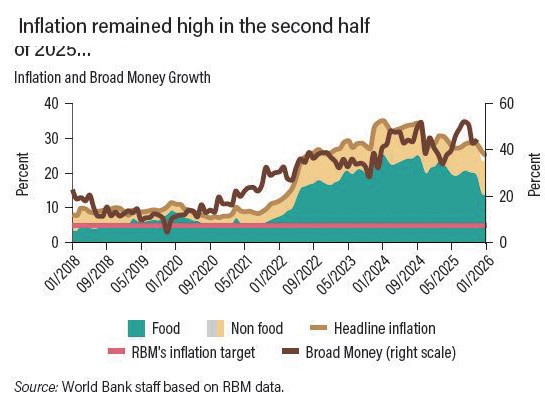
The central bank’s 24.8 percent forecast is an upward revision from the 23 percent it made in October 2025 and significantly higher than government’s 15 percent projection with the bank attributting the adjustment to upside risks that heightened pressure on non food inflation.
Reads part of the report: “The MPC observed that inflation is projected to moderate to an annual average of 24.8 percent in 2026, down from 28.4 percent in 2025, reflecting favourable climatic conditions supporting agricultural production, base effects from 2025, and the continued transmission of earlier tight monetary policy measures.
“Recent inflation developments present a mixed picture. While food price pressures have started to ease, partly reflecting government relief measures, particularly maize imports. Upside risks to headline inflation remain, driven by persistent foreign exchange shortages,and the effect of the recent upward adjustments in fuel pump prices and electricity tariffs.”
Food inflation, on the other hand, is expected to ease, averaging 25.6 percent in 2026 compared to 33.2 percent in 2025, according to the report.
This decline reflects improved food supply supported by favourable agricultural weather conditions and statistical base effects.
“Conversely, non-food inflation is projected to rise slightly, averaging 23.7 percent in 2026 against 20.7 percent in 2025. The increase highlights ongoing cost pressures from fuel, electricity tariffs and indirect taxes,” adds the RBM report.
The RBM’s forecast comes weeks after the Economist Intelligence Unit (EIU) projected that Malawi’s 2026 annual average inflation rate will rise to 29 percent due to the Middle East conflict on fuel prices, among others.
The forecast by EIU, a subsidiary of UK’s Economist Group, also followed the United Nations (UN) and the World Bank projections that Malawi recent inflation gains could be lost due to the impact of the ongoing US- Israel-Iran war.
Reads part of the report: “The EIU projects that inflation will rise slightly to 29 percent in 2026 and average 28.6 percent over 2026-29, significantly higher than the previous forecast of 16.6 percent.”
In separate interviews, analysts are cautiously optimistic that moderate food prices could ensure inflation remains below last year’s levels.
University of Malawi economics lecturer Edward Leman said that overall, much will depend on the trajectory of global fuel prices, exchange rate stability and domestic food supply conditions.
“There are reasons for cautious optimism. Malawi’s inflation is predominantly food-driven and a favourable agricultural season could help ease pressures, potentially bringing the annual average slightly below last year’s 28.4 percent,” he said.
Consumers Association of Malawi executive director John Kapito said the speculative increases in global fuel prices will have a negative impact on economic growth targets and inflation projections, but the impact could be slightly cushioned by food prices.
“The impact will depend on the volume of the increases. However, assuming there will be any fuel increases, we hope much of it will be offset by lower food prices,” he said.
Meanwhle, the World Bank and UN have expressed fear that increased costs of fertiliser and fuel due to the impact of the ongoing war poses fresh challenges on the local economy.
In a notice dated March 26 2026, the Bretton Woods institution said it is working with governments, the private sector, regional partners and other stakeholders to find solutions to the new set of challenges.
Economics Association of Malawi president Bertha Bangara-Chikadza is quoted by The Nation as having said that a surge in fuel prices was likely to subject countries that rely on imports such as Malawi to inflationary pressures on essential goods, transport and manufacturing.
On the other hand, RBM spokesperson Boston Maliketi Banda is on record as having said to contain the expected inflationary pressures, the central bank is ready to deploy appropriate monetary policy tools, including liquidity management and maintaining appropriate interest rate stance.