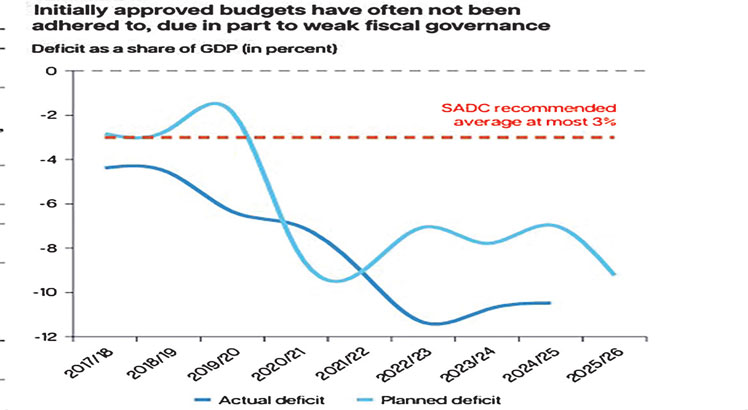
The Malawi Government opened the 2026/27 financial year that started on April 1 with a K106.5 billion fiscal deficit, almost two-thirds lower than the K300.0 billion recorded during the corresponding period last year.
However, economists have cautioned that the improvement may reflect spending restraint rather than a lasting strengthening of public finances.
Latest figures contained in the Reserve Bank of Malawi (RBM) Monthly Economic Report show that central government recorded K480.5 billion in revenue against K587.0 billion in expenditure during the review period, resulting in the lower deficit. The outturn also compares favourably with the K254.2 billion deficit recorded in the previous month.
The narrower financing gap was largely driven by a sharp contraction in expenditure. Government spending fell by K301.6 billion to K587.0 billion, mainly due to a K306.6 billion decline in recurrent expenditure to K498.1 billion. Development expenditure, however, increased modestly by K5 billion to K88.9 billion.
At the same time, total revenue declined by K153.9 billion from the previous month to K480.5 billion as both tax and non-tax collections weakened. Tax revenue fell by K134.2 billion to K380.2 billion, while non-tax revenue declined by K47.1 billion to K21.2 billion. The decline was partly offset by higher grant inflows, which rose by K27.5 billion to K79.1 billion.
Scotland-based Malawian economist Velli Nyirongo said the lower deficit was an encouraging development but warned against interpreting a single month’s performance as evidence of successful fiscal consolidation.
“A lower fiscal deficit at the start of the 2026/27 financial year is a positive development, but it is too early to conclude that Malawi has achieved meaningful fiscal consolidation,” he said.
Nyirongo observed that sustainable fiscal consolidation required consistent reductions in borrowing supported by stronger domestic revenue mobilisation, disciplined expenditure management and improved economic activity.
“In this case, the narrower deficit appears to have been driven largely by lower government spending rather than stronger revenues. While expenditure control is important, delaying or reducing spending is not the same as addressing the structural causes of persistent fiscal imbalances,” he said.
Nyirongo noted that declining tax and non-tax revenues suggest economic activity remains subdued, limiting government’s ability to finance public services and development programmes without continued borrowing.
Centre for Social Concern economic governance officer Agnes Nyirongo also welcomed the narrower deficit but said the quality of fiscal adjustment would ultimately determine whether it benefits the economy and ordinary Malawians.
“The improvement should be interpreted cautiously because it has been driven mainly by reduced government expenditure rather than stronger domestic revenue collection,” she said.
Nyirongo warned that while expenditure restraint can improve budget balances, prolonged spending cuts could undermine implementation of development programmes if they affect priority sectors.
She said: “If spending cuts are achieved through improved efficiency, elimination of waste, stronger procurement systems and reduced leakages, then the outcome is positive.
“However, if expenditure reductions result in delayed development projects, shortages of medicines, underfunded schools or weakened social protection programmes, then ordinary Malawians will bear the cost of fiscal adjustment.”
Both economists said government should complement expenditure discipline with measures to broaden the tax base, strengthen tax administration, improve compliance and reduce wasteful spending.