The Malawi Confederation of Chambers of Commerce and Industry (MCCCI) says businesses should brace for prolonged inflationary pressures as global energy volatility and supply disruptions persist, warning that Malawi’s recent inflation slowdown may not ease operating costs in the near-term.
In its recent inflation bulletin, MCCCI has urged firms to continue planning for higher operating costs as energy market volatility and supply chain constraints are likely to prolong price increases, particularly in sectors exposed to fuel and logistics shocks.
Reads the bulletin in part: “Businesses should remain vigilant in anticipating sustained inflationary pressures worldwide.
“This environment necessitates strategic planning and adaptive risk management as inflationary dynamics are expected to remain elevated across both advanced and emerging economies.”
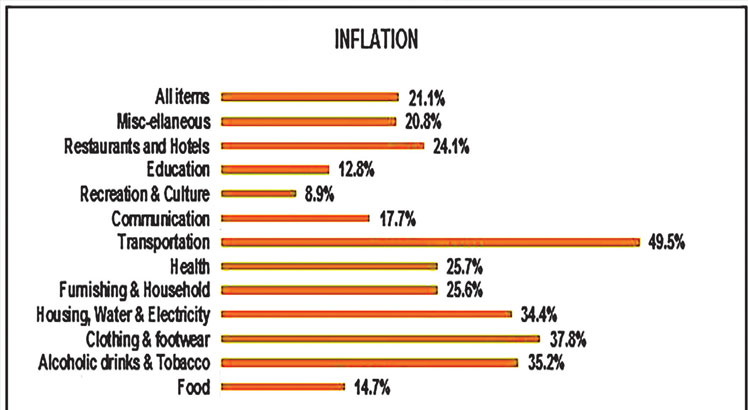
Published National Statistical Office data show that Malawi’s year-on-year inflation rate declined to 21.1 percent in June 2026, a 2.3 percentage point reduction from the 23.4 percent recorded in May 2026.
The moderation was driven largely by a notable easing in food inflation, which fell to 14.7 percent in June from 17.6 percent in May while non-food inflation registered a marginal decline to 32.1 percent compared to 33 percent in May.
During the period under review, transportation recorded the highest year-on-year inflation, registering 49.5 percent followed by clothing and footwear at 37.8 percent and alcohol and tobacco at 35.2 percent.
In contrast, the lowest inflation rates were observed in recreation and culture at 8.9 percent, education at 12.8 percent and communication at 17.7 percent.
Despite the moderation, Malawi’s inflation remains well above that of regional peers, with Mozambique recording 7.5 percent, Zambia 6.5 percent, Tanzania four percent and South Africa about three percent.
MCCCI says some neighbouring countries have contained inflation through stronger macroeconomic policies, stable currencies and greater domestic production capacity, making them more resilient to external shocks.
In an interview, Reserve Bank of Malawi (RBM) spokesperson Boston Maliketi Banda said the central bank sees disinflation process being sustained should food prices continue decreasing as expected, pledging the central bank’s commitment to sustain the momentum.
However, Centre for Social Concern economic governance officer Agnes Nyirongo warned that Malawi could experience disinflation without affordability, a situation where inflation numbers improve on paper, but households continue to struggle.
“What is key is to ensure that inflation is kept at a manageable level,” she said.
In its 2026 Monetary Policy Report, RBM projected annual inflation rate at 24.8 percent, down from 28.4 percent in 2025, citing persistent risks that could offset easing food prices.
Malawi’s year-on-year headline inflation continued to ease in the first half of this year, averaging 23.6 percent compared with 28.9 percent the previous year, according to the National Statistical Office (NSO).
The NSO data further show that June inflation rate, which has dropped to 21.1 percent from 23.4 percent, makes it the lowest inflation in four years, driven largely by easing food prices following fresh harvests, particularly maize, which carries significant weight in the inflation basket.
RBM spokesperson Boston Maliketi Banda is quoted as having described the decline in inflation as “inspiring” and pledged the central bank’s commitment to sustain the momentum.
He said: “This development is encouraging indeed. We observe that the slowing down in inflation has largely been influenced by declining food prices.
“We see this disinflation process being sustained should food prices continue decreasing as expected.”
RBM Deputy Governor for operations Kisu Simwaka, writing on his Facebook page, argued that single-digit inflation is achievable with effective policy coordination between the central bank and government.
“Malawi’s inflation problem has a solution. The economy is not an outlier. Other countries in the region have shown that single digit can be achieved and sustained,” he wrote.
Local businesses are facing a number of challenges largely compounded by shortage of foreign exchange, which continues to affect companies’ ability to import raw materials to expand production.