Smart women sweat, reads the message on Joyce Kafantaye’s T-shirt.
All day, the casual wear absorbs sweat as the 40-year-old woman, from Pomba Village, Traditional Authority Ngabu in Chikwawa, swings a hammer mightily to break rocks for sale.
“My family depends on this,” she says, splitting a granite rock. “There is no free lunch.”
Kafantaye has been sweating it out from 6am to 6pm since 2005.
“I don’t want my children to starve,” she declares.
Her tenacity mirrors a woman-led resistance to chronic hunger and poverty that unfolds all day around a crocodile-infested burrow in her village.
At least 50 women dare the rock-splitting business along the pitted mouth of the vast dam where Mota-Engil sourced rocks for the Chikwawa-Bangula-Nsanje M1 section.
“Smart women contribute to their families’ well-being,” she states. “Dependency only stresses our men, who are doing their part against the odds.”
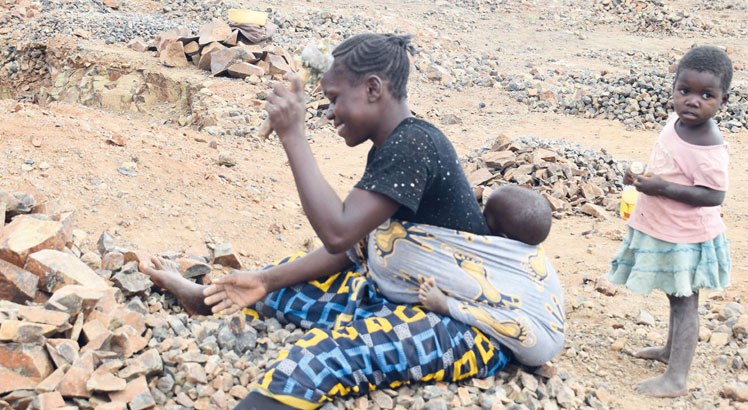
Kafantaye earns K5 000 to K10 000 a day, enough to buy two basinfuls of maize and some fish for her family of six, she says.
Her teenage daughter, Eliza, lifts the rocks from the perilously steep sides of the deep excavation, a breeding ground for malaria-transmitting mosquitoes and roaming reptiles.
“I’m teaching her the value of hard work. If you rely on men for small things such as soap, phone airtime or internet bundles, you will become their slave,” says the mother of four.
No sweet without sweat
Her zeal also inspires her toiling daughter’s peer—Tiyanjane Masamba, a 22-year-old single mother who has been crushing rocks since 2019.
She quit school last year to give birth and care for her baby.
“I love money,” says Masamba. “The more you sweat for it, the sweeter it becomes.”
She warns the youth against sex for freebies, which trap many into risky sexual webs that fuel unintended pregnancy, child marriage, school dropouts and sexually transmitted infections, including HIV.
Masamba argues: “People find money in various ways that I cannot manage. Some require skills and others require risk-takers.
“I cannot get employment due to low education and lack of skills, but this doesn’t mean I should resign into dependency and transactional sex. I once thought a man could solve all my problems, but it was a big mistake.”
No gumboots. No gloves. No face masks. Masamba crushed her index finger, which she uses to whip dust off her eyes, nose, ears and throat.
The heavily pitted zone exposes environmental, health and occupational hazards associated with excavations left gaping after engineering projects.
Two weeks ago, the High Court of Malawi ordered CR20 to pay Samuel Tembo K237 million after four children, aged five to 15, died in a similar pit following the construction of the taxpayer-funded Marka-Nsanje Road in the Shire Valley.
The court heard that the pit had no fencing, barriers, warning signs or any physical demarcation.
“It stands that a reasonable contractor would not have left the burrow pit in such a hazardous state,” Justice Allan Muhome ruled.
The same applies to Mota-Engil’s pit near Ngabu Trading Centre, save for sporadic warnings in English language that adorn some rocks in the Sena-speaking r community.
‘You cannot leave early’
During the visit, we saw children walking along its perilous perimeter, as women were hard at work.
“We haven’t had any drowning case because children are afraid of crocodiles brought by floods induced by Cyclone Ana in 2022,” says Edna Thawani, 47. “Since the storm, I have spotted two—a giant and a small one.”
She found the burrow pit already swamped in 2014 when her family fled perennial floods in Nkhwangwa, T/A Ngokwe, along the Shire River.
“My husband is a builder and the little I make here keeps us going,” says the mother of four.
The rock crusher sell need eight scoops to fill a wheelbarrow. Each measure costs K200.
Mercy Amon, from Tsabeta Village nearby, works “as long as it takes to sell a quarter bucket or two”.
“You can’t leave early,” she says. “You don’t know when a customer would come.”