Commercial State-owned enterprises’ (SOEs) capacity to service debt obligations as they fall due remains the biggest challenge, a recent risk assessment of the parastatals show.
The assessment, done from years ending March 2022 through March 2024, show that collectively, the 10 SoEs have debts in excess of K495 billion and that the risk could become more manageable with some policy interventions.
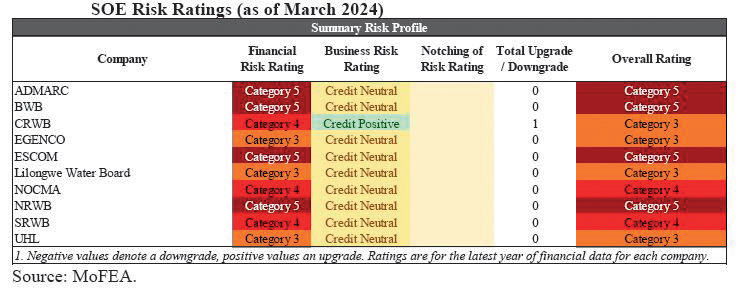
Out of the 10 SOEs assessed, there was no SOE that was rated category one and two.
However, 40 percent were within category three and category four comprised 20 percent of the sampled SOEs, respectively. Category five of the SOEs constituted 40 percent of the sample.
Category one indicates the lowest risk and category five indicates the highest risk.
According to the SOE Credit Risk Assessment Report for Commercial State-Owned Enterprises published last week, the majority of the SOEs were assigned category four, reflecting their financial difficulties and limited debt payment capacity, which, in turn, expose the government to higher fiscal costs and risks stemming from SOEs.
Reads the assessment in part: “High operating and administrative costs, delays in financial reporting or audit submissions, weak revenue collection and debt recovery systems, frequent pipe bursts, leaks, and service disruptions, high non-revenue water due to leakage and illegal connections, outdated treatment facilities that cannot meet current demand or standards, inadequate monitoring of distribution systems, illegal connections and tampering with meters were the primary cause of the risk rating in most cases.
“The risk could become more manageable in the case of some policy interventions such as timely approval of cost recovery tariffs, pre-financing social obligations and potentially setting debt ceilings for some SOEs.”
According to the data, Escom Limited’s present value of the government’s total exposure is K152 billion while the present value of expected losses of the government from Escom’s guaranteed and on-lent debt totalled K98 billion as of March 2024.
For Electricity Generation Company (Malawi) Limited, the present value of the government’s total exposure is K3 billion while the present value of expected losses of the government from Egenco’s debt totalled K72 million as of March 2024.
For National Oil Company of Malawi, the present value of the government’s total exposure is K192 billion while the present value of expected losses of the government from Nocma’s on-lent debt totalled K34 billion as of March 2024.
As for Blantyre Water Board, on the other hand, the present value of the government total exposure is K24 billion while the present values of the expected losses of the government from its facilities stand at K14 billion.
Lilongwe Water Board has a present value of the government total exposure of K47 billion while the present values of the expected losses of the government from LWB’s facilities stand at K5 billion as at March 2024.
For Northern Region Water Board, the present value of the government’s total exposure is K71 billion while the present value of expected losses of the government from the firm’s guaranteed and on-lent debt totalled K42 billion.
The present value of the government’s total exposure is K45 billion in Admarc Limited while the present value of expected losses of the government from Admarc’s guaranteed debt totaled K27 billion as of March 2024.
In an interview, corporate governance commentator Jimmy Lipunga observed that a turnaround for SOEs is possible depending on their level of commitment to corporate governance best practices.
He said: “Developing strategies is often not a difficult task; what is often lacking is appropriating sufficient authority to boards and management to deal with the constraints and risks in a timely manner.”
On her part, Economists Association of Malawi president Bertha Bangara Chikadza earlier said most SOEs have a working capital reliance as they use loans to cover operational costs rather than productive investments, indicating chronic cash flow problems.