Tawonga Nyirenda:Turning organic waste into valuable resource

Agriculture is Malawi’s main economic stay which continues to attract innovations to improve productivity and food security.
Apart from technology capitalising on agricultural mechanisation to achieve food productivity, there is a young woman in Lilongwe, Tawonga Nyirenda, who has taken a different route to make a difference in the country’s agricultural sector.
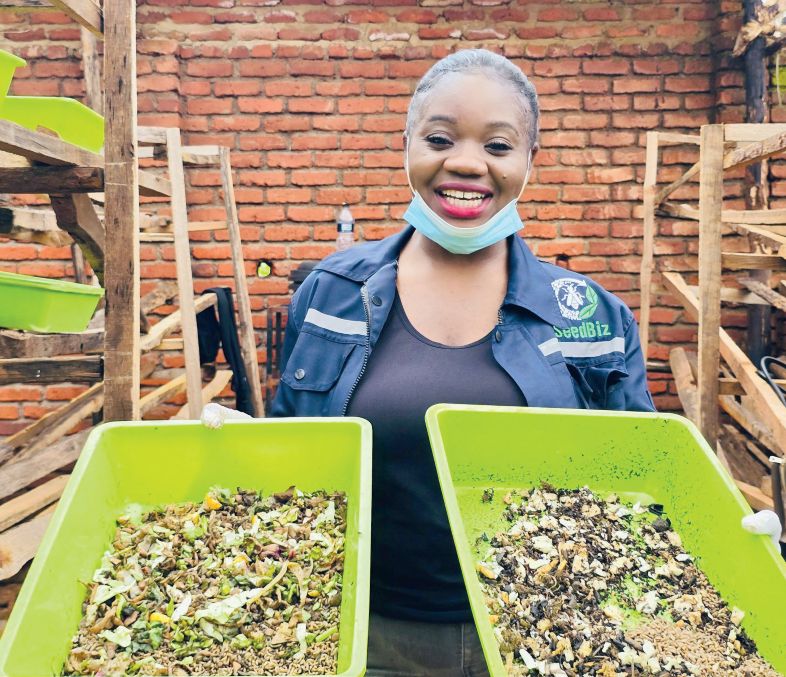
She has embraced an innovation called Black Soldier Fly to make affordable nutritious feed for livestock and fertiliser.
Tawonga, 34, is founder and managing director of SeedBiz, a company located in Area 38 (along the By-pass road) in Lilongwe, which is transforming organic waste into livestock feed and fertiliser.
Basically, Black Soldier Fly innovation collects and turns waste into biomass that is 40-50 percent protein and 35 percent fat.
This is used to feed different livestock such as poultry, pigs and fish.
The by-product is called frass, an organic fertiliser which is an input used by small holder farmers to improve their crop yields and restore soil health.
“What makes our innovation unique is that it is a community-led circular economy model,” said Tawonga.
She founded SeedBiz in 2022 and formally registered it in 2023.
She said her inspiration came from high cost of livestock feed which was affecting many farmers and their economic activities.
“Having witnessed how high livestock feed costs were limiting farmers’ ability to earn sustainable profits, I realised that unless production costs were reduced, many farmers would struggle to maintain their livelihoods. This motivated me to create a solution that not only provides affordable, high-quality feed, but also turns organic waste into a valuable resource, supporting farmers, creating jobs and contributing to a cleaner, more sustainable environment,” she said.
Since 2023, Tawonga said, SeedBiz has been operating at the intersection of food security, climate action and circular waste management; transforming organic waste into sustainable livestock feed using Black Soldier Fly larvae.
She said the Black Soldier Fly–based feed provides a cost-effective alternative to conventional livestock feed while reducing organic waste and promoting sustainable food production.
Tawonga described the reception of the Black Soldier Fly innovation as positive.
“To date, we have served over 200 farmers, supporting improved livestock productivity and environmentally responsible farming practices. SeedBiz has created 12 jobs in management, waste collection and feed production, while also generating indirect income opportunities across the agricultural value chain,” she said.
Tawonga went to Wukani and Viphya primary school in Mzuzu.
She then went to Mary Mount Girls Secondary School in Mzuzu.
Tawonga went through the corridors of Blantyre International University for her undergraduate degree in Tourism and Hospitality Management.
She proceeded to the University of Pretoria and Tshwane University of Technology where and MSc in tourism management respectively.
Tawonga expressed gratitude for empowering other people, especially women, through her innovation.
“One thing I love about this innovation is its accessibility and transformative potential for other women. Black Soldier Fly farming allows women to actively contribute to food security starting right at household level, using organic waste generated within their own homes to produce feed for poultry or livestock.
“This does not only create opportunities for income generation, but also improve household nutrition through reliable protein sources. I strongly believe that empowered women are central to building resilient food systems and businesses such as SeedBiz demonstrate how women can lead practical, community-driven solutions that strengthen both livelihoods and food security,” she explained.
Tawonga added that she embraced the Black Soldier Fly innovation to offer solutions to the ever-rising costs of livestock feed, over-reliance on fish meal and soybean feeds, which deplete natural resources and the challenge proper waste management, especially in major cities.
Asked about the impact of the Black Soldier Fly innovation, this what Tawonga said:
“Overall, our impact lies in demonstrating that locally driven circular economy solutions can simultaneously address food security, climate action and sustainable waste management challenges facing Malawians today.”
Tawonga loves researching on different topics, thus she likes reading a lot.
Other than that, she spends her time with her family which she said helps her to unwind and provides her with the much-needed therapy that keeps her thriving.
She is the first born in a family of three girls. Tawonga said she grew up in a loving home where her parents were and are still hard workers.
“I am a hard worker, just like my parents. To date, my parents still raise poultry among other things, the same poultry business that took my siblings and I through school and ultimately inspired my love for poultry farming. So in summary, I was raised by prayerful, humble, loving and hardworking parents. I owe my character to their upbringing,” said Tawonga.
However, she said growing up as a girl in Malawi taught her the importance of resilience, creativity and using the resources around her wisely.
“I learned early that opportunities are not always handed to you. You have to be resourceful and proactive to create them. These lessons shaped my upbringing by instilling a strong sense of independence, problem-solving and vision beyond my immediate surroundings.
“This inspired me to pursue SeedBiz, where I could turn simple ideas into impactful solutions that benefit not just me personally, but my community and also have the potential to reach people globally,” said Tawonga.
In the next five years, she envisions scaling SeedBiz into a fully operational venture capable of processing seven-10 tonnes of organic waste daily, converting it into about two tonnes of sustainable livestock feed and about four tonnes of organic fertiliser each day into sustainable livestock feed and organic fertiliser.
Tawonga believes they will be able to divert abourt 3 000 tonness of organic waste from landfills annually, significantly reducing environmental pollution while advancing circular economy solutions.
“Our long-term goal is to build resilient and sustainable food systems in Malawi and beyond,” she said.