Every day in Nancholi, Blantyre City, sunrise is welcomed with foot thuds of early risers heading to communal water kiosks can be heard.
Women carrying empty buckets walk along dusty footpaths while others join forming lines at the communal water points, waiting for their turn to collect the day’s supply as some head for streams stuffed with waste.
In Ndirande Township in the same city, the scene is almost similar. Long queues form in public kiosks as residents from populous neighbourhoods search for water.
By noon, the queues begin to disappear.
But behind the morning rush is a deeper struggle as thousands of Malawians, including the commercial city’s residents, cannot afford the rising cost of clean water.
Talent Kaisi from Nancholi understands the struggle.
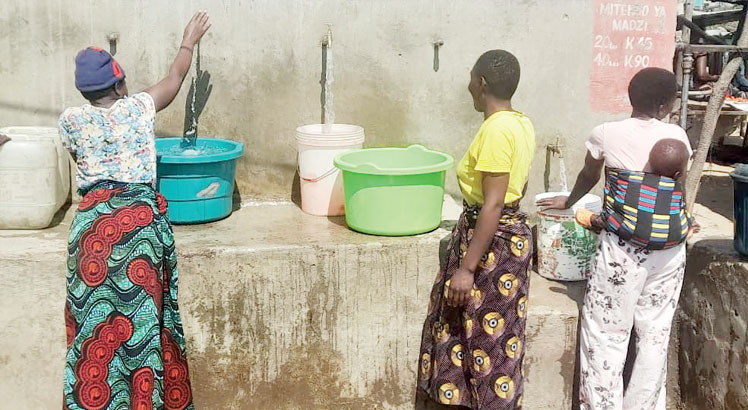
She recounts: “For years, the cost of water in kiosks supplied by Blantyre Water Board [BWB] was beyond the reach of many poor households that they are supposed to serve.
“When we did not have money, we had no option but to get water from stinking streams. We knew the water was not clean or safe, but we had to choose between buying food and buying water.”
Access to free water
Chimire II block leader Esnart Maunde said Cyclone Freddy, which induced Soche Hill mudslides that killed at least 100 people in Blantyre in March 2023, worsened the water situation.
The disaster affected about 2.5 million people across the Southern Region, killing 679 and 537 are still missing.
The devastating mudslides and floods shattered water supply, including boreholes, hand pumps and piped systems across the 13 affected districts.
“Since the disaster struck, water remains one of the biggest challenges. Many families have continued struggling over the years,” she says.
In Blantyre’s low-income communities, the cost of water became a taxing daily burden.
“Some households turned to unsafe sources, increasing the risk of waterborne diseases, including cholera,” Ndirande Malabada Water Users Association (WUA)chairperson Shaibu Imam.
A K105 million programme by BWB, with support from the World Bank, seeks to close the gap as Blantyre has been hit the hardest by the cholera outbreak, currently on the wane.
Vulnerable households in the city, including cholera hotspots such as Chilomoni, Manase and Mulunguzi, have been accessing free water through communal kiosks since last month.
The utility reports that access to safe water has since expanded from about 300 000 people to 500 000.
“We want to increase access to people who cannot afford regular water charges,” BWB assistant public relations officer Peter Chilenga told journalists during a tour of kiosks in Manje, Ndirande and Soche.
Blantyre has about 900 communal water kiosks, but only 600 kiosks are benefitting from the free water programme.
The WUAs, which manage the kiosks in partnership with BWB, identify vulnerable households eligible to access safe water.
Maunde says the project will help make cholera history in the city and her area.
For the past five years, Blantyre has become an epicentre of the deadly diarrheal disease caused by a breakdown in access to safe water, sanitation and hygiene.
“People were relying on dirty water sources because they could not afford piped water. When families are struggling, they think about food first. They believe water can be found freely from streams,” she says.
Cholera hotspot
Blantyre was the hotspot of Malawi’s deadliest cholera outbreak, which began in the wake of Cyclone Ana in March 2022, spreading to all 29 districts where it killed 1 766 of over 58 000 confirmed patients by mid-2023
The city has recorded 59 cholera cases and eight deaths since January 2026.
The disease claimed three lives in Chimire, including one from Maunde zone.
“Now that people can access clean water free of charge, we hope cholera will disappear for good,” she says.
However, the free water programme has limits. BWB has given each kiosk a specific quota, meaning free water supply ends once the allocation is exhausted.
“The water is also strictly for household use and cannot be used for irrigation, construction, livestock or collected in containers exceeding 40 litres,” says Chilenga.