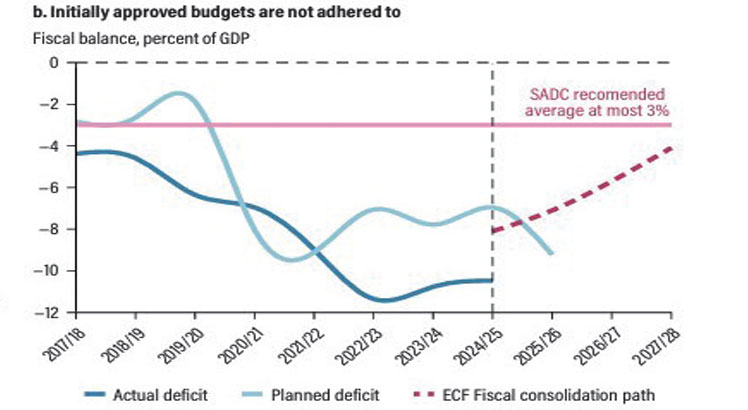
Malawi’s K8 trillion 2025/26 National Budget has posted a deficit of K1.2 trillion in the first quarter, which is half of the planned K2.47 trillion annual deficit, according to data from the Reserve Bank of Malawi.
This shows that the 2025/26 fiscal year has started with huge government
spending, a situation economic analysts fear will force the Treasury into increased borrowing likely to surpass the K2.3 trillion benchmark provided in the current budget.
RBM data contained in the Financial and Economic Review for Second
Quarter (Q2) of 2025 show that total revenues for the quarter from April 1 to June 30 stood at K1.1 trillion against expenditures at K2.3 trillion, creating a K1.2 trillion deficit.
Reads part of the report: “Total revenues during 2025Q2 were estimated at K1.1 trillion. This represented a 14.2 percent increase from K974 billion recorded during the preceding quarter and a 17.1 percent growth from K949.9 billion collected in a corresponding quarter of 2024.
“The outturn followed an 8.2 percent rise in tax revenue collections to K895.1 billion, a 47 percent increase in grant collections to K190.9 billion and a 59.5 percent expansion in non-tax revenues to K26.4 billion.”
On the other hand, total government expenditures increased by 59.1 percent to K2.3 trillion during the quarter under review following a 62 percent surge in recurrent expenditures to K1.8 trillion and a 46.7 percent rise in development expenditures to K480.7 billion.
Among others, RBM has attributed the rise in the budget deficit to the decline in both tax and non-tax revenues and some expenditure pressure which intensified in May.
During the said month, revenues decreased by K86.7 billion to K348.4
billion from K435.1 billion in the preceding month while expenditures increased by K82.8 billion to K648.4 billion.
In the quarter under review, tax revenues were recorded at K895 billion driven by corporate tax at K252 billion, values added tax K236 billion, pay as you earn tax at K188 billion and import duty K104 billion.
In an interview on Monday, economic consultant Booker Matemvu said the situation risks the projected budget deficit to balloon while threatening the public debt to continue piling which could result in economic recession if not handled properly.
He said: “This means that the government is spending more than it is collecting. Essentially this leads to continued borrowing on the local and foreign markets to finance the insatiable appetite to spending. It also calls to question the budget deficit assumptions in the budget.”
He said if the deficit figures are off sharply like “we have observed above, it means fiscal discipline is off course and the economy, if not treated quickly, might be heading to a recession”.
Economics Association of Malawi acting president Bertha Bangara-Chikadza said yesterday that the current trends in the budget deficit indicate that government spending is consistently outpacing revenue, creating an unsustainable financial situation.
“If this trend continues, Malawi risks not only exceeding its annual deficit target, but also exacerbating inflation and deepening its debt crisis.
“It is worth noting, however, that higher deficits during election years are not uncommon. Historical data reveals that deficits in election years have averaged over 70 percent higher than those in non-election years, highlighting the cyclical nature of fiscal pressures during such periods.
Centre for Social Concern economic governance officer Agnes Nyirongo said huge recurrent expenditure and low development expenditure threatens to derail long-term poverty reduction efforts.
“If we continue increasing recurrent costs, largely salaries and administrative overheads while cutting investments in health, education and infrastructure, we are simply locking ourselves into a low-growth, high-inequality future,” she said.
Economic statistician Alick Nyasulu is quoted as having cautioned that rising government deficits coupled with the foreign aid and debt squeeze, will force the government to borrow more from the domestic market.
Treasury projected that the fiscal deficit will be primarily financed through domestic borrowing amounting to K2.33 trillion and foreign borrowing of K145.78 billion