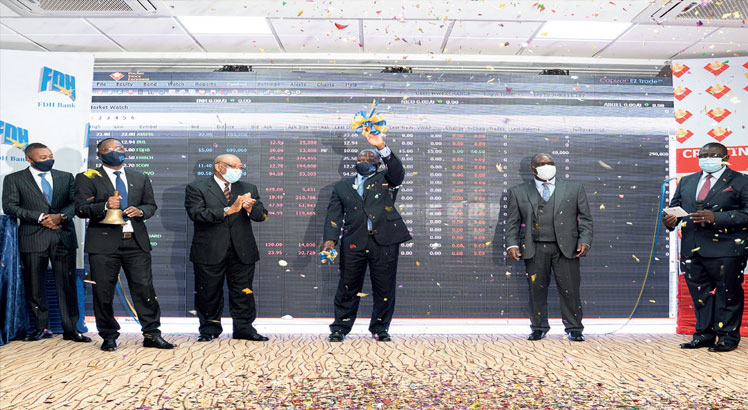
The 16-counter Malawi Stock Exchange (MSE) closes 2025 tomorrow on a high note, with the overall market measure more than doubling to 619 000 points and market capitalisation hitting K33 trillion.
On paper, this was a remarkable year for one of the smallest stock exchanges in Africa. But beneath the rally lies a more complicated reality driven by high inflation, deep currency instability and thin liquidity that raises fundamental questions about what the numbers actually represent.
A rally that outpaced the economy
The MSE opened the year steadily, but gathered pace through the second quarter, then recorded explosive growth in the third.
Banking sector stocks led the rally supported by strong earnings, high dividend expectations and increased institutional allocations.
The Malawi All Share Index (Masi), the overall measure of market performance, rose from 280 000 points in January to about 385 000 in June, before rocketing past 535 000 in September and then 619 000 in December.
In an interview, Market analyst and investor Benedicto Nkhoma said the surge reflected both fundamentals and market conditions.
“Most of the listed companies in the financial sector have performed well above inflation. Increased money supply, stellar half-year results and limited availability of quality assets pushed investors toward equities,” he said.
But inflation-adjusted performance tells a more cautious story. Throughout 2025, inflation hovered between 27 and 31 percent, eroding real purchasing power even as nominal share prices rose.
The weak macro-economic environment pushed investors towards stocks not out of confidence in growth, but as a defensive shield against value erosion.
At the same time, the kwacha’s instability worsened. The official exchange rate remained stuck at K1 751 to the dollar, but the parallel market rate climbed to as high as K4 500, giving diaspora investors more kwacha per dollar and making MSE assets appear comparatively cheaper.
Nkhoma, a former investment banker, said the premium mattered, adding: “The depreciation in the parallel market could have played a part as some investors from the diaspora changed to have more kwacha to buy ‘cheaper’ assets.”
How individual counters performed
The 2025 rally was highly concentrated. A handful of heavyweight counters pulled the Masi upward while several others lagged behind.
Standard Bank plc, one of the blue-chips, dominated headlines after executing a five-for-one share split in August that reduced its trading price from about K12 000 to K2 140 per share.
Standard Bank plc officials called the share-split a huge milestone, saying the revised price “significantly lowered the barrier to entry and strengthened financial inclusion”.
The bank’s share price continued to rise post share-split and remained one of the top contributors to market capitalisation growth.
National Bank of Malawi plc also posted strong gains throughout the year, largely driven by robust profits and attractive dividend prospects. Its performance made it a favourite for pension funds seeking defensive positions.
Equally, FMB Capital Holdings plc, which owns First Capital Bank in Malawi, Zambia, Zimbabwe, Mozambique and Botswana, delivered some of the most dramatic movements on the exchange, especially in September and November.
FMB Capital Holdings plc price jumps helped propel the Masi to record highs, reflecting both strong earnings expectations and speculative interest.
Illovo Sugar (Malawi) plc retained its place as the market’s dividend leader, consistently offering yields of 17 to 19 percent. The sugar manufacturer’s share price remained stable, but upward-trending, reflecting strong export performance and reliable cash flows.
Investors looking for real returns found Illovo among the few counters that outpaced inflation.
In contrast, the telecommunications counters struggled. Airtel Malawi plc posted steady declines weighed down by revenue uncertainty and regulatory pressures. TNM plc fared no better, trading at some of the lowest valuations on the market.
Other counters such as Nico Holdings plc, Press Corporation plc, Sunbird Tourism plc and Icon Properties plc delivered moderate but steady growth, contributing stability rather than momentum to the index.
Market driven by institutions
Behind the surge was a structural imbalance. Daily turnover remained low, often under K1 billion despite market capitalisation rising by more than K20 trillion.
MSE chief operating officer Kelline Kondowe observed the shifting patterns within that imbalance.
She said: “Retail investors contribute a significant proportion of the number of transactions being registered.
“Institutional investors still take the lead in value, but we can see retail investors taking up a larger portion of the transaction values as well.”
Stockbrokers Malawi Limited equity analyst Kondwani Makwakwa cautioned that price movements were not always reflective of economic fundamentals.
“The gains partly reflect company fundamentals, but they do not fully match the wider economic situation. Investors were using the MSE as a safe place to preserve value from inflation and currency weakness,” he said.
The pattern is consistent. Real-sector growth remained sluggish, inflation stayed high, the fiscal deficit widened and foreign exchange shortages persisted. Yet equities soared.
Standard Bank share split: A bright spot for inclusion
The year’s most transformative event for participation was Standard Bank’s share split.
MSE CEO John Kamanga said the move “makes high-valued shares affordable to low-income earners and helps improve liquidity”.
Investors widely welcomed it, with finance expert Brian Kampanje calling it a win for minority shareholders seeking to “earn substantial income”.
Looking ahead: Can the rally hold?
The MSE closes the year with momentum, supported by strong corporate earnings and cautious investor optimism.
But risks remain. The growing disconnect between market performance and economic fundamentals, severe currency distortions, high inflation and thin liquidity pose challenges to sustaining the rally.
As the year closes, the key question is whether the MSE’s surge represents the first step toward deeper capital-market development.