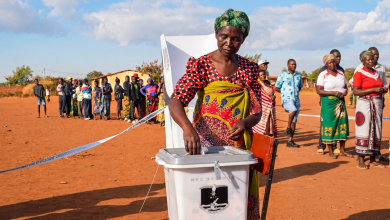
Thomas Tsoka, 46, of Mkuziwaduka Village, Traditional Authority Mponela in Dowa, switched to irrigation in 2020 following failed crops due to unpredictable rainfall.
“I grew crops once a year and I had to wait for the rains the following season to till the land again,” he says.
The father of four is among 500 farmers who depended on rain-fed agriculture, which fuelled perennial hunger and poverty.
the youth. | Kondwani Kandiado
Dry spells and flooding frequently thwart rain-fed food production amid climate change.
“We were at the mercy of unpredictable weather,” he says. “We prayed for good rains, but our yields kept dwindling due to erratic rainfall.”
Environmental degradation and climate change have worsened the vulnerability of subsistence farmers whose livelihoods hinge on rain-fed agriculture.
However, Tsoka’s group gets surplus yield for sale as they grow crops three times a year.
Churches Action in Relief and Development (Card) established Mkuziwaduka Irrigation Scheme under the Agroecology for Communities’ Transformation and Integrated Value Chains Enterprise Project, funded by Bread for the World.
The scheme at the foot of Chiponde Hills uses water from the overflowing Kapotera River.
Card installed solar-powered water pumps for climate-smart agriculture practices.
It also gave them business management skills, which Tsoka described as a revelation.
“We make money throughout the year and exploit their natural resources sustainably. The proceeds improve our livelihoods and income,” he says.
Concurring, Tamara Tembo says she is diversifying her income sources.
“I sell fresh maize, beans and tomatoes every three months, making at least K3 million. I pay school fees for my children and run a grocery and barber shop,” she says.
Patrick Banda is a proud breadwinner, thanks to irrigation.
“Had I started this 10 years ago, I could have been financially free by now. I make about K2.5 million from tomatoes and maize,” he says.
The farmer has bought two motorcycles that carry travellers at a fee in his rural community.
“The kabaza business gives me K30 000 a day,” he says.
Tsoka has harvested about 14 700 cabbages valued at about K5 million.
“Vendors from Lilongwe come to buy from me and the expected earnings can support my family for the next three months,” he states, transplanting tomatoes to sustain his cash flow.
Since 2021, Tsoka has acquired eight cows and built a five-bedroom house roofed with corrugated iron sheets.
Card project assistant Lennia Kandodo is pleased to see farmers’ livelihoods improving.
She says: “It is amazing to see people achieving food and nutrition security amid the effects of climate change.
“Clearly, they are empowered economically and their households are benefitting.”