The International Monetary Fund (IMF) has urged Malawi and other sub-Saharan African economies to shift from State-led growth to a private sector-driven model.
The global lender argues that the current approach, anchored on public spending and debt, has failed to deliver sustained economic progress.
In its Regional Economic Outlook, the IMF said growth across the region remains too weak to close income gaps with emerging economies.
“Sub-Saharan Africa’s growth remains too weak to deliver income convergence, leaving the State as the dominant growth engine,” reads the report, pointing to low productivity, weak governance and limited private investment as key constraints.
The Bretton Woods institution added that the current model is no longer sustainable, warning that rising public debt, currently at K24 trillion, high borrowing costs and declining aid are limiting governments’ ability to drive growth through public spending.
The IMF estimates that closing just half of the structural gaps in governance, business regulation and the external sector could raise output by up to 20 percent over a period of five to 10 years, provided reforms are well designed and implemented.
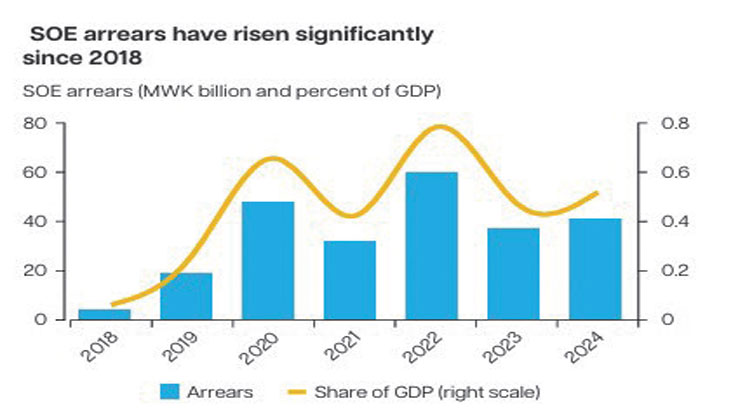
But for Malawi, economists and public finance management experts say the path to that transition is complicated by governance and institutional weaknesses, particularly in State-owned enterprises (SoEs), which continue to weigh on fiscal stability and private sector confidence.
Economist and public finance expert Mavuto Bamusi, in an interview yesterday, said persistent political interference has eroded efficiency, turning SOEs into “cash cows” and centres of patronage.
“Political interference reduces economic efficiency and undermines the role SOEs should play in supporting growth,” he said.
Bamusi said frequent bailouts of underperforming SOEs place additional strain on the limited fiscal space, crowding out development spending and reinforcing inefficiencies in the broader economy.
He proposed three key reforms: depoliticising SOEs operations, injecting capital to modernise infrastructure and professionalising management systems.
In a separate interview, Centre for Social Accountability and Transparency executive director Willy Kambwandira said limited transparency in reform processes is undermining accountability and trust.
He said: “We are greatly concerned that the engagement between the IMF and the government continues to take place largely behind closed doors.
“This makes it difficult to track implementation and hold both parties accountable when agreed reforms are not delivered.”
Kambwandira said that policy inconsistency and weak enforcement have created an unpredictable business environment.
“Investors struggle to operate in an environment where rules are unevenly applied. Without practical and enforceable reforms, ambitions for private sector-led growth will remain constrained,” he said.
Given the fiscal constraints, Kambwandila said recapitalisation of SoEs should be pursued through public-private partnerships (PPPs) to attract private investment without increasing pressure on the budget.
The impact of these governance failures is already visible in private sector behaviour.
Malawi Confederation of Chambers of Commerce and Industry chief executive officer Daisy Kambalame said in an interview that investors are increasingly shifting capital into government securities rather than productive sectors.
“If you look at where private sector money is going, it is going into government instruments,” she said, noting that firms prefer the higher and more predictable returns offered by Treasury instruments.
Kambalame said most firms are still opperating below capacity, reflecting declining production and investment.
Nico Capital Limited chief executive officer Misheck Esau is quoted as having said that inefficiencies in SoEs remain a major deterrent to private investment in key sectors such as energy and infrastructure.
“Efficiency and governance discipline are critical. Investors need confidence that resources are being managed professionally,” he said.
The convergence of these challenges points to a deeper structural issue: while policy frameworks increasingly emphasise private sector-led growth, the underlying conditions required to unlock that growth such as credible governance, efficient institutions and predictable policy environments, remain weak.