Industry experts have linked the cotton sector’s stunted growth to Malawi Government’s lack of interest to boost production through provision of subsidised farm inputs.
They argue that the situation has left the country exporting raw lint and weakening the whole value chain.
The sentiments come at a time the 90-day cotton marketing season opened this week and the Cotton Council of Malawi projects production at 22 894 metric tonnes (MT) out of the country’s 400 000 ginning capacity.
In an interview yesterday, longtime cotton commercial farmer Duncan Warren recalled that since 2010 when the Bingu wa Mutharika administration financed production and achieved 100 000MT output, the country only produces around 10 000MT because of low investment.
He observed that unlike other countries that have revamped the industry by subsidising genetically modified (GMO) cotton seed, Malawi has turned a blind eye on the opportunity, leaving farmers stuck with local varieties that offer low yields.
“Since the past four to five years, industry stakeholders have been providing government with proposals of subsidising GMO cotton seed to ensure production is boosted but it shows that government is clearly not interested in cotton.
“What is unfortunate is that the cotton value chain is very much linked to industrialisation and can easily complement efforts to solve the country’s forex challenges,” said Warren, who is also a former Cotton Council of Malawi chairperson.
He said the country exports raw cotton because most ginners closed shops or left the country due to extremely low production, emphasising that it does not make business sense for a company to be operating below capacity.
Malawi has seen a drop in the number of ginners from around 12 to just four in the past decade, leaving only Admarc Limited, Afrisian limited, Malawi Cotton Company and Masapa Cotton Ginners.
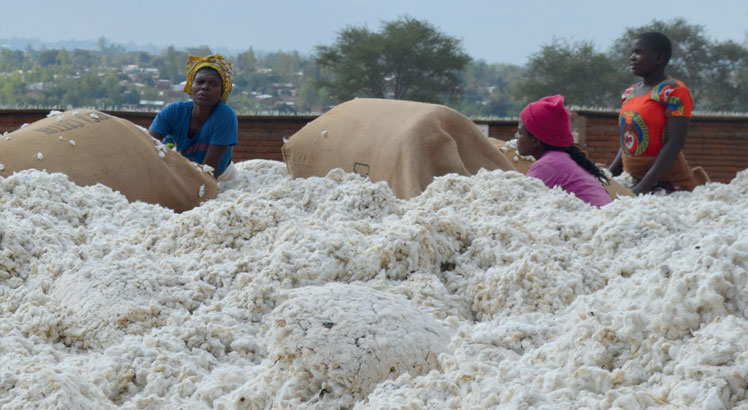
bales. | Nation
In a separate interview, agricultural policy expert Leonard Chimwaza said lack of political will, proper industry player collaboration and weak regulatory environment are killing the cotton sector.
“In 2009, cotton production improved because there was huge investment into the industry with more ginners coming in. But the political will has faded because government has been seemingly reluctant to significantly invest in the sector,” he said.
Meanwhile, commenting on the declining production, Balaka-based Malawi Cotton Company field manager Yohane Jim said the factory is only accessing 3 000 MT against capacity of 30 000MT.
He said: “Cotton business relies on volumes, but for many years, we are only getting 3 000 metric tonnes while we have an installed capacity of 30 000 metric tonnes.
“This means we just operate to run the machine and this is very costly to any business.”
Cotton Council of Malawi spokesperson Prisca Jamali said the council is now implementing the cotton seed supply system and it expects this initiative to improve production to 50 000MT by next year.
“The thing is we have not been able to come up with the seed supply system which is sustainable but this time we are intensifying the development of the seed supply system to have supply of seed consistently,” she said.
But Ministry of Agriculture, Irrigation and Water Development deputy director for crop development responsible for field crops Osborne Tsoka expressed optimism that the seed supply system and other issues that the ministry is looking into will transform the sector starting next season.
“These coming years we should reach around 50 000 MT and even reaching 300 000 MT over the years because of the issues that we want to address. I know there are issues about the problem of availability of cotton seed and this is being addressed,” he said.
The Cotton Council of Malawi opened this year’s cotton marketing season on Monday 25 2026.
Last season the country also projected to produce 22 000MT but ended producing half the figure. Government set this year’s cotton farm gate price at K1 500 per kg.