Malawi Confederation of Chambers of Commerce and Industry (MCCCI) says the country’s private sector investment has fallen sharply and remained volatile over the past five years, undermining productive expansion, job creation and stronger economic growth.
The private sector lobby group says this reflects persistent structural challenges that continue to undermine investor confidence
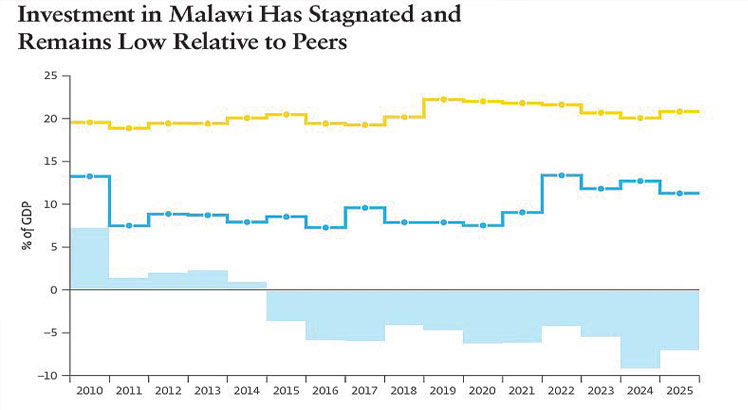
MCCCI’s assessment comes on the back of published data from the World Bank’s June 2026 Country Private Sector Diagnostic, which show that gross investment declined to 11.1 percent of gross domestic product (GDP) in 2024 from more than 20 percent between 2017 and 2019.
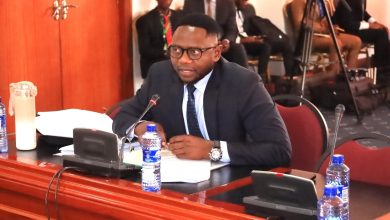
In a written response on Thursday, MCCCI director of business environment Lucky Mfungwe observed that the difficult operating environment continues to discourage both domestic and foreign investment and slow economic transformation.
He said Malawi’s investment climate continues to be constrained by persistent foreign exchange shortages, high inflation, elevated interest rates, unreliable energy supply and an unpredictable policy and regulatory environment.
Said Mfungwe: “These constraints have significantly weakened private sector confidence, reduced production capacity and discouraged both domestic and foreign investment.
“This underinvestment has constrained the expansion of productive sectors, job creation, export growth and economic transformation.”
The World Bank report further said over the past five years, total investment has averaged 15 percent of GDP compared to more than 23 percent among regional peers.
On the other hand, private investment averaged only nine percent of GDP and accounted for less than 60 percent of total investment.
The report further said that net foreign direct investments (FDI) as a share of GDP has also fallen significantly since the early 2010s.
After peaking at 6.8 percent of GDP in 2014, net FDI averaged just 1.5 percent of GDP between 2019 and 2024, below the level of most regional peers
The chamber’s 2025 Annual Economic and Business Review shows that 74.1 percent of businesses identified foreign exchange shortages as their biggest constraint, followed by inflation at 70.4 percent and rising input costs at 55.6 percent.
The report further revealed that 51.9 percent of firms were operating below 50 percent of installed capacity, while only 11.1 percent were operating above 75 percent capacity, largely due to limited access to foreign exchange, high production costs and energy supply challenges.
In a separate interview, National Working Group on Trade and Policy chairperson Frederick Changaya said capital formation is a leading indicator of future economic performance and deserves greater policy attention than it currently receives.
“We ought to be tracking capital formation more seriously because it points to future economic outcomes,” he said.
Changaya, who is also National Planning Commission director general, said there is also need for structural reforms, policy predictability and consistency so that investors have confidence to commit long-term capital.
Malawi Investment and Trade Centre earlier said despite progress following some policy reforms, there is still limited infrastructure to facilitate investments.
According to Mitc, policy reforms and initiatives such as the establishment of special economic zones, liberation of the electricity sector, setting up of Malawi Mining Authority and the agriculture, tourism, mining and manufacturing strategy, among others, all seek to promote investments in manufacturing, mining and value addition.