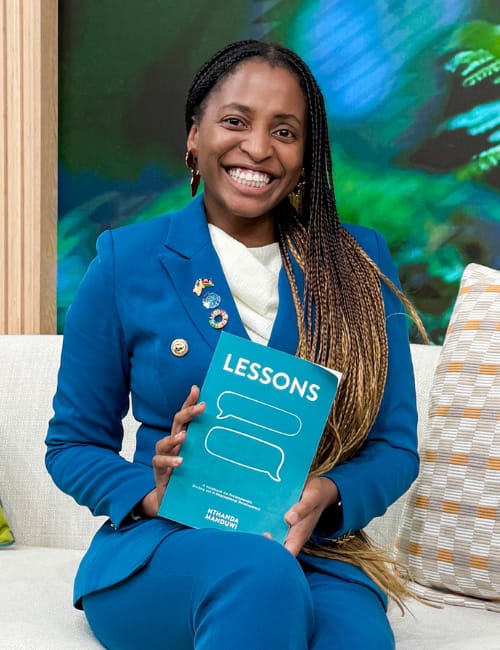
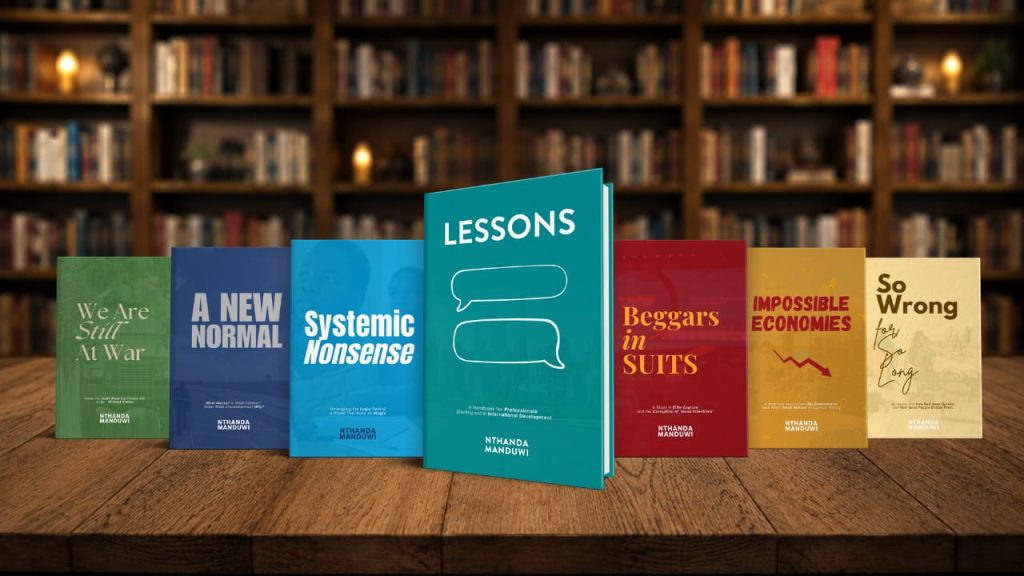
As Malawi observes Independence Day today, Ntha Foundation founder, NTHANDA MANDUWI, has released seven books on international development. They are Lessons, Beggars in Suits, Systemic Nonsense, Impossible Economies, So Wrong for So Long, We Are Still at War and A New Normal. She speaks to our News Analyst LLOYD CHITSULO. Excerpts;
Q. What’s the motivation behind releasing these seven books on Independence Day?
Independence Day is a moment to celebrate, but it should also be a moment to think honestly. Sixty two years after independence, Malawi has made progress, but we are still asking many of the same questions about industry, institutions, jobs, education, technology, and development. I wanted the books to be part of that national reflection. They are not just books about development, they are books about what we have learned, what we have refused to learn, and what we must now build differently.
Q. What is the Lessons Series about?
In 2022, I was selected as one of 18 professionals out of 38 709 applicants, to join the United Nations Development Programme (UNDP). I worked as an Evaluation Analyst and a Knowledge Management Specialist with the Independent Evaluation Office in New York, United States, and this work is in a way a continuation of that role. The Lessons Series is a seven-book reflection on development, institutions, power, failure, and the future. It speaks first to young professionals entering international development, then moves into elite capture, institutional dysfunction, economic history, bad ideas, modern power, and finally the question of what comes next. Across the series, I am asking one core question: if we already have more evidence, more technology, and more global knowledge than any generation before us, why do so many systems still fail to deliver for ordinary people?
Q. How did your own journey shape these books?
My journey took me from Malawi into government work, World Bank-supported programming, the United Nations (UN) system, and later business school in the United States. Working inside these spaces changed how I understood development. I entered many of them believing the problem was mostly about better projects. Over time, I came to understand that the deeper issue is often about systems: incentives, institutions, implementation, power, and whether people are willing to learn when evidence challenges their assumptions.
Q. Why is Lessons important for Malawi specifically?
Lessons is especially close to my heart because it speaks to young professionals who are just starting out in international development. Many Malawians leave the country to study, work, and gain global experience. I believe that when we do that, we should not only build our own careers, but we should also become stepping stones for others. The point is not simply to “make it out.” The point is to learn, grow, and create pathways that make it easier for the next generation to go further.
Q. Beggars in Suits is a provocative title. What are you trying to say?
The title is intentionally uncomfortable because the subject is uncomfortable. Malawi cannot build its future if begging becomes an industry. I am not saying this to shame the country; I am saying it because I believe we need a much more honest conversation about dependence, elite capture, and the performance of development. Sixty two years after independence, we should be asking why we still have such a weak industrial base, why we remain so dependent, and what it would take to build productive capacity from the ground up.
Q. How do the other books connect to that national conversation?
Systemic Nonsense looks at why institutions keep doing things that everyone privately knows are not working. Impossible Economies asks how small nations are expected to succeed inside global economic structures they did not design. So Wrong for So Long studies why bad ideas survive even after evidence has arrived. We Are Still at War looks at how power operates today through finance, trade, technology, infrastructure, rules, and narratives. Each book is a different doorway into the same larger question: why do systems fail, and what would it take to make them learn?
Q. You recently delivered a TEDTalk titled “World 2.0”. What does that mean?
That is actually the tagline for the last book in the series: A New Normal. This, I believe, is where the series turns from diagnosis to possibility. It asks what Malawi, Africa, and global institutions should do in a world being reshaped by AI, digital systems, infrastructure, climate pressure, and institutional reform. I connect that conversation to Malawi 2063, Agenda 2063, and UN 2.0 because these are all attempts to imagine new systems. But imagination is not enough. The real question is execution: what works, in what context, under what circumstances, and why?
Q. You are studying in the United States. How does that fit into this story?
I recently completed my STEM MBA at Michigan State University, graduating with a GPA of about 3.9/4.0. That experience helped me connect development thinking with business strategy, systems design, analytics, technology, and execution. It also shaped the next stage of my work. I am now thinking less only about critique, and more about building institutions, companies, and systems that can test some of these ideas in practice.
Q. You have also been selected for major fellowships. What do they support?
I was selected for the Rockefeller Foundation Big Bets Africa Fellowship and the Detroit Tech Residency Fellowship. Both are connected to the next stage of my work: thinking about technology, infrastructure, systems innovation, and Africa’s future. These opportunities matter because they create space to move from writing and analysis into building. The books explain the questions. The fellowships and my company, Q2 Systems, are part of how I am beginning to work on answers.
Q. What is Q2 Systems?
Q2 Systems is the company I am building around robotics, autonomous systems, infrastructure, agriculture, and logistics for constrained environments. For me, it is directly connected to the books. If we say Malawi needs industry, infrastructure, technology, and better systems, then we also have to build practical models that can work in places like Malawi. Q2 Systems is part of that effort: moving from commentary about development into actual systems that can be tested, improved, and scaled.
Q. How can people get the books?
The books are available on Amazon, and they ship globally. They are part of a larger mission. Proceeds from the books will support the Ntha Foundation’s programmes, and between now and the end of August, we will also be giving away free copies to encourage wider public engagement. To get copies, people can visit the website: nthafoundation.org. I do not want this to be a conversation only for people who can afford books. If the work is about Malawi’s future, then young people, students, professionals, and community builders should be able to access it.
Q. Do you see yourself coming back to Malawi?
Malawi is home. The deeper question is how the country creates conditions that allow people in the diaspora to return and build meaningfully. We often talk about brain drain, but we do not talk enough about brain circulation or brain return. If Malawians gain global education, experience, capital, and networks, the country should be thinking seriously about how to draw that talent back. Coming home should not feel like a sacrifice. It should feel like an opportunity to build. A lot of our neighbouring countries like Botswana, Kenya and Rwanda are being intentional about drawing talent into their countries. Malawi should be too.
Q. What do you hope Malawians take from the series?
I hope people take the books as an invitation to think more seriously and more boldly. We cannot keep diagnosing the same problems every Independence Day and then return to the same habits. Malawi needs industry, capable institutions, technological readiness, honest leadership, and a generation willing to build beyond slogans. These books are my contribution to that conversation. They are not the final word, but I hope they help open a more serious one.
About Nthanda;
●She is a Malawian author, systems entrepreneur and former United Nations Development (UNDP) professional.
●Her release of the seven-book Lessons Series on Malawi’s Independence Day is a contribution to national reflection on development, institutions, industry, and Malawi’s future.
●She recently completed her STEM MBA at Michigan State University with a GPA of 3.9/4.0.
●In 2022, she was selected as one of 18 professionals out of 38 709 applicants, and she worked with UNDP in New York.
●She was selected for the inaugural Rockefeller Foundation Big Bets Africa Fellowship.
●She was selected for the Inaugural Detroit Tech Residency Fellowship.
●She is currently building Q2 Systems, a company focused on robotics, autonomous systems, infrastructure, agriculture, and logistics for constrained environments.
●She previously worked with the UNDP Independent Evaluation Office and the Global SDG Synthesis Coalition.
●Proceeds from the books will support Ntha Foundation programmes and free copies will be made available through the Foundation between now and the end of August.