The Malawi Government says it is turning to commercial banks and other private sector financing models to sustain infrastructure development amid dwindling donor support and rising fiscal pressures.
Minister of Transport and Public Works Jappie Mhanga, speaking yesterday in Blantyre at the International Conference on Infrastructure Development and Investment, said departing from traditional financing models is part of efforts to find new ways of mobilising resources for infrastructure.
He said emphasis will be placed on maintaining quality, agreed project costs and timely delivery.
Said Mhango: “We are embracing a lot of innovations and that is finding new ways of generating resources.
“We are also partnering with banks in infrastructure development where a couple of roads that will be built going forward will be financed by resources from the banks.”
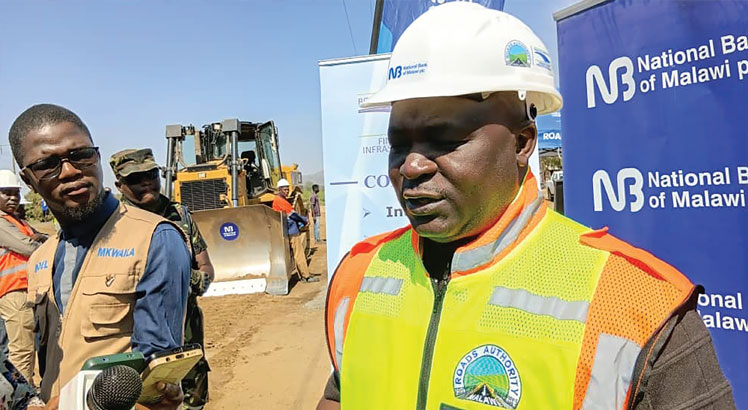
To date, the government has secured K200 billion for the 58.4-kilometre Golomoti-Monkey Bay Turn-Off Road with K100 billion each from Malawi Stock Exchange-listed FDH Bank plc and National Bank of Malawi plc.
Currently, the process is underway to process a similar facility to fund rehabilitation of the 105km Karonga-Chiweta stretch on the M1.
In his address, Mhango said infrastructure planning must account for climate change, given the damage already caused to roads and other public assets while new projects should be built to withstand future climate shocks.
The financing challenge comes as Malawi’s climate finance remains heavily dependent on development partners, which provided about 88 percent of climate-related funding in the 2025/26 financial year compared with 12 percent from government, according to Construction Sector Transparency Initiative (CoST) Malawi analysis.
The analysis further shows that about 98 percent of public climate-related funding is managed at national level while 61 percent of the development budget is financed through concessional loans and grants amid rising public debt.
Climate change is also increasing pressure on infrastructure resources, with research showing that roads are particularly vulnerable to more frequent and intense flooding while rainfall variability raises maintenance costs, especially for unpaved roads.
On the other hand, climate-related shocks currently result in annual economic losses equivalent to about 1.7 percent of the gross domestic product, according the World Bank.
Conference chairperson and University of Johannesburg professor Innocent Musonda said Malawi has many financing options on the domestic market, including pension funds to support infrastructure development.
“Just five percent would contribute over K17 billion. That is a lot of money in terms of assisting towards developing infrastructure,” he said, calling for stronger partnerships between the public and private sectors and the academia.
Meanwhile, Malawi University of Business and Applied Sciences Vice-Chancellor Associate Professor Nancy Chitera said financing is critical to translating research and policies into infrastructure that can transform communities and enhance development.
She said infrastructure development should support Malawi 2063, the country’s long-term plan that seeks to turn Malawi into a lower middle-income economy by 2030 and an upper middle-income economy by 2063, through resilient roads, better connectivity, urban development and decentralisation, with government, academia and industry working together through models such as public private partnerships.
The three-day conference is being held under the theme ‘Infrastructure for a new development era: Climate resilience, innovation and investment partnerships’.
It has brought together experts and stakeholders from within and abroad to explore sustainable and innovative approaches to infrastructure development.