Fuel queues have resurfaced and getting longer by the day with diesel facing a critical shortage and petrol’s availability is erratic as the country continues to grapple with perennial foreign exchange scarcity choking import financing.
What started as isolated cases of stockouts have now transformed into a full-blown scarcity with queues of diesel vehicles waiting for supply at service stations becoming a common sight.
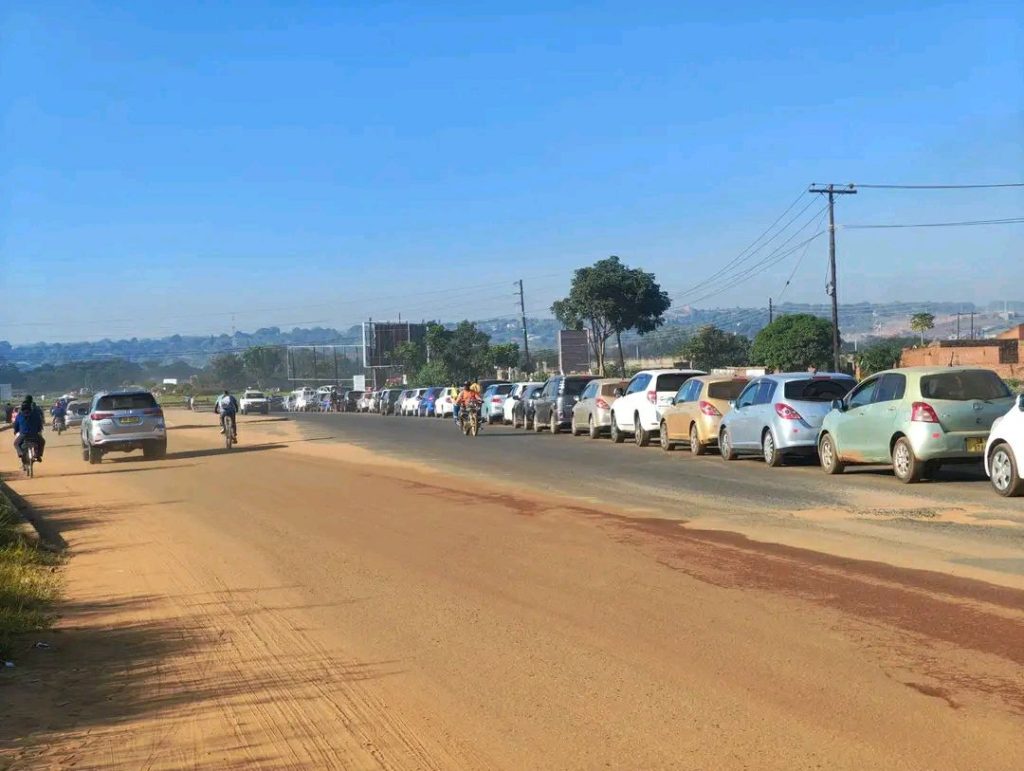
Petrol too, while often available, is in erratic supply with most service stations also having no stocks.
The scarcity has revived the parallel market which has seen vendors selling the commodity, especially diesel at between K10 000 and K15 000 per litre against official pump prices of K5 619 per litre for petrol and K5 863 per litre for diesel.
In an interview yesterday, Fuel Retailers Association chairperson Happy Jere said diesel supplies have been constrained for about three weeks while petrol shortages worsened last week, with the situation deteriorating, particularly at service stations outside major urban centres of Blantyre, Lilongwe, Mzuzu and Zomba.
“Diesel has been a problem for the last three weeks, whilst petrol, we have noted the problem from last week. Diesel, we are averaging 30 percent [in urban areas], remote filling stations at zero percent,” he said.
Jere said Malawi needed to address the structural foreign exchange shortage by boosting exports and tightening management of the scarce resource.
“We need to take farming of cash crops seriously. We need to take mining seriously. The Reserve Bank of Malawi [RBM] should also be serious with its forex controls and tame the black market,” he said.
The latest shortages have already disrupted transport and commercial activity, with haulage operators reporting lengthy queues and rising reliance on fuel from neighbouring countries.
Truck Drivers Union vice-president Francis Mkandawire said some trucks were spending up to a week in fuel queues, affecting the movement of goods.
“One week on a queue, how can you be productive? The black-market diesel goes at around K12 000. This is fuel that is smuggled into the country from neighbouring countries,” he said.
In a separate interview, Transporters Association of Malawi spokesperson Frank Banda attributed the scarcity to the Russia-Ukraine War which has disrupted supply since February 24 2022.
He said trucks were dispatched to Beira Port in Mozambique last week and others to Dar es Salaam in Tanzania for loading, but it is not clear when they will load.
“We cannot give exact numbers of trucks we have sent so far to Beira and Dar es Salaam and when we expect them back because we are in the process of getting those details,” said Banda.
Construction Industry Association of Malawi board vice-chairperson Kondwani Kadango said the sector has expanded significantly with the rollout of the Reformed K5 billion Constituency Development Fund (CDF)-funded projects, many of which are machinery-intensive and require reliable fuel supply.
National Oil Company of Malawi (Nocma) Limited spokesperson Raymond Likambale referred The Nation to Ministry of Energy spokesperson Joan Thaundi.
Thaundi said Malawi imports all the petroleum products and the industry has to compete with others for forex.
She said: “Due to this, there have been un honoured Letters of Credit with our banks; hence, the disruption. We are still stocking in line with the availability of forex. A good number of Letters of Credit have now been honoured by the Reserve Bank of Malawi and we are confident that the situation will start normalising within this week.”
Malawi Energy Regulatory Authority (Mera) consumer affairs and public relations manager Fitina Khonje also admitted that the shortages are directly linked to the country’s wider foreign exchange constraints, although fuel procurement remains a priority.
“The forex constraint is a national issue. We appreciate that forex allocation for fuel procurement is prioritised. However, financing gaps sometimes occur and their effects become evident over time,” she said.
In December last year, Nocma said it would import about 412 000 metric tonnes (MT), an equivalent of about 549 million litres of fuel in the 2026/27 financial year. The quantity is equivalent to 60 percent of the country’s consumption.
On the other hand, Petroleum Importers Limited (PIL), a consortium of private sector oil marketing firms, also issued its tender calling for suppliers of 176 300MT, about 200 million litres.
On average, Malawi consumes one million litres of petrol and one million litres of diesel per day, translating to 60 million litres of petrol and diesel per month and 720 million litres of both items per year.