Community Energy Malawi’s work show how independent, localised electricity systems can transform remote economies where national grid extension is too costly or slow, our Staff Writer JAMES CHAVULA reports.
After sunset, Malawi, a country dominated by thick grasslands with trees here and there, fades into thick darkness, with scattered glowing lights from just over a quarter of homesteads with electricity.
The tropical savanna’s skyglow turns blue-black in the countryside, home to 84 percent of Malawians—the human faces of public policy.
Years of expanding power lines to rural markets and surrounding villages have left 96 percent of the rural majority behind.
Only four percent of the rural households receive power from the Electricity Supply Corporation of Malawi (Escom) grid, shows the 2018 census.
“Rural access remains at four percent,” says Ministry of Energy spokesperson Joan Thaundi, showing how rural electrification has stagnated in nearly a decade.
Data show it could be shrinking with rapid population growth.
However, trends suggest that investing in producing and supplying electricity right in off-grid communities that need it could jump-start stuttering rural electrification. Experts point to the 80-kilowatt (kW) Sitolo Solar Minigrid in Mchinji District and 60kW Mwansambe Hydropower Minigrid in Ntcheu as shining examples. Others are the 53kW Chipopoma Hydropower Minigrid in Rumphi, 220kW Mulanje Energy Generation Agency, 46kW Chisi in Zomba as well as 18.8kW Mthembanji, 17.8kW Kudembe, 4.5kW Kaname and 12.4 kW in Dedza.
Darkness shapes way of life
Community Energy Malawi (CEM) executive director Edgar Bayani says decentralised energy investments could speedily deliver power to communities left behind.
He states: “We still lose sleep that only 25.9 percent of Malawians access clean electricity currently.
“It’s like that darkness still shapes who lives, learns, thrives and prospers in our country. More needs to be done to accelerate access to clean electricity, especially productive energy use so that even rural communities can benefit.”
Since 2013, CEM has delivered 15 off-grid energy hubs worth $3.5 million (about K6.2 billion) to over 300 000 people in 18 of the country’s 28 districts.
This investment includes the installation of the Sitolo minigrid and the management of the newer pair at Mwansambe and Chisi.
The National Energy Policy promotes minigrids for populations located 10 kilometres off Escom power lines.
The United Development Programme (UNDP)-funded minigrids have shattered the costly wait for grid power, powering homes and businesses.
“What keeps us going and dreaming bigger is realising that expanding access to renewable electricity could unlock opportunities and transform lives across sub-Saharan Africa,” Bayani states.
The Malawian energy company has taken its footprint to Zambia, where 60 percent of the population lives without electricity, mainly in rural areas off the national grid.
“Lack of energy traps communities in poverty,” he states. “Without clean, affordable energy, progress in health, education, gender equality and economic growth remains out of reach.”
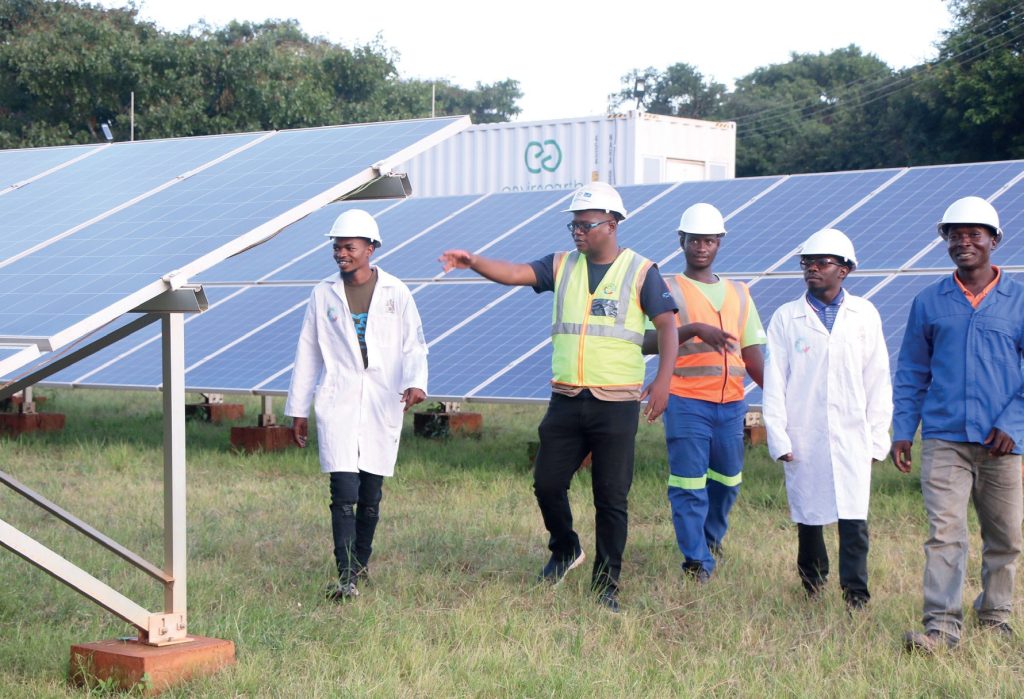
The 80-kilowatt Sitolo Solar Minigrid supplies 752 homes, 94 businesses, a local school, an under-five clinic and seven churches.
The business enterprises include two maize mills and a sunflower cooking oil presser.
Women own nearly one in five business enterprises, especially salons, grocery stores and poultry.
“I no longer rely on my husband for every little thing. I sell cold drinks from home and the profits support my family,” says Leticia Phiri in an interview from her electrified grass-thatched home.
She recalls the “dark days” when locals fetched firewood for cooking, women endured long walks to mill grain, learners could not study beyond sunset and teachers struggled to plan lessons.
Today, 255 solar panels in three arrays convert sunlight into electricity stored in 468 batteries, supplying 854 customers in Sitolo, Molosiyo and Ndawambe villages day and night.
Since 2019, some households along the 7.2 kilometre transmission line cook using electricity and trade beyond nightfall. Likewise, teachers and learners work under bright lights while farmers grade, process and pack potatoes, onions and tomatoes at night.
Gabriel Chisale operates a mill that presses 10 to 15 litres of cooking oil from a 50 kg bag of sunflower. The remaining, blackish sunflower cake constitutes nutritious animal feed.
“Gone are the long travels to get goods and services that require electricity,” he says.
Lucy Sakala, 23, heading home with sunflower oil, could not hide her smile.
She recalled: “We used to cross into Zambia to press our sunflower into cooking oil and animal feed, but things have changed. Now we process it in our village.”
Bright future
There are similar tales of deepening entrepreneurship, improved livelihoods and easy access to basic needs in the shadow of emerging minigrids.
Bayani says the Sitolo community energy investment has taught him that a successful minigrid is not just about connections and bright lights, but also about creating a local economic hotspot.
“The next generation of mini-grids must combine reliable electricity, deliberate demand stimulation, productive use, strong data and appropriate financing to become both impactful and financially sustainable,” he says.