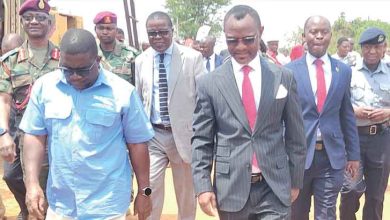
Vice-President Jane Ansah insists she will not stop what last week turned out to be her almost daily sojourns across the country to supervise operations of her delegated disaster management portfolio.
In a written response on Friday, spokesperson for the office of the Vice President Richard Mveriwa said Ansah needs to be on the ground to personally assess situations and provide policy direction.

With this stance—a response to questions for a story our sister newspaper The Nation carried last Friday—Ansah has answered her critics who charged that her frequent in-country sojourns under the Lean Season Food Response Programme and multiple visits to people affected by stormy rains are a drain on taxpayers’ money as there are paid government officials in her Department of Disaster Management Affairs (Dodma) and district councils to carry out the operational tasks she is engaging in.
Her country trotting, warned observers, is also against the letter and spirit of her own government’s austerity measures, which include a sharp drop in both internal and external travel.
But Ansah, in just four days between Monday and Thursday last week—had been to at least eight districts, including Mangochi, Thyolo, Nsanje, Chikwawa, Zomba, Ntcheu, Lilongwe and Mchinji distributing maize and visiting households affected by stormy rains.
Mveriwa said Ansah is obligated to be on the ground to appreciate realities firsthand, adding that the travels are planned within the framework of the government’s austerity measures.
“As Vice-President [who is also] responsible for disaster management, she is expected to assess the impact of disasters on the ground, verify reports and provide informed guidance on immediate and long term mitigation measures.
“This requires her physical presence in various districts to appreciate the situation firsthand and ensure that response efforts are reaching the intended beneficiaries,” he said.
Mveriwa added that effective disaster management cannot be done from the office alone, arguing the travels are not only justified, but necessary for her to effectively execute the responsibilities entrusted to her.
He added: “It requires presence, verification, coordination and timely decision-making, especially during the lean season and periods of heavy rains when vulnerable households need urgent support.
“Visits enable her to directly appreciate the scale of damage and humanitarian needs, monitor the delivery and fairness of aid distribution, engage local leadership and technical teams and identify both immediate and long term solutions to mitigate future disasters.”
But Mzuzu University based economist Christopher Mbukwa said yesterday that the justification from the Vice-President on her frequent travels is baffling and incomprehensible given the set of expenditure controls that authorities are now not willing to implement.
He said: “As much as it is important for the VP to physically monitor the situation for effective humanitarian response for her office, it will be a missed opportunity to enforce the expenditure control measures because you will not expect Ministries, Departments and Agencies [MDAs] to adhere when their superiors are flouting the same.”
Willy Kambwandira of the Centre for Social Accountability and Transparency said visibility must never replace systems.
He said the country’s humanitarian response architecture has a fully-fledged structure through Dodma, district councils, humanitarian clusters and non-governmental organisatons whose job is precisely to assess, distribute and monitor aid.
“As such, when the VP makes daily trips to appreciate damage it must raise serious questions about efficiency, duplication and cost especially at a time the State is struggling to fund basic services.
“The VP’s justification explains the intent, but not necessity, scale or frequency of her travels. When a country is under strict austerity and a leader insists she cannot stop daily travels, it can be interpreted as a return to the old pattern of political theatrics disguised as humanitarian leadership,” he said.
On his part, National Advocacy Platform chairperson Benedicto Kondowe said while the VP is right to emphasise the importance of disaster preparedness and understanding humanitarian needs firsthand, such travel should be moderated against the government’s own austerity commitments and taxpayers’ expectations of prudence.
“When executive mobility becomes excessive—particularly during austerity—it raises legitimate concerns about tone-deaf governance, blurred institutional roles and the risk of humanitarian engagements being used for political optics rather than efficiency,” said Kondowe.
On his part, human rights activist Gift Trapence said the pronounced austerity measures should not be a mockery to Malawians, but a commitment government must see through.
He said: “The culture of executive arrogance has been a going concern in Malawi and is entrenched among our politicians, especially when politicians are in government. They behave differently when they are outside government.”
Like Trapence, governance pundit George Chaima said the comfort zone of leadership builds arrogance once people taste its flavor, noting it begins slowly and grows faster to a wider and uncontrollable extent.
“Of course she was appointed to provide oversight, but not to trot around draining public resources in that sense unless fresh disaster strikes. She would better use the office to receive data and other necessary reports by responsible officers,” he said.
In November, the Office of the President and Cabinet announced austerity measures that included a reduction in fuel entitlements for Cabinet ministers, deputy ministers and senior public officers by 30 percent.