Malawians commemorate the ceremonial birthday of the founding president, Hastings Kamuzu Banda, every May 14.
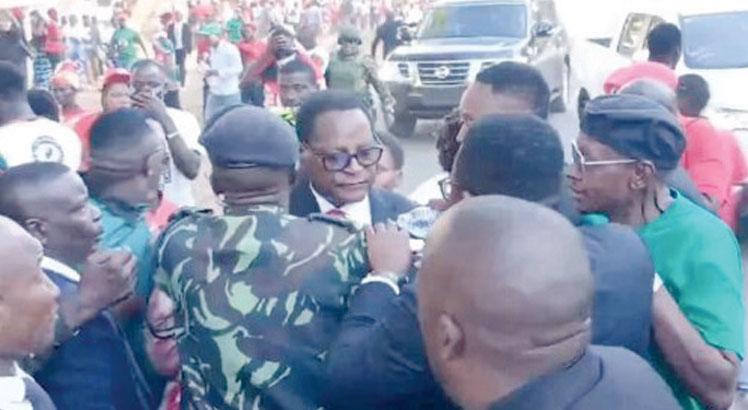
However, the bank holiday last Thursday degenerated into political anarchy when police teargassed immediate past president Lazarus Chakwera and Malawi Congress Party (MCP) supporters on the way to lay wreaths at Kamuzu’s mausoleum in Lilongwe City Centre.
The scene happened shortly after a State commemoration at the gravesite. The party says it was excluded from the memorial, according to its mobiliser Moses Kunkuyu.
A day later, Deputy Minister of Homeland Security Norman Chisale claimed responsibility of the teargas attack.
He told his Ntcheu Central East constituents on Friday that “it wasn’t much and the MCP leadership should expect more of the same”.
“Yes, I teargassed them because they don’t listen. Every village has one chief. Love it or loathe it, the chief is in charge till death,” he declared in Ntcheu.
In a viral video, the second in command for internal security links the police operation to perceived atrocities by the Chakwera administration, which repeatedly detained him for various charges, now dropped by Director of Public Prosecutions Fostino Maere.
“They should remember that this is what they did to me,” adds Chisale.
His remarks suggest a grudge battle for supremacy.
Blurred boundaries
They also raise questions about the police’s impartiality and professionalism.
Section 153 of the Constitution creates the Malawi Police as “an independent organ of the Executive” to protect public safety and human rights according to constitutional prescriptions and other laws—not political vendettas.
However, the recent events suggest that the deputy minister could be weaponising the security agency to settle his political scores. Not long ago, Chisale widely blamed the Chakwera administration for similar abuse of State institutions.
According to political scientist Ernest Thindwa, the framing of police operations as political retaliation mirrors a deeper structural weakness in Malawi’s political system.
“Once State power is justified through political grievance, it blurs the line between law enforcement and political retaliation,” he argues. “
Thindwa reckons that in the country’s “highly adversarial political environment”, national events are increasingly shaped by competition—not consensus-building.
How Democracies Die, Steven Levitsky and Daniel Ziblatt argued that when political leaders treat opponents as enemies, they normalise the use of State institutions against rivals and weaken norms of restraint.
Democracy partly thrives on formal rules as much as restraint in how power is exercised, the political analysts write.
According to Juan Linz, democracies become vulnerable when political authority becomes personalised and leaders identify the State with their political survival.
Gradually, he warns, “institutions lose neutrality and become tools of political competition”.
Dark past
Just as Joseph Stalin’s Soviet Union fused the State machinery with political loyalty, Uganda’s Idi Amin widely used security agencies to sustain his reign of terror.
Malawi has experienced a fair share of shrinking boundaries between State systems and party agendas.
For 31 years, Kamuzu Banda’s one-party regime used the State machinery to muzzle, exile and accidentalise its perceived dissidents.
In their 2006 analysis, legal scholar Edge Kanyongolo and his co-authors described the superiority complex as a Big Man Wamkulu syndrome.
Lack of separation of power continues to haunt multiparty Malawi, as incumbents increasingly use State instruments to tighten their grip on power.
Justifying law enforcement as political payback represents a new low for President Peter Mutharika’s handlers such as Chisale, his security aide.
Centre for Social Accountability executive director Willy Kambwandira says shrinking political tolerance normalises political hostility.
“When State action is publicly celebrated in partisan terms, it sends a message that State institutions can be used for political advantage rather than national service. That is dangerous for any democracy,” he says.
‘Respect diversity’
Concurring, campaigner-turned-lawyer Benedicto Kondowe says the attempts to justify the use of force against unarmed citizens reflect a worrying decline in political tolerance likely to undermine public confidence in security agencies’ neutrality and professionalism.
“In any constitutional democracy, leaders are supposed to de-escalate tensions, respect political diversity and uphold the rights of all citizens regardless of affiliation,” he says.
Mutharika last October named Chisale to his first Cabinet amid questions over police impartiality during Chakwera’s rule. At that time, some unformed cops were photographed watching helplessly as thugs attacked activist Sylvester Namiwa during mass protests in Lilongwe.
Internal security chiefs such as Chisale hold the keys to the desired reforms and they must demonstrate political will to change because Malawi is not their chief’s village or fiefdom, but a 33-year-old democracy that thrives on tolerance, rule of law and plurarity.