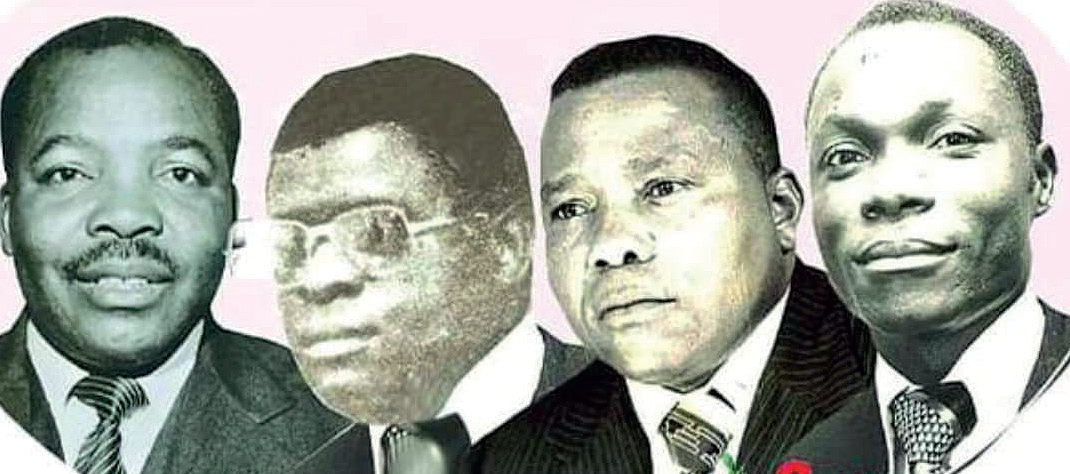
This week, on May 18, Malawians took time to remember the four local politicians who were murdered during the one party regime in 1983.
The four are Aaron Gadama, Dick Matenje, Twaibu Sangala and David Chiwanga. Their deaths, presented as ‘an accident’ were later confirmed to have been a murder. It was a political and sensitive issue and details of their passing remained mysterious until the wind of change reached Malawi around the early 1990s.
At this point, in 1993, musician Lucius Banda, in his early 20s, travelled to South Africa where he recorded his debut album titled Son of a Poor Man.
It was a reggae album.
In a move that shocked many, Banda boldly recorded songs with political messages basically condemning the one party regime.
One of the songs that literally introduced him to Malawians was Mabala, a song with a thinly-veiled message condemning the oppression of one party rule.

In part the song goes:“Inu mumati zidzakhala choncho
Mpaka liti abale?
Ana a Mulungu sangakhale akulira
Masiku onse a moyo wawo
Analanda ufumu kalero
Nawupeleka kwa woyenera
Ndichani chingamulake
Mbuye Mulungu wachilungamo!
Ndi wachikondi?”
This was around the time Malawians were beginning to revolt against the one part rule. When he sang ‘inu mumati zizakhala choncho mpaka liti abale?’, he was basically asking those who had been in power if they thought their rule would be for life.
Later, after Malawi embraced democracy and the first democratic president Bakili Muluzi, Banda went back into the studio with a more direct song Mizimu in which he mentioned the four fallen politicians.
He sung in solemn tone about how Malawians wanted to know what happened to the four on that fateful day.
“Anafuna kuti tidziwe, mzimu wa a Gadama
Tidziwe zoona zokha, mzimu wa a Sangala
Kamtengo kang’ono ng’ono, mzimu wa a Matenje
Kakoke bwanji galimoto, mzimu wa a Chiwanga..”
The song became an anthem that practically cemented Banda’s status as a legendary musician who had demystified an issue that many only spoke in low tones.
On his part, Lost History Foundation’s Paliani Chinguwo said Banda’s songs are an important contribution to Malawi history.
“Lucius Banda’s music played a significant role in shaping public memory and discourse around the Mwanza Four. At that time, Malawians were still emerging from decades of fear, silence and restricted political expression,” he said.
Chinguwo further highlighted that the songs did not merely entertain, but contributed to documenting the emotional and political atmosphere surrounding one of Malawi’s most controversial historical episodes.
He said: “Mizimu by Lucius Banda remains a masterpiece in public awareness and helped the younger generation to become curious about what happened.
“This song was precisely a reminder why cultural production such as music, oral history, documentaries, books and archives, remain central to preserving histories that were previously neglected, suppressed or politically sensitive.”
One of Banda’s fans, Mariah Tasaukadala said one of the reasons Banda stood out was his ability to tell history in a song.
“I was born in 1992, obviously long after the Mwanza Four were killed, but through Banda’s music, I was able to piece together information and understand what happened,” she said.
Tasaukadala added that the songs, though initially about entertainment, also gave Malawi an opportunity to reflect on their past and choose better for the future.
Banda would later come to attain the moniker Soldier of the poor due to his music that advocated for the poor and pointing out at the evil in society.
During his lifetime he had a total of 20 albums with the last one titled Love and Hate in 2022. He died on June 30 2024 after battling organ failure. He was 54.
Additional information from Lost History Foundation