Malawi Confederation of Chambers of Commerce and Industry (MCCCI) has warned that despite easing prices, foreign exchange shortages, elevated non-food inflation and rising business costs will continue to exert pressure on the economy.
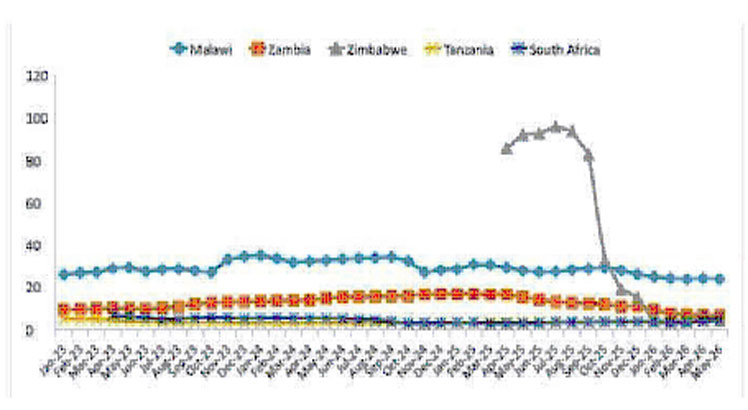
In its latest inflation bulletin, the private sector lobby group says many economies, including those in southern Africa, have maintained relatively low and stable inflation through prudent monetary policies, stronger currencies, improved agricultural performance and enhanced export earnings.
Reads the bulletin in part: “”Although headline inflation is gradually easing, persistent non-food inflation, foreign exchange shortages, rising operational costs and supply-side constraints continue to undermine business growth.
“Reforms that promote export diversification, industrialisation, value addition and infrastructure development will be critical in addressing structural bottlenecks and improving competitiveness.”
MCCCI said the private sector, touted as the engine of economic growth, is expected to continue operating in a difficult environment in the near-term although opportunities exist in regional market integration, import substitution, export growth and value-added production.
The chamber said that going forward, the sustained collaboration between government and the private sector will be key to attracting investment and advancing the aspirations of Malawi 2063, the country’s long-term development strategy that seeks to turn Malawi into a lower middle-income economy by 2030 and an upper middle-income economy by 2063.
Centre for Social Concern economic governance officer Agness Nyirongo warned in an interview yesterday that Malawi could experience disinflation without affordability, a situation where inflation numbers improve on paper, but households continue to struggle.
“What is key is to ensure that inflation is kept at a manageable level,” she said:
Published National Statistical Office data show a continued decline in inflation, with headline inflation easing to 23.4 percent in May 2026, down from 24.3 percent the previous month.
During the review period, food inflation declined to 17.6 percent, reflecting improved agricultural market supplies and lower food prices while non-food inflation eased to 33 percent, supported by stabilising price pressures and the fading effects of earlier fuel price adjustments.
The Reserve Bank of Malawi (RBM) policy rate, the rate at which commercial banks borrow from the central bank as the lender of last resort, is at 24 percent, following the reduction from 26 percent in March 2026.
RBM said it expects the disinflation trend to continue.
“The Reserve Bank of Malawi remains committed to maintaining price stability and supporting sustainable economic growth,” said the central bank in its May 2026 inflation commentary.
RBM had projected 2026 annual inflation at 24.8 percent, an upward revision from the 23 percent it made in October 2025 and significantly higher than government’s 15 percent projection, but slightly down from 28.4 percent last year due to persisting upside risks that undermine easing food Inflation.
The Economist Intelligence Unit (EIU) has also projected that Malawi’s 2026 annual average inflation rate will rise to 29 percent due to the Middle East conflict on fuel prices, among others.
The forecast by EIU, a subsidiary of UK’s Economist Group, also followed the United Nations and the World Bank projections that Malawi recent inflation gains could be lost due to the impact of the ongoing US- Israel-Iran war.