Key offices have chosen silence over First Vice-President Jane Ansah’s claim that she is being deliberately sidelined from her constitutional duties.
More than 24 hours by press time last night after Ansah named Chief Secretary to the Government Justin Saidi as the key figure blocking her from executing her functions, State House, the Attorney General (AG) and the ruling Democratic Progressive Party (DPP) were all unable to give substantive responses.
Presidential press secretary Cathy Maulidi had not responded to questions by press time at 9pm.
AG Frank Mbeta said he was unaware of the developments.
I”I will have to find out first before I can comment,” he said when contacted for comment on whether the situation could trigger a constitutional crisis.
DPP spokesperson Shadric Namalomba, who is also Minister of Information and Communications Technology, declined to weigh in: “The party is offering no comment, for now, until later.”
Saidi himself declined to comment when we contacted him on Tuesday evening after the Ansah interview.
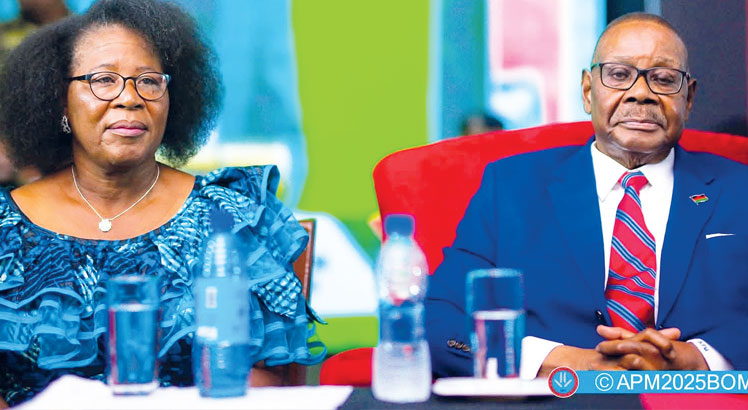
The silence comes after Ansah, in a Monday evening interview on Zodiak Broadcasting Station, charged that she has been excluded from Cabinet invitations and State functions.
Her troubles trace back to a controversial private trip to the United Kingdom, where a leaked list showed an entourage of at least 15 people—in defiance of President Peter Mutharika’s austerity drive—compounded by an extended stay. Since then, the ruling establishment has given her the cold shoulder, with her absence from Cabinet meetings now conspicuous.
Former minister of Justice Fahad Assani—who once served as Director of Public Prosecutions and was part of a team that drafted the 1994 Republican Constitution—suggested yesterday that President Mutharika must be aware of the FVP’s situation.
He said: “It would be naïve to think the President does not know her situation,” Assani said. He warned that Ansah’s continued exclusion maybe unconstitutional.
“In this regard, any act or conduct that excludes the Vice-President from her duties in Cabinet is unconstitutional — no beating about the bush.”
Private practice lawyer Benedicto Kondowe said while Section 89(1)(b) empowers the President to convene and preside over Cabinet, that power cannot be used to rewrite its constitutionally prescribed membership.
“The power to convene Cabinet is not the power to rewrite its constitutional composition. Administrative machinery cannot legitimately be used to defeat what the Constitution expressly provides,” Kondowe argued.
The fallout has exposed deep structural fractures in the DPP. Mutharika picked Ansah—a retired Supreme Court judge—as his running-mate ahead of the September 16 2025 General Election.
While Ansah maintains her personal relationship with the President remains cordial, her direct accusation against powerful insiders points to a fracturing at the apex of the State.
She claimed during the interview that several DPP officials from the start were unhappy with her appointment.
In August, Weekend Nation reported that senior Cabinet ministers and aides linked the breakdown not to policy differences, but to a total collapse of trust triggered by Ansah’s trip to the United Kingdom last December.
Governance analysts warn the silence will cost government.
University of Malawi political analyst Gift Sambo said: “The presidency should work in unison so as to achieve collective responsibility,” said Sambo.
He has since urged the Public Affairs Committee to mediate.
Mzuzu University expert Chrispin Mphande said the episode should force parties to rethink running mate selection, noting Mutharika twice opted for an outsider — the late Saulos Chilima in 2014, Atupele Muluzi in 2020 and now Ansah.
Former vice-president Khumbo Kachali called for a constitutional review to define the VP’s role.
University of Malawi law professor Garton Kamchedzera observed that while Section 79 expected Parliament to elaborate Executive roles through an Act, the country has failed to do so.
“The office hence remains merely with delegated functions to assist the President. If the President does not want to be assisted, the deputy is sidelined and of little, if any, use to the country,” he said.