The Economics Association of Malawi (Ecama) says the local economy faces a daunting task of reducing the inflation rate to 15 percent by March 2027 as food prices, electricity tariffs, fuel costs and exchange rate pressures continue to weigh heavily on the economy.
In its May 2026 Malawi Inflation Outlook published yesterday, Ecama argues that food prices remain the biggest obstacle because they account for more than half of the country’s inflation basket and contributes 13.5 percentage points to the country’s 23.4 percent headline inflation recorded in the first quarter of 2026.
The Ecama study further says that food inflation needs to decline by about 1.5 percentage points every quarter for the country to reach the 15 percent target within the projected period.
However, the study warns that the disinflation path remains fragile due to high fertiliser prices, transport costs, imported input expenses and persistent kwacha depreciation.
It added that stabilising the exchange rate, easing production costs, managing administered prices carefully and improving food supply conditions will be critical in sustaining the recent moderation in inflation.
Reads the report in part: “Given that Malawi’s inflation is predominantly supply-driven, monetary restraint alone cannot bring headline inflation to the 15 percent target.
“Tighter monetary conditions must be accompanied by concurrent action to ease production costs, stabilise the exchange rate and manage administered prices prudently.”
In the current environment, the monetary policy has remained tight.
During its second 2026 meeting, the Monetary Policy Committee (MPC) of the Reserve Bank of Malawi resolved to maintain the policy rate at 24 percent, but increased the liquidity reserve requirement from 10 to 12 percent, a move intended to compress demand by limiting the availability of loanable funds within the banking sector.
Food dominates the consumer price index (CPI), an aggregate basket for goods and services used to compute inflation at 53.7 percent while housing, water and electricity account for a further 23.7 percent, with transport weighted at 4.1 percent. Together, these three categories make up over 80 percent of the CPI.
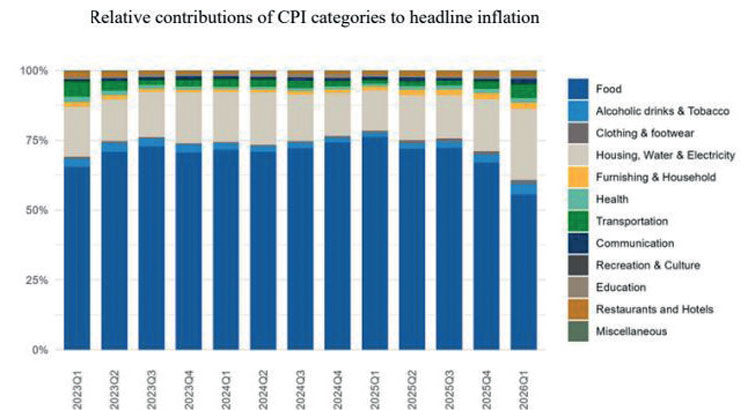
Ecama data show that food alone contributed between 65 and 75 percent of headline inflation through most of 2023 and 2024 before easing to 56 percent in the first quarter of 2026.
On the other hand, housing, water and electricity have risen sharply as a contributor, from less than 18 percent of headline inflation in early 2023 to more than 25 percent by the first quarter of 2026, reflecting the effects of electricity tariff adjustments and fuel-linked energy costs.
While commanding a small contribution, transport has grown rapidly, rising by almost two percentage points to around five percent between December 2025 and March 2026.
In absolute terms, food contributed 13.5 percentage points to the 23.4 percent headline inflation rate recorded in the first quarter of 2026 while housing, water and electricity added 6.2 percentage points with transport contributing 1.2 percentage points.
Meanwhile, housing, water and electricity costs are also expected to remain elevated as the final eight percent Electricity Supply Corporation of Malawi tariff adjustment under the current multi-year pricing plan still remains outstanding.
Fuel prices also present another major risk as Malawi remains exposed to global oil market shocks and foreign exchange shortages that continue to affect import costs and transport inflation, according to Ecama.
In an interview yesterday, Mzuzu University economics lecturer Christopher Mbukwa observed that the general cost of living is likely to remain unchanged and even worse if there are no cushions while Consumers Association of Malawi executive director John Kapito conceded that water, electricity, rentals, food and transport cost are giving economic pressure on consumers’ welfare.
Centre for Social Concern economic governance officer Agness Nyirongo in an interview yesterday warned that Malawi could experience disinflation without affordability, a situation where inflation numbers improve on paper, but households continue to struggle.
RBM spokesperson Boston Maliketi Banda is on record as having said to contain inflationary pressures, the central bank is ready to deploy appropriate monetary policy tools, including liquidity management and maintaining appropriate interest rate stance.