Malawi’s foreign exchange challenges persist despite some emergency measures to address foreign exchange market structural challenges.
World Bank data which Business News has seen show that the parallel forex premium now exceeds 100 percent while official foreign exchange reserves stand at about two weeks of import cover.
Ideally, for a country such as Malawi, a healthy reserve level would be at least three to four months of import cover.
While the local unit is selling at K1 751 on the official market, on the parallel market it is fetching as much as K5 000.
In a written response on Saturday, Reserve Bank of Malawi (RBM) spokesperson Boston Maliketi Banda conceded that short-term solutions like demand management, including currency devaluations, have proven ineffective with boosting exports remaining the only sustainable solution to address the core issue.
He said the central bank is collaborating with the government, the financial industry and the private sector to prioritise and invest in productive sectors with high export potential.
Said Maliketi Banda: “The country’s persistent foreign exchange shortages are a symptom of a deep-rooted, structural imbalance: for decades, our imports have significantly exceeded our exports. This deficit has been temporarily covered by external borrowing, donor grants, and project inflows.”
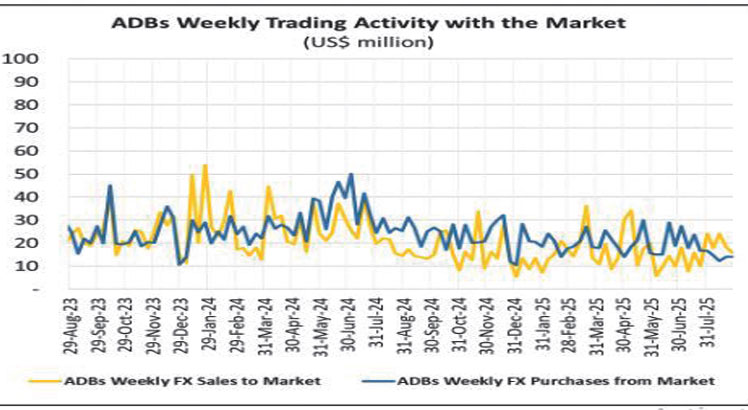
Meanwhile, RBM data show that fluctuations in authorised dealer banks (ADBs) foreign exchange trading activity, with purchases picking from $84.71 million (about K148 billion) in March 2025 to $97.28 million (about K170 billion) in July 2025 before falling to $57.24 million (about K100 billion) in August 2025.
During the same period, sales picked up from $84.78 million (about K148 billion) to $69.72 million (about K122 billion) before picking up again to $81.94 million (about K143 billion).
Speaking seperately, Financial Market Dealers Association of Malawi president Leslie Fatch said reduced supply into the market has affected commercial banks’ ability to service the market due to limited supply, adding that measures to ration forex by the banks are in reaction to the drop in supply.
“Considering that structural challenges are yet to be fully addressed in the market and are yet to bear fruits, for now banks have to actively prioritize on which bills to be serviced with the limited resources,” he said.
On his part, economist Bond Mtembezeka observed that tight controls amid this scarcity only worsen the situation, adding that declining ADB purchases is an indication that the market is getting drier and drier.
He said: “Of course, I understand why the regulator is acting this way—to ensure that at least foreign exchange for strategic commodities remains available.
“However, where we are getting it wrong is clear: we are not doing enough to boost our exports—by identifying new markets and increasing production.”
Consumers Association of Malawi executive director John Kapito said all goods on the market are now pegged to the parallel market exchange rates which is hurting both consumers and businesses.
Recently, RBM announced a reduction in the mandatory conversion rate for export revenues from 30 percent to 25 percent, with further reductions for qualifying companies anticipated.
In March, RBM also amended foreign exchange controls to promote import substitution and incentivise the export sector while curbing the use of informal sources of funds for importation.
Among others, the central bank reduced the mandatory conversion ratio on export proceeds for exporters with exemption from the mandatory conversion of export proceeds for manufacturers meeting the criteria issued by the central bank.
RBM also reduced the mandatory conversion ratio from 70 percent to 50 percent for non-governmental organisations and introduced a verification requirement for importers to demonstrate that their imports have been financed through the formal banking channel.
The central bank has since issued a directive urging exporters of goods and services to repatriate export proceeds in the registered name of the exporter to Malawi within 120 days from the date of exportation, failing which the exporter shall be liable to a monetary penalty equal to 150 percent, exporter deregistration, fines of up to K200 million and imprisonment.