A youthful couple of Braveson Chithope, 28, and Lezina Keliasi, 25, from Kumitengo Village, in Senior Chief Kalumbu in Lilongwe District, has all reasons to walk tall as the 2025/26 growing season harvest period approaches.
The couple had always desired to farm beyond subsistence, but access to inputs, coupled with unforgiving long dry spells stood in the way over the past growing seasons.
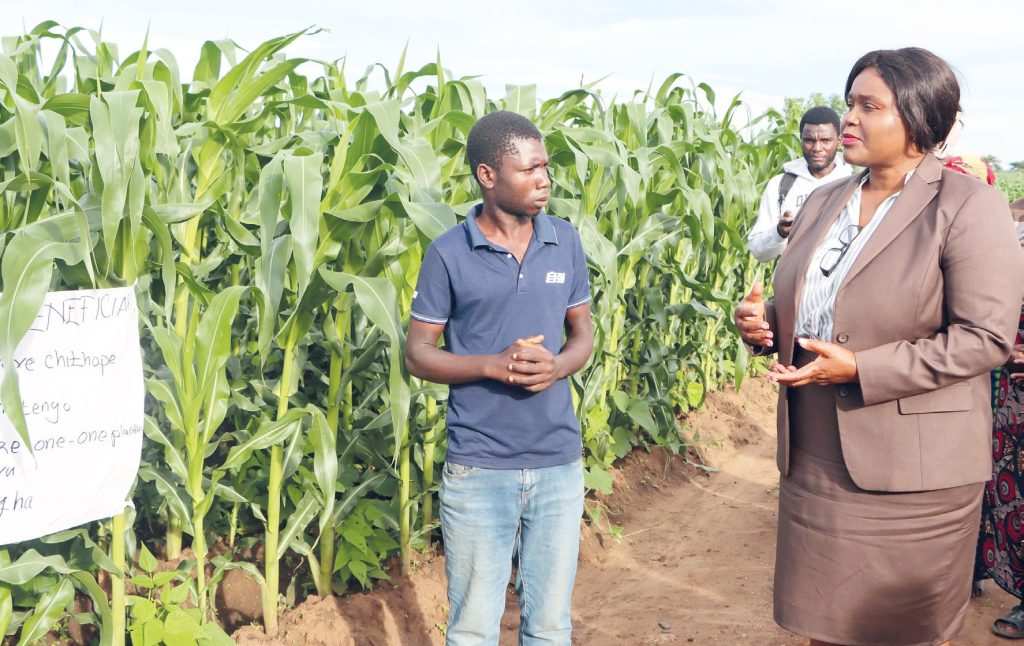
But this growing season they are singing a different song as their maize crop promises a bumper yield, with long and healthy maize cobs developing.
“It’s a one-acre field and as you can see, the yield is very promising,” explained the wife, Lezina, during a media tour mid-February, 2026.
“We are expecting not less than 80 bags of maize as the variety that you are seeing here is Njobvu, which yields way beyond 100 bags per hectare, holding all factors being constant.”
Her husband, Chithope had expressed similar optimism earlier in mid-January when the Minister of Agriculture, Irrigation and Water Develoment Roza Mbilizi visited the field as the maize crop was just about to tassel.
Chithope and his wife are among farmers in Lilongwe who benefitted from Response to Emergency and Disaster (RED), a contingency component within the Sustainable Agricultural Production Phase II (Sapp II), designed to respond to emergencies and disaster that may arise in Malawi.
When in November 2025 President Peter Mutharika declared a State of Disaster in 28 districts due to prolonged dry spells, drought and floods, appealing for humanitarian support, the RED component was activated with $3 million (K5.2 billion) funding from the International Fund for Agricultural Development (Ifad).
The contingency component aimed to boost food security and restore livelihoods of 22 000 vulnerable farmers in Lilongwe Rural and Balaka District with agricultural inputs for the 2025/2026 growing season.
In Lilongwe, the programme listed 17 950 Farm Inputs Subsidy Programme (Fisp) beneficiaries from the six Sapp II implementing extension planning areas (EPAs,) namely; Chiwamba, Chitsime, Nyanja, Malingunde, Mlomba and Nyang’amire while in Balaka, it targeted 4 050 farmers in Bazale and Ulongwe extension planning areas.
The RED support package included 2 bags of fertiliser (NPK and Urea) at a subsidised price of K10 000 each, and free five kilogramme of maize seed, with adoption of Good Agricultural Practices (GAPs).
According to the RED Component brief report, by January end over 18 000 famers had redeemed their packages, representing over 80 percent redemption rate.
Despite the dry spell that threatened farmers in a number of districts, including Lilongwe and Balaka, most RED beneficiaries have been least affected, with their maize crop promising a bumper yield, raising hopes of prosperity among older, and young farmers like the Chithope’s.
“When we harvest our maize, we plan to reserve a few bags for consumption up to the other harvest and sell the rest,” explained Lezina, adding: “Then we will invest the generated income into a business of our choice and make more gains.”
Elsewhere in Malingunde EPA, the unfolding results of the RED support package has gotten another youthful beneficially, Kelvin Lyson, dreaming big.
Lyson is 23 and a Form One dropout with a growing ambition to go back to school and pick up from where he left.
Although his maize was few days from tasselling at the time of the media tour mid-February, the final results of the maize crop was an open secret and, all being equal, Lyson will likely fulfil his longtime wish.
“Farming has never been easy for us due to high prices of inputs such as fertiliser and seed,” explained Lyson, who comes from a family of six children, with their mother single-handedly struggling to provide for the family’s needs.
“But this year farming has been very easy with the RED support and, for the first time in years, we may have enough food for the family’s consumption, and surplus to sell.”
Lyson is optimistic that he will be able to return to school after selling the surplus maize, come harvest time.
RED component support package has not just benefitted the youth like the Chithopes and Lyson: It has also benefitted older farmers, among them, Village Head Kalonga of Chitsime EPA, in the area of Senior Chief Kalumbu in Lilongwe.
Like Chithope’s maize field earlier in January when Mbilizi visited Kalonga’s maize crop had also been outstanding and it survived the dry spell that prevailed early February.
By mid-February during the media visit, Kalonga’s maize crop stand was “plagued” with long cobs everywhere, with most stalks carrying twin cobs.
The picture is generally the same among most of the RED component participants in the six EPAs in Lilongwe: farmers are now seeing themselves bidding farewell to food insecurity, a development that has left both programme implementors and government smiling.
“As a programme we are happy with the way the farmers have made use of the inputs,” explained Sapp national programme coordinator Rex Balua in an interview.