Step into the incubation room and the world melts into darkness.
In this pitch-black environment, no light, air or water is permitted.
To the untrained eye, it looks like stagnation.
For young Malawians turning to mushroom farming to beat the country’s crippling youth unemployment, it is precisely where economic growth begins.
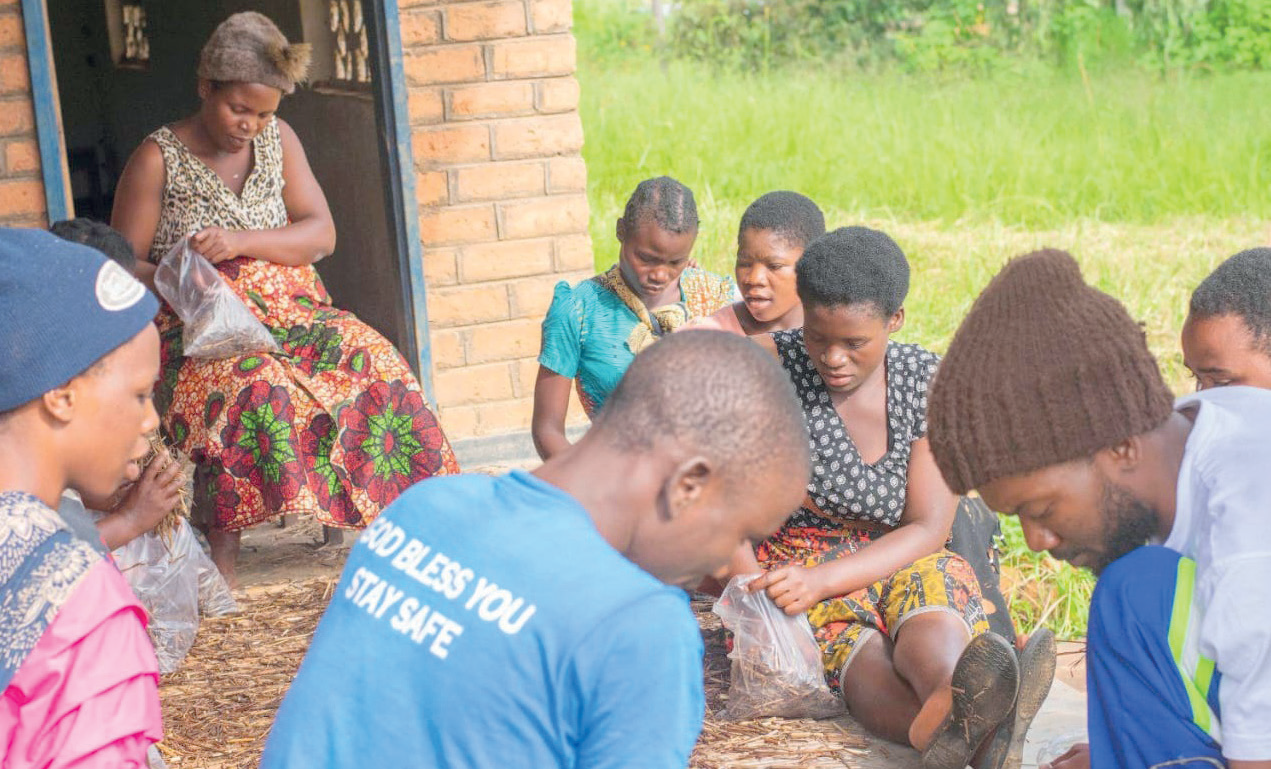
The “dark stage” marks a critical phase where sterilised bags packed with substrate and mushroom spores sit in total isolation.
Unlike field crops, mushroom growing depends entirely on clinical sanitation, as a single microscopic contaminant can obliterate an entire harvest.
Mushrooming business
Despite the razor-thin margins for error, this high-stakes agribusiness is fast becoming a preferred enterprise for young Malawians as the domestic market remains heavily underserved.
Malawi requires up to 50 tonnes of mushrooms a week, but shelves remain undersupplied because smallholder farmers view the strict biological discipline, called mycology—as too demanding.
Now, some young, jobless graduates are transforming this niche agricultural science into a highly profitable economic lifeline.
John Njoka aptly personifies the journey from academic frustration to agribusiness success.
In 2018, he discovered the hard way that academic papers no longer guarantee employment.
“Every single job application I sent out brought back nothing but disappointment. Anyone who has looked for work in Malawi knows how crushing that cycle is,” says Njoka.
However, he refused to let his horticultural expertise go to waste.
After earning K80 000 from constructing a greenhouse in Blantyre, he built a rudimentary mushroom house in Njewa, on the outskirts of Lilongwe, which birthed Nirvana Mushroom Company, which makes him one of the country’s leading youth agropreneurs.
Njoka was selected to train 30 young farmers in Lilongwe under the Youth Action for Green Agro-Enterprise (Yaga) project.
The training positioned mushroom farming as a crucial income generator and form of Climate-Smart Agriculture.
Youth Entrepreneurship For the Future of Food and Agriculture (YEFFA) Program implemented by AGRA funded by Mastercard Foundation.
Mushrooms require minimal land and water because they grow vertically indoors and utilise agricultural waste.
This makes them uniquely resilient to droughts and erratic weather patterns currently plaguing maize in Malawi.
Atulupe Chiwena, from Chitipi in Lilongwe, has launched a K200 000 mushroom enterprise.
“I am starting small, but the goal is rapid expansion,” she says. “Mushrooms are rarely produced at scale here, yet the demand from hotels and supermarkets is staggering. This gives us immense leverage as young producers.”
The youth need capital
However, development experts warn that entering the market requires more than just enthusiasm.
African Fertilizer and Agribusiness Partnership (AFAP) Project Officer Baba Kainga emphasizes that while the 50 tonne weekly deficit guarantees a ready market structural barriers remain stubborn.
“Young people in Malawi face a severe lack of economic empowerment and practical skills,” Kainga explains. “Mushroom farming is a direct solution to job creation, but it requires technical precision.”
After two to three weeks of sterile isolation, the dark stage gives way to the light phase. As the first white caps sprout from sawdust bags, young farmers see themselves shifting from the dark chapter of unemployment into self-reliance, job creation and and climate-smart innovation.