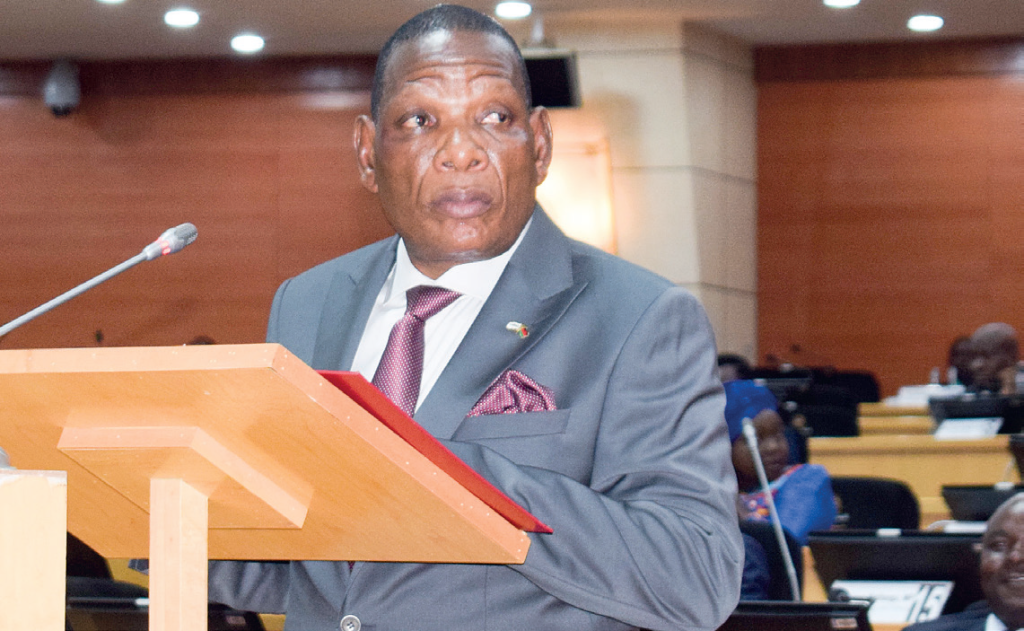
Parliament yesterday approved key votes in the K11 trillion 2026/27 National Budget amid Minister of Finance, Economic Planning and Decentralisation Joseph Mwanamvekha’s resistance to accommodate cluster committees’ lobby to widen the resource envelope.
During the Committee of Supply stage when members of Parliament (MPs) scrutinise vote by vote, the legislators passed several high-value and politically-sensitive votes largely unchanged.
The voting pattern pointed to the government’s grip on the fiscal framework despite sustained calls for adjustments.
Mwanamvekha insisted that Parliament’s role was to legalise spending on what Treasury had already budgeted.
“What you are going to approve is what is legal,” he said, warning that any spending outside approved votes would be unlawful.
Parliamentary cluster committees had earlier lobbied for additional allocations totalling K2.3 trillion, an expansion that would have driven the fiscal deficit beyond K5.1 trillion or about 16 percent of gross domestic product. However, Treasury rejected the proposals outright.
The K2.4 trillion allocation to Vote 121 of the National Local Government Finance Committee, which anchors the Constituency Development Fund (CDF), drew sharp scrutiny over accountability and spending controls.
Dedza Kasina MP Joshua Malango (Malawi Congress Party-MCP) questioned the legality of councils making payments outside approved budget lines while Mzimba South MP Emmanuel Chambulanyina Jere (MCP) pressed for clarity on allocations, including K53 billion for medical supplies and K17 billion in council grants.
In response, Mwanamvekha said the funds would be channelled to councils for service delivery, particularly medicines, but allowed the vote to pass without structural changes.
A rare concession emerged under Vote 130 for Ministry of Lands, Housing and Urban Development where allocations were trimmed following concerns raised during earlier deliberations.
Legislators, including Mzimba South West MP Khumbo Kachali (Freedom Party) faulted cuts in allocations to housing projects targeting security institutions and vulnerable groups.
However, the minister justified the cuts and cited suspected mismanagement as a contributing factor.
“We have been advised that given how the funds were used, it will not be prudent for us to give more resources until we do an audit,” he said, adding that funding could be revisited after verification.
Tensions between austerity and spending priorities also surfaced under Vote 050 covering the State Residences with Mulanje Central MP Kondwani Nankhumwa (People’s Development Party) describing the allocation as excessive.
But Mwanamvekha maintained that the allocation was necessary, noting that it was reduced from the previous year and was aimed at rehabilitating key national assets.
A similar debate played out under Vote 090 of the Office of the President and Cabinet, with MPs questioning rising administrative and travel costs.
Here, the minister countered that the allocation had dropped from K49 billion to K41 billion following the removal of election-related expenses.
Under Vote 093 for Department of Human Resource Management and Development, lawmakers flagged increased spending on travel and goods and services.
In his response, Mwanamvekha linked the rise to an ongoing civil service headcount which is revealing major payroll irregularities.
“We have about 11 000 people that we do not know how they were employed,” he said, arguing that the exercise would deliver long-term savings.
The Office of the Vice-President under Vote 240 also came under scrutiny over reduced funding and unmet requests for vehicles and official residence rehabilitation, with Treasury again citing austerity constraints.
In a notable structural shift, the budget introduces, for the first time, a standalone vote for the Office of the Second Vice-President with an allocation of K4.15 billion.
Despite robust debate, the passage of votes leaves the fiscal framework largely intact, underscoring government’s focus on expenditure control, audit-driven reallocations and deficit containment.
Mwanamvekha tabled what was initially a K10.978 trillion fiscal plan in Parliament on February 27 2026 under the theme ‘Driving economic recovery and sustainable growth through impactful reforms and fiscal consolidation’.
Read annual budget story on allocations in Business News